Try going into a Chennai supermarket and the health food aisle will loudly declare that brown bread is good for the waist line. Replace the white with brown, the packaging suggests, and you are healthy. Patients who come to VK Allure Dermaclinic for weight management consultations often have already made this switch months ago — and are frustrated that the scale hasn't moved.
What is it that the swap in itself is not them problem? The issue is that the brown bread we get in India does not actually belong to this category, but at its basest level. Even if it was, substitute a bread with another one is not enough of a weight-loss strategy.
This article is a an unvarnished version of that. We will examine the real nutrition difference between white and brown breadThe how to read a bread label and determine if you're being misledWhat glycaemic index really means for your appetite and fat lossWhy and when does it ever make sense to be eating 2 slices of bread in a real weight loss diet?What are the alternatives that have more logical solutions from an Indian perspective or when food doesn't influence what you want to lose on the scale.
Real whole wheat brown bread is better than white bread with moderate weight loss — more fibre, lower glycaemic index, very good satiety. However, most commercial brands of 'brown bread' in India is really nothing more than refined white flour plus caramel colour — nutritionally similar to white bread. Even bread from genuine whole wheat is calorie dense carbohydrate. Two slices contain 140–180 calories. Just changing the colour of bread is not going to lead to any significant weight loss. However, total caloric intake, dietary pattern and physical activity remain the strongest determinants.
First, the Uncomfortable Truth About Most Brown Bread in India
Most patients are surprised to hear this, so let's get it out early.
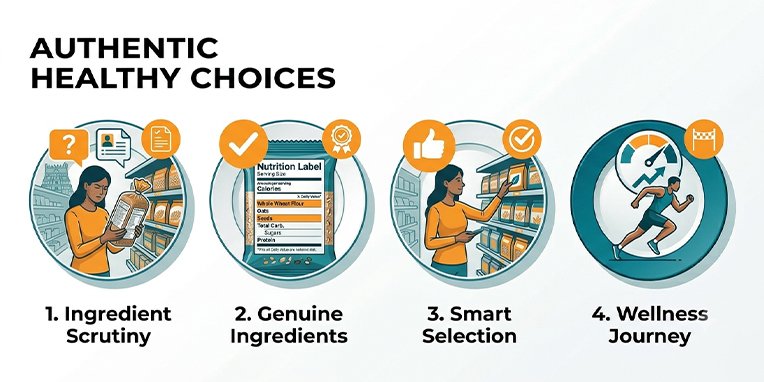
Now go to a store, pick up some common Indian brown bread — Britannia, Harvest Gold, or even most supermarket brands — and check the ingredients in them. Not the front-of-pack marketing. The real ingredient list (in order).
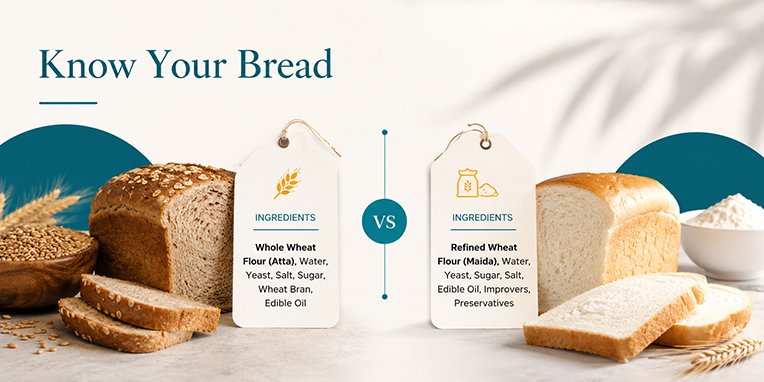
You will typically find: "Refined wheat flour (maida)" listed as the first ingredient. Next, colour was normally added — usually caramel color E150a. Next up: sugar, salt, yeast, emulsifiers and preservatives. Because the bread was browned. Not because it has noticeably more whole grain than white bread.
This is not a niche problem. This is the standard in packaged bread industry in India. In 2017 an audit of popular bread brands published in the Indian Journal of Community Medicine found that most products labeled "brown" or "wheat" did not meet any accepted standard definition of whole grain products.
The test is simple: the first ingredient must say "whole wheat flour" (atta). Not "wheat flour." Not "enriched flour." Not "refined wheat flour." The word "whole" has to be there. If it isn't, the brown colour is cosmetic.
What Genuinely Separates Whole Wheat Bread from White Bread
Assuming you have found actual whole wheat bread — what is the real nutritional difference? And does it matter for weight loss?
The three parts of a wheat grain include bran (the outer coat), germ (the embryo, rich in nutrients) and endosperm (the starchy middle). White bread only uses the endosperm — the bran and germ are lost through milling. In contrast, whole wheat bread makes use of all three components; including the bran and germ retains the fiber, B vitamins, iron, magnesium and healthy fats that are abundant in those parts.
Here is what that looks like per slice in numbers:
| Nutrient | White Bread (per slice ~30g) | Whole Wheat Bread (per slice ~30g) | Difference |
|---|---|---|---|
| Calories | ~80 kcal | ~70–80 kcal | Minimal (5–15 kcal) |
| Carbohydrates | ~15g | ~13–14g | Slightly lower |
| Dietary Fibre | 0.5–1g | 2–3g | Significantly higher |
| Protein | ~2.5g | ~3g | Marginally higher |
| Glycaemic Index | 70–85 | 51–69 | Meaningfully lower |
| B Vitamins | Low (often added back) | Naturally higher | Better in whole wheat |
| Magnesium | ~7mg | ~23mg | Significantly higher |
| Sodium | 130–200mg | 150–220mg | Similar (brand-dependent) |
The only two numbers that matter for weight loss and which are important to know and remember are fibre, glycaemic index. Two slices may be very similar, but the calories difference per slice is small — 5 to 15 calories. A year of two slices a day, that comes out to ~3,650–10,950 calories lower than you normally eat (which theoretically translates to 0.5–1.5 kg fat). Not dramatic. More than the calorie count, the actual benefit of whole wheat bread is how it manages appetite, blood sugar, and gut health.
Glycaemic Index — What It Actually Means and Why It Matters for Weight
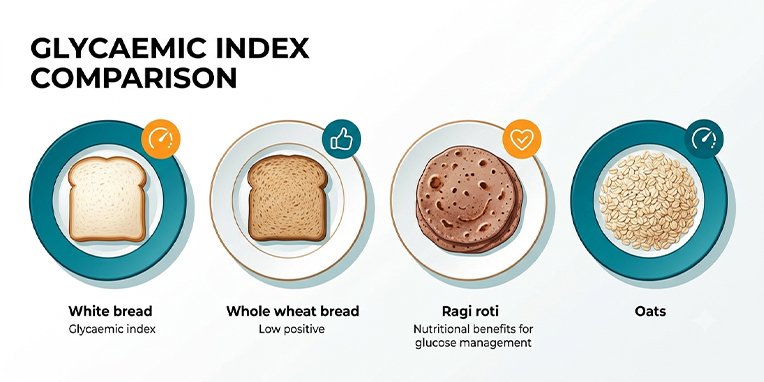
Glycaemic index (GI) method measures the relative speed at which a carbohydrate food raises blood glucose levels in comparison to pure glucose (GI = 100). Foods with a glycemic index above 70 are considered high GI, those between 56 and 69 are medium, and anything lower than 55 is low.
White bread: GI 70–85. Genuinely whole wheat bread: GI 51–69.
But here's what GI doesn't tell you by itself. GI is measured in isolation — bread eaten alone, on an empty stomach. In practice, you never eat bread alone. Add a boiled egg and the GI of the meal drops significantly. Add butter — it drops further. The fat and protein in toppings slow gastric emptying and blunt the glucose curve from the bread. This is why "eat bread with protein" is practical advice, not just habit.
This is why the lower GI is key when it comes to weight management; the insulin response. Insulin rises sharply when blood glucose responds to a spike. Insulin moves glucose out of the blood — into muscle cells when they need energy, into fat cells when they don't. Frequent high-GI eating keeps serum insulin elevated for extended periods which enhances fat storage, especially subcutaneous fat around the abdomen. This does not take away the response but modulates it, in a low GI eating. Over months, this matters.
There's also the satiety angle. Low GI foods cause a slower rise in blood glucose and therefore you do not get that ridged peak, hence much more settled fullness. That 11am snack craving after a white-bread toast breakfast is driven by the crash that follows a high-GI meal. The whole wheat bread, combined with protein will make you eat till lunch.
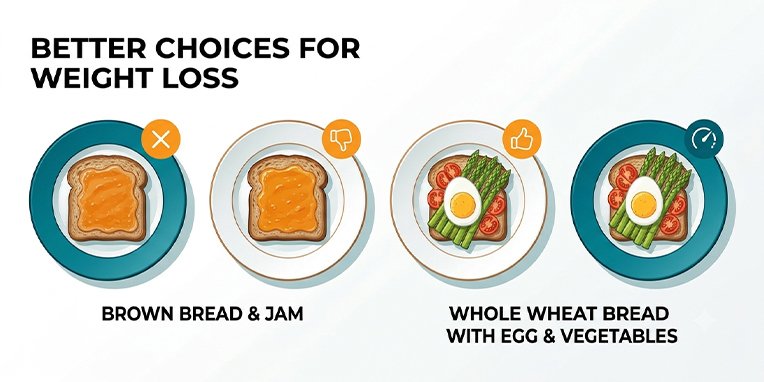
At our weight management consultations at the Kilpauk clinic, we routinely see patients having 'healthy' breakfasts that raise glucose levels significantly — brown bread (caramel-coloured) with jam, orange juice and a banana. That meal has a very high total glycaemic load, insulin response happens fast, and by 10:30am those people are hungry again. Substituting the white bread for real whole wheat bread still isn't enough because it's all those jams, juices and fruit are far larger carbohydrate drivers than the bread. It is not merely about a switch of bread but the whole pattern of diet needs to change.
The Fibre Story — Why It's the Best Thing About Whole Wheat Bread
If there is one nutritional argument for choosing genuine whole wheat bread over white bread, it's fibre. Not calories. Not protein. Fibre.
Regular whole wheat, on the other hand, has about 2–3 grams of dietary fibre per slice. Has 0.5–1g versus — a 3–4x difference: white bread. 4–6g (for two slices) vs 1–2g, respectively; the ICMR recommends 40g of dietary fibre per day for Indian adults — most consume only about 15–20g.
What fibre does for weight management:
- Physical volume without calories — fibre adds bulk to food without adding digestible energy, which means more stomach stretch per calorie, which signals fullness earlier
- Slows gastric emptying — food moves through the stomach more slowly when fibre is present, extending the satiety window
- Feeds the gut microbiome — Fibre soluble are fermented by the gut microbiota into short-chain fatty acids (SCFAs) like butyrate, which contributes to the integrity of the gut wall and has been associated in studies with reduced inflammatory signalling — particularly interesting because chronic low-grade inflammation is associated with insulin resistance and weight gain.
- Moderates cholesterol — soluble fibre binds bile acids in the intestine leading to a reduced reabsorption of those acids — this is associated with a reduction in LDL cholesterol and also affects the metabolic profile that often accompanies obesity
None of this makes whole wheat bread a superfood. It makes it a moderately better carbohydrate choice than refined white bread. That's the honest characterisation.
How Bread Fits (or Doesn't) Into a Real Weight Loss Diet
The more honest conversation isn't "which bread" but "how much bread, paired with what, and within what total diet."
The calorie maths on bread
Two slices of whole wheat bread (140–160 calories). 1 tbsp of butter: +100 calories. Fried egg: +90 calories. That's a 330–350 calorie breakfast. Sensible — that's 16–18% of a 2,000 calorie daily stick. But you swap the eggs for jam (which there is sugar in) to bring it down from 120 to empty calories, then take away the protein and it's 260–280 calories of mostly just refined carbohydrates + sugar that would be left banked after the clock hits 10am.
The bread itself isn't the problem in most cases. What goes on it and what doesn't is.
The portion trap
Two brown bread slices is not more virtuous than two white bread slices, simply from the energy-in (calories) perspective. Four slices of WHOLE WHEAT BREAD would count as roughly 280–320 calories of carb. Most patients don't calculate this. They think "brown" and "healthy", and believe quantity is negotiable. It cannot. Every bread is calorically dense bread. It doesn't matter what the colour is; portion discipline comes into play.
Where bread actually sits in Indian diet context
India is not a bread country. Roti is. Idli and dosa are. Rice is. Colonialism and urbanisation brought bread, too — for pragmatic reasons, it needs no preparation, is stored long without spoiling and suits the busy city-dwelling life. These are genuine advantages. But zooming out from a nutrition-first view, bread is more like processed food — one with salt and preservatives, emulsifiers, and often added sugar. It is convenient, not optimal.
The wisest counsel I could figure out was: for most Indian patients attempting to shed pounds, white bread or brown bread is not the question any longer; it's "why on earth are we eating a lot of bread? An Indian diet that revolves around home-prepared foods—dal, sabzi (stir-fried vegetables), roti, rice in moderation, curd and veggies—is much better suited to weight management than a so-called "healthy" breakfast of brown bread with processed spreads.
This is the honest position, and it's what we tell patients at our weight loss programme at VK Allure. Not that bread is evil — but that it shouldn't be the anchor of a weight loss diet when better options exist.
Smarter Carbohydrate Choices for the Indian Weight Loss Kitchen
If bread isn't the optimal foundation, what is? Here are the alternatives we recommend when patients want to reduce processed carbohydrates without abandoning satisfying, familiar foods.
Whole wheat roti (home-made)
An average-sized stone-ground whole wheat atta roti is 70–80 calories, virtually zero salt, zero preservatives, no emulsifiers and has a GI of 60–65. A meal of 2 rotis with dal and sabzi provides a calorific balance at nearly 400 calories. Not one single commercial brown bread conforms to this profile — and it suits the Indian palate and digestive system without forcing.
Ragi (finger millet) roti or porridge
Ragi therefore has a GI of about 38–42 — far lower than any wheat bread. Very high in calcium (the highest of all the cereal grains), iron and fibre. In Tamil Nadu and Karnataka, ragi mudde or ragi roti are traditional. This is an easy to get, low-GI, high-fibre carbohydrate base that most of us have been eating in some form going up for somewhat Chennai patients.
Oats porridge
Rolled oats (not instant oats which are more processed and higher GI) = approx 55 on the glycemic index. Cooked in water or low-fat milk, flavoured with vegetables and a boiled egg – this is a real low-GI high-fibre breakfast that keeps you going. These types of flavoured instant oats, such as those for instant brown breads are also sugar-added and nutritionally inferior versions of the base nutrition.
Jowar (sorghum) or bajra rotis
Jowar and bajra are traditional millets with GIs of 50–55; both are gluten-free, so they constitute the best weight management options. They are lower (~60%) in calories per gram than wheat flour, higher in iron andother micronutrients, and an integral part of the South Indian food tradition. Millets are restoring their age-old standing, now in the urban Indian diet, backed with sound nutrition.
Poha and upma (moderated portions)
In fact, realistic carbohydrate bases could be traditional Tamil Nadu and South Indian breakfast items like upma (without excess oil) and vegetable poha when the portions are limited and there is dominance of vegetables in the making. Commercial bread has generally a higher salt content, so your sliced breads will tend to be much lower in sodium and more nutritionally diverse.
The Weight Loss Equation — Where Bread Fits in the Bigger Picture
So let's be blunt about an idea that has become lost in discussions over food. Losing weight is really a function of calories. Not carbs vs fat. Not brown vs white. Calories in versus calories out, modulated by hormonal context (insulin sensitivity, thyroid function, cortisol), sleep quality and quantity, muscle mass and level of activity.
For example, replacing white bread with brown bread adds about 70–140 calories a week to the deficit if all other habits are kept the same. Not actually nothing- it's marginal fat loss over the course of a year. But it is dwarfed by:
- Cutting one large tea with 3 teaspoons of sugar daily (saves ~60 calories/day = 420/week)
- Dropping one biscuit packet (saves ~120–150 calories)
- A 30-minute brisk walk (burns ~150 calories)
- Reducing cooking oil from 4 tablespoons to 2 tablespoons per meal (saves ~240 calories)
None of this is to dismiss bread choices. But the bread conversation should not be the weight loss conversation. It's a sub-clause in a much bigger dietary and lifestyle discussion.
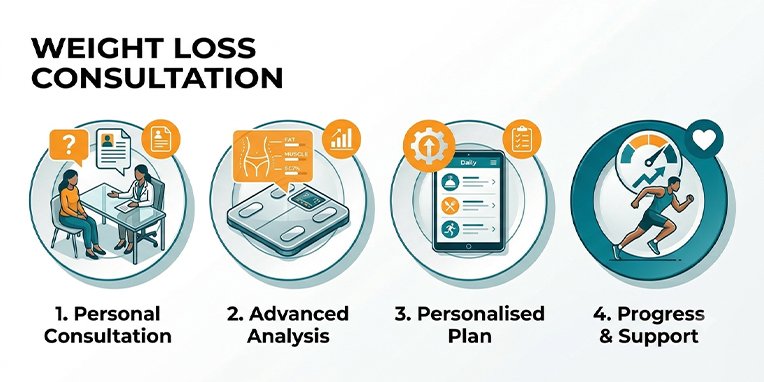
In clinical weight management — which is what we offer through our structured weight loss programme and inch loss therapy At VK Allure, this is based on a full dietary assessment — not just one food swap! While body composition analysis shows how much fat or muscle the patient loses. It takes baseline bloodwork to tell us whether thyroid, insulin resistance or hormonal imbalances are impeding progress. It is then programed to the individual's actual metabolism and lifestyle, not some cookie-cutter clean-eating list.
When the Problem Isn't the Food — Clinical Weight Loss Realities
Many patients who present for weight loss have already done everything "right" according to the logics of popular diets. They've switched to brown bread. They've cut sugar. They work out three times a week. And the scale doesn't budge, or it does and then come months it returns.
Several things can explain this pattern that food choices alone cannot address:
Subclinical hypothyroidism
Some patients have metabolic slowdown that renders caloric restriction ineffective even in the face of a TSH in the upper-normal range (3–5 mIU/L) [10]. This can be diagnosed with a full thyroid panel including free T3 and free T4 levels. At VK Allure, thyroid assessment is one of the key routines included as part of our clinical weight loss workup.
Insulin resistance without frank diabetes
When HOMA-IR >2.5, patients then move into the zone of severe insulin resistance – this means that the individual needs more and more insulin in order to manage a given load of glucose. In this situation, carbohydrate restriction and low-GI eating is of greater importance than it would be in a metabolically healthy person. This group is really the one at greater need of cutting down on bread (all breads) and overall CHO altogether — not just changing bread colours.
Chronic sleep deprivation
Sleep less than 6 hours per night increases ghrelin (the hunger hormone) and decreases leptin (the satiety hormone). What this results in is an ongoing increase in your appetite, and particularly for carb rich foods, you will also experience a drop in sufficient caloric burning. Nothing the population can eat compensates for that. And if a patient is sleeping 5 hours, sleep conversation (of course) comes before the bread conversation.
Muscle mass deficit
Basal metabolic rate is lower in a patient with low lean muscle mass. Yes, the less muscle you have, the fewer calories you burn at rest. This is why crash diets that induce muscle loss (instead of mainly fat loss) result in progressively lower metabolic rate; the classic yo-yo approach. It is important to analyze body composition (and not just weight on a scale) to understand what is really going on.
These are the conversations that happen in a clinical weight loss setting. Not "brown bread or white bread?" — but "what does your full metabolic picture look like, and what interventions actually match it?"
The Role of In-Clinic Body Contouring in Weight Management
Proper nutrition is where it all starts when losing weight. However, some patients — especially those who have localised fat deposits that do not respond to caloric restriction — can take advantage of in-clinic body contouring treatment to combine with their dietary program.
At VK Allure Dermaclinic, we offer several evidence-supported options that complement a healthy diet:
- Cool sculpting / cryotherapy — Coolsculpting: a fat destroying method, for exposing yourself this summer, that is 100% non-invasive and uses controlled cooling to destroy fat cells in small areas (abdomen flanks thighs double chin). The fat cells are slowly removed in the process of 8–12 weeks. It is not a weight-loss treatment — it does not lead to much change in body weight — but very effective for targeting visible fat.
- EMS (Electromagnetic Muscle Stimulation) — You exercise as much and strong that would never be possible with volitional training, increasing your muscle mass and definition: it enhances deep muscles contractions at a frequency and intensity higher than those deliverable by maximum voluntary exercise. Especially for patients who are sedentary due to arthritis pain or general fatigue, and the ones that only need to overcome this common muscle deficit responsible for a low metabolic rate.
- Inch loss therapy — This combination programme promotes fluid retention, fat reduction and skin tightening in areas that.. Usually prescribed in combination with dietary change rather than as a single option.
These treatments do not replace a healthy diet. They are adjuncts — kinda like tools that go to work, supplementing what diet and exercise struggle to efficiently reach. In this study, the patient that eats well, is active on a regular basis and then chooses in-clinic treatments achieves a better body composition result than either dietary change or in-clinic treatments separately.
Five Common Misconceptions About Brown Bread and Weight Loss
Misconception 1: "Brown bread has significantly fewer calories than white bread." Difference of 5–15 calories per each band have been trained on mouthful. It's not meaningful in isolation. This notion of brown bread as a "diet" food comes from the analogy to so-called "healthy eating" marketing — not from reading the numbers on the label
Misconception 2: "Multigrain automatically means healthy." At least not if the first ingredient contains maida, with a subtle sprinkling of seeds for aesthetics sake. Read the label. Grains at the end of the ingredient list after vision flour? In insignificant quantities — they do not fundamentally change the nutritional profile of bread.
Misconception 3: "Brown bread doesn't spike blood sugar." Brown bread, made from refined flour with colour added to it for commercial purposes has a GI of 70–75 — the same as white bread! To illustrate, even true whole wheat bread falls into the category of 55-69 for GI. That is still a moderate-height to high GI food. It spikes blood sugar less than white bread — but not without some consequences. It is important to pair protein with fat for moderating the response meaningfully.
Misconception 4: "You can eat as much brown bread as you want on a diet." No carbohydrate works this way in a fat loss context. Calorie density is calorie density. At 70–80 calories per piece, whole wheat bread adds up quickly. The aspect of discipline with the dose is for any bread irrespective of its nutritional value.
Misconception 5: "Gluten-free bread is better for weight loss." Most gluten-free breads are refining starches — rice flour, tapioca, potato starch — higher GI and lower fiber than whole wheat bread. If you do not have a diagnosis of gluten intolerance or indeed coeliac disease, there is no benefit in terms of lost weight from going gluten-free; some evidence suggests poorer satiety outcomes from rice-starch-based gluten-free products.
Practical Brown Bread Tips for a Weight Loss Diet — If You're Going to Eat It
If brown bread is going to be in your weight loss diet — because it's convenient, your family eats it, or you travel and rely on it — here is how to make it work as well as possible.
Choose correctly
First ingredient: whole wheat flour. Not a drop of caramel colour in the list. Make it with very few ingredients — Authentic bread requires flour, water, yeast, salt and maybe a tiny amount of sweetener to feed the yeast. As a rule-of-thumb, if the list contains 15 ingredients or more than its a processed health halo food.
Limit to 2 slices per meal, maximum
Two slices – a fair portion — 140–160 calories. Source with just Four slices =320–280 calories from carbohydrates. If the weight loss diet is 1,400–1,600 calories a day, four slices of bread has consumed 18–23% of the calorie budget before anything else gets added in.
Pair with protein, not sugar
Good ideas are eggs, paneer, dal, hummus, unsweetened peanut butter or avocado. They greatly reduce the glycaemic load of that meal. Stack on jam, sweetened peanut butter and honey or processed cheese spreads, which more or less just contribute empty calories.
Don't eat it alone
When you eat bread alone — even whole wheat, for that matter — it causes a much greater glucose spike than when eaten as part of an integrated meal that contains fat, protein and fibre. Always eat with a full meal or have it along something. From a metabolic standpoint, the absolute worst scenario in bread consumption would be two slices and only that.
Consider the alternative honestly
140–160 calories Two rotis made at home using whole wheat no preservatives, zero sodium from processing and very similar GI to real whole wheat bread. When you have 10 minutes on hand in the morning, roti is better nutrition. Brown bread's biggest point is convenience, not nutrition.
When to See a Specialist Instead of Reading More Food Articles
If you have made verifiable dietary changes for 3 months and the scale has hardly budged, you need an evaluation — not another grand swap of food.
Come in for a consultation if:
- You are eating under 1,600 calories but not losing weight — this warrants thyroid and metabolic investigation
- You lose weight and gain it back within weeks of stopping a diet — this suggests muscle-to-fat ratio issues that need body composition analysis
- You have a family history of Type 2 diabetes or PCOD — insulin resistance is likely and dietary strategy needs to be calibrated specifically
- You have tried multiple diets and none have worked — a clinical assessment identifies which dietary approach actually matches your metabolism
- You have significant localised fat deposits (belly, flanks, thighs) that don't respond to diet and exercise — these may need targeted body contouring
At VK Allure Dermaclinic, our clinical weight management programme starts with body composition analysis, dietary history, and relevant bloodwork. From there, we build a plan — dietary, supplementary, and where appropriate, in-clinic intervention — that is specific to you, not generic. You can also explore our full range of services for everything we offer across both branches.
Final Thoughts
It is not brown bread, if the bread has been sufficiently processed to make white flour from it. Brown bread is a superior carbohydrate to white — higher fibre, lower GI (glycaemic index), greater satiety. That's true. The marketing has to take over from the science at this point when saying "better carb choice" to "weight loss food".
Over the past few months I have been lamenting about how most of the brown bread available in India is not made from genuine whole wheat. The still-isn't-a-diet-food is a processed convenience item with a calorie quant that needs portion control. And the bread, which is either white or brown, rests alongside many other small levers in a weight management strategy that must consider total calories eaten, meal composition (this article ignores), activity level, sleep (above cited and this article ponders; more later) and metabolic health factors never considered by diet articles.
Read the label. Choose genuinely. Pair smartly. And if the weight still isn't moving — come in and let's look at the whole picture, not just the bread.
Struggling with weight loss despite eating right?
Our clinical weight management programme at VK Allure Dermaclinic — Kilpauk and ECR Uthandi — starts with understanding your actual metabolism, not a generic food list. Book a body composition assessment and consultation.