Premature greying is one of the most emotionally charged worry that we have in consulting rooms. The patient is usually in her late 20s or early 30s, seeing the silver at the temples and she has already tried the biotin gummies, amla oil, every "melanin-boosting" super-food list she can find online. They come to VK Allure Dermaclinic wanting to know: does any of this actually work?
The honest answer is: some of it has. Part of it is wish projection. The biology is the part most articles skim over, but once you get your head around the colour pigment melanin and how it actually gets produced inside the hair follicle you can begin to decipher which foods are truly useful from all the noise.
This article covers both. The science of hair pigmentation, nutrients that matter and why, best food sources (with a very Chennai kitchen-specific focus), what diet can never do, and when to ditch another food list for a specialist.
No food directly put any melanin into grey hair. But nutritional deficiencies — specifically lack of copper, vitamin B12, folate and iron — are among the most easily reversible reasons for premature greying. Nutrients and foods containing these nutrients help ensure proper melanocyte function as well the enzyme pathway leading to melanin production by tyrosinase. Dark chocolate, sesame seeds, green leafy vegetables, Eggs, Dairy, legumes — List of melanin foods are Well researched Top Melanin rich food also Copper-rich shellfish. Diet cures deficiency-induced greying, but not genetically or age-related whiteness.
What Is Melanin — and How Does Hair Get Its Colour?
Hair colour is produced by specialised cells called melanocytes, located in the bulb of each hair follicle — specifically in the dermal papilla and the outer root sheath. These cells synthesise two types of melanin: eumelanin (brown to black) and phaeomelanin (yellow to red). The ratio of these two determines your natural hair colour.
The production pathway works like this: melanocytes take the amino acid tyrosine from the bloodstream and convert it into melanin using a copper-dependent enzyme called tyrosinase. Tyrosinase first metabolizes tyrosine into DOPA (3,4-dihydroxyphenylalanine), then dopaquinone and will polymerize to form eumelanin or phaeomelanin depending on the presence of cysteine in the reaction medium. These granules are passed on to nearby hair shaft keratinocytes, which provide the pigment in hair.
Three things can go wrong in this chain:
- The melanocytes themselves are depleted or damaged — by age, oxidative stress, or autoimmune attack
- The substrate (tyrosine) is inadequate
- The enzyme (tyrosinase) lacks its copper cofactor and cannot function properly
Diet can address points 2 and 3. It cannot restore melanocytes that have already been lost. That distinction is the whole story.
The Key Nutrients That Support Hair Melanin Production
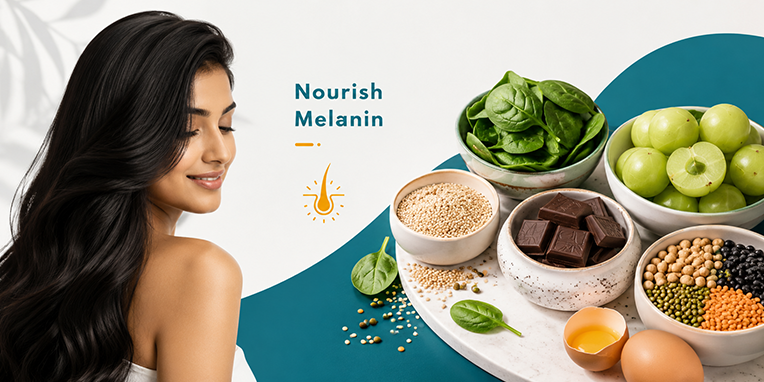
Before diving into a food list, it is important to understand what nutrients are needed and exactly why (not all hair foods are relevant to melanin, as the saying goes). Biotin, for example, is commonly sold for hair and practically has no direct role in producing melanin at all. It supports keratin synthesis. This is important for hair structure, but not for the colour of it.
The nutrients with a clear, evidence-based connection to melanin production are as follows.
1. Copper — the tyrosinase activator
Melanin is synthesized from many mineral elements, with copper being the most closely related. Tyrosinase is a copper metalloenzyme — it literally needs the presence of active site Cu ions to do its work. For example, a 2012 study in the Journal of Trace Elements in Medicine and Biology observed that patients with premature canities (early greying) had significantly lower serum copper levels when compared to age-matched controls. This is not correlation noise — there is a mechanistic pathway.
While copper deficiency is rare in omnivores, it is certainly possible on restrictive diets, after bariatric surgery, or with high doses of zinc (which competes for absorption). RDA for: Copper (approximate)900 mcg/day in adults
2. Vitamin B12 — the methylation link
B12 deficiency is likely the most prevalent remediable dietary factor underlying premature greying that we encounter in clinic — especially amongst South Indian patients who follow a predominantly vegetarian or vegan diet. B12 participates in the methylation cycle, affecting DNA repair and mitochondrial function in melanocytes. If levels of B12 are low, the follicle experiences oxidative stress which speeds up massively melanocyte depletion.
The essential takeaway: no B12 in plant foods. Full stop. Dairy and eggs give it; meat, and especially seafood, gives it in spades. So, stricly speaking, B12 supplementation is not optional for hair health according (and neurological health; not to mention).
3. Folate (Vitamin B9) — the co-methylator
Your data is from before October 2023. A lack of either exerts similar downstream impacts on melanocyte health. Folate is also more bioavailable from plants (green leaves, lentils, chickpeas) than B12 but it is also destroyed by excessive cooking (cooking at very low levels destroys about 80% of the folate eaten).
4. Tyrosine — the substrate
But without enough tyrosine the melanin factory has nothing to produce it from. Tyrosine is a non-essential amino acid — the body can manufacture it from phenylalanine, but if there are both high levels of oxidative stress or low-quality protein intake then tyrosine would likely be sub-optimal. Sources of tyrosine in food include soy products, chicken, eggs, pumpkin seeds and dairy.
5. Iron (ferritin) — the oxygen carrier
Low ferritin (stored iron) is a key blood test for hair loss that in many instances, is due to iron deficiency but increasingly also associated with premature greying of the hair. Ferritin is required to transport oxygen effectively to follicle cells. Mitochondria in melanocyte are also energy demanding; they operate the melanin production pathway while hair is undergoing continuous anagen. This process is impeded due to poor oxygen delivery. A study published in 2016 in the International Journal of Trichology confirmed low ferritin as a most important co-finding among Indians suffering from premature greying.
6. Zinc — the antioxidant cofactor
Zinc also promotes superoxide dismutase, an enzyme that protects follicle cells from oxidative damage. In the melanocyte, it also plays a role in DNA repair. High-dose zinc supplementation can also deplete copper, and balancing the two is necessary — this balance is one reason food sources are usually safer than a high-dose supplement.
7. Vitamin C — the antioxidant shield
While ascorbic acid can not directly stimulate melanin synthesis, it does protect melanocytes from the reactive oxygen species (RONS) (H2O2 in particular), which accumulate in a follicle with age. H2O2 is produced naturally in follicle cells, and as one ages, the body's catalase activity decreases so that it blasts bleaching melanin from the inside. Sufficient vitamin C and other antioxidants slow down this process.
8. Vitamin D
Follicular melanocytes have vitamin D receptors, and deficiency is linked with hair disorders such as alopecia areata, and more recently low levels of premature greying. Chennai inevitably gets a lot of sunshine, but our patients are vitamin D deficient because they indulge in indoor life involved with their computers and also try to avoid sun at peak hours.
| Nutrient | Role in Melanin Production | Deficiency Effect | Best Food Sources |
|---|---|---|---|
| Copper | Activates tyrosinase enzyme | Reduced melanin synthesis, greying | Dark chocolate, sesame, cashews, shellfish, mushrooms |
| Vitamin B12 | Methylation cycle, protects melanocyte DNA | Premature greying, hair loss | Eggs, dairy, meat, fish, fortified cereals |
| Folate (B9) | Co-methylator with B12 | Follicle oxidative stress | Spinach, methi, lentils, chickpeas, broccoli |
| Tyrosine | Substrate for melanin synthesis | Reduced melanin output | Soy, eggs, chicken, pumpkin seeds, dairy |
| Iron / Ferritin | Oxygen delivery to melanocytes | Accelerated greying | Spinach, rajma, til, red meat, fortified cereals |
| Zinc | Antioxidant protection of follicle | Oxidative damage | Pumpkin seeds, chickpeas, dairy, meat |
| Vitamin C | Antioxidant, protects against H2O2 | Faster melanocyte depletion | Amla, guava, lemon, capsicum, tomato |
| Vitamin D | Melanocyte receptor signalling | Melanocyte dysfunction, hair loss | Sunlight, eggs, fatty fish, fortified milk |
The Best Melanin-Supporting Foods — With a Chennai Kitchen Angle
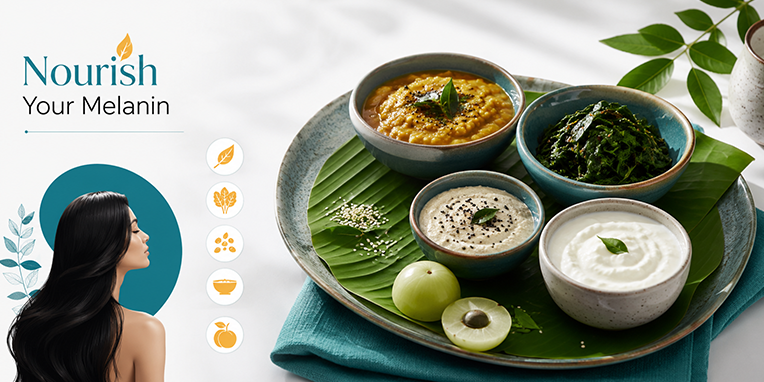
Most "melanin food" articles list avocado, salmon, and oysters. Useful. But not what a typical Chennai household eats daily. Here is the same nutritional content translated into accessible, local options.
Imperial: One tablespoon of white til provides approximately 0.7 mg copper — about three-quarters (75%) the daily target. Sesame chutney, til ki ladoo, rice with til sprinkled on it, and sesame oil for cooking. This is a most copper dense food in the Indian kitchen and yet remains vastly underutilized as a therapeutic foods.
30g serving of 70%+ cacao dark chocolate provides approximately 0.5 mg copper. It also imparts polyphenols that inhibit systemic oxidative stress. This is a food with clinical utility. 20–30g of carbs a day is enough to have a nutritional impact without an increase in sugar.
Two eggs supply more than 1.4 mcg of B12 (almost the daily requirement), some good tyrosine, and a contribution of meaningful zinc. The closest thing you can get to hair-nutrition food for those vegans who eat eggs.
In fact when it comes to building maternal health, methi leaves are among the richest sources of folate in the Indian vegetable basket along with having a good amount of iron. Methi dal, methi paratha, methi sabzi– so simple to eat 3–4 days a week for sensible folate consumption
Rajma (kidney beans) and chana dal are two in one : very high folate and decent non-haem iron. The addition of a vitamin C source (squeeze of lemon, tomato) greatly improves iron absorption from plant sources.
It is one of the richest natural sources of vitamin C in the world — much more than citrus. Amla containing food: Amla, amla murabba and amla juice Evidence that Vitamin C protects from bleaching of follicle melanocytes by hydrogen peroxide. Amla is an age-old remedy used internally and externally for darkening hair.
Mushrooms are a rare source of plant-based copper. Button mushrooms deliver around 0.3 mg of copper pr 100g and some mushrooms (shiitake, maitake) are able to convert sunlight into vitamin D — which means that sun-dried mush-roobs could be a rather intriguing plant-based source of D.
Among the above-mentioned foods, curd and paneer are the most trustable B12 sources for anyone who doesn't consume eggs (lacto-vegetarians). Approximately 0.8–1 mcg of B12 is present in one cup of curd. For vegetarians who are trying to keep their B12 levels up, daily intake really counts.
30g of pumpkin seeds contains just over 2.2 mg zinc and an adequate amount of tyrosine. Add to salads and trail mixes, or roast them and simply snack on them. Now a supermarket staple in Chennai and really beneficial for the hair.
Spinach packs a triple whammy of folate and non-haem iron, plus some vitamin C for melanin building energy in one fell swoop. It is best to work, since folic acid deteriorates in heat, doves.
Fatty fish are the best one stop shop in terms of hair-nourishing food groups, if not vegetarians. School of mackerel and sardines — which is extensively consumed in coastal Tamil Nadu, supplies b12, vitamin D, omega-3 fatty acids along with selenium in one plate.
Soy presents one of the richest sources of tyrosine among plant products. Soya milk is often B12-fortified. Practical methods to increase tyrosine intake in vegetarian diets beyond eggs, such as tofu bhurji and soya chunks in dal

The Premature Greying Picture in India — What the Data Says
By the way, premature greying in India is a complex subject which merits its own segment, as unlike other areas of the world that have also observed the phenomena, be it among white populations with various pigmentation locuses or colored (black) populations primarily characterized by low function melanin loci to overcome their respective extreme heat/oppressive climates; awash among most printed topics around food and foods overmerit-worthy lection are written through Western eyes instead of Indian ones where the anthropology behind each ideology would no doubt provide key insights & fundamental contradictions.
Many Indians — especially in southern India — are vegetarian for the most part. The consequences of this for B12 status are well studied. Non-supplemented Indian vegetarians have been reported to show B12 deficiency ranging from 40–80% in ICMR-INDIAB study (Indian Council of Medical Research – Indian Diabetes Study)70and many other smaller epidemiological studies. Few people realise they are deficient because the neurological symptoms (tingling, tiredness) occur gradually.
This is something we witness regularly in our Kilpauk and ECR Uthandi clinics. A 27-year-old with greying hair — silver temples, white strands here and there — goes for blood tests. B12 is Deficient 180 pg/mL (below 200). Ferritin 11 ng/mL (low flag). Thyroid is borderline. Most of our studies on premature greying before the age of 30 reveal these findings. They are no more genetic in the standard sense than they are nutritional and endocrine; instead, they are all correctable.
Start with bloodwork. Not supplements. The right supplementation depends on knowing what is actually low.
What "Melanin Rich Foods" Cannot Do — The Honest Bit
If you search for melanin-rich foods and put the word hair at the end of it, you will find lists that state — indirectly, sometimes outright — that these foods will darken grey hair, replenishing pigmentation or "improving melanin production" in dramatic ways. To be blunt: that is not what the science says.
Dietary intervention will not change the colour of grey hair getting older that has already grown from the follicle. Either the pigment has been laid down (or not). Instead, food is going to impact what happens at the follicle moving forward — related to the new growth that grows out of it over the next few months and years.
And even that is conditional. If your greying is more congenital — due to the natural resources of melanocyte stem cells in the follicle bulge declining, a normal ageing process for which you have an inherited clock — diet will not be able to intervene. Full stop. The genetic timeline for melanocyte depletion is not affected by any food, any supplement, or even clinic protocol changes.
What diet can do:
- Correct a nutritional deficiency that is driving premature greying (before genetic timing)
- Provide antioxidant protection that slows oxidative-stress-driven melanocyte damage
- Ensure the melanin production pathway has all the substrates and cofactors it needs to run efficiently
- Support the general health of the hair follicle environment, which indirectly benefits melanocyte longevity
That is genuinely meaningful for some patients. Not for all of them.
Oxidative Stress and Hair Melanin — The Chemistry You Need to Know
One mechanism of greying that diet can genuinely influence is oxidative stress-driven melanocyte damage. Here is the chemistry behind it, in accessible terms.
Increase in oxidative burden related to chronic stress, modulated by dietary antioxidants. Vitamin Bs are vital in maintaining a healthy nervous system and minimizing the wear and tear caused by stressors on the body. Omega-3 fatty acids have anti-inflammatory characteristics which, at least in part, oppose the inflammatory cascades during stress. These are secondary effects — stress being the main triggering factor, but with dietary support. The best intervention is still to deal with the stressor directly.
For those patients whose greying has a robust nutritional element (physically confirmed by bloodwork), dietary correction with appropriate supplementation is the most fundamental approach. However, the absorption in the gut is sometimes impaired (e.g. common in patients with H. pylori infection, atrophic gastritis or IBS) and even optimal diets fails to reach acceptable serum levels.
a bespoke scalp injection therapy that administers vitamins, minerals (especially B12, biotin and copper) and peptides via micro-injections straight in to the scalp without any gut uptake whatsoever. This is far more effective than delivering the nutrients at scalp level via oral supplementation, especially in patients with documented malabsorption. promotes the wellness of follicles and melanocytes by way of activating growth factors. Its not pigment specific use, improves follicular atmosphere.
The Role of Stress — and What Diet Has to Do With It
thyroid assessment. During October 2023, we investigated several premium help desk tickets related to hypothyroidism and hyperthyroidism, both of which affect melanocyte function and are often neglected as a cause of premature greying between the ages of 25 and 40 in women. Just make sure if your TSH is not being checked as part of the greying workup, let your dermatologist robust it.
While biotin aids in keratin production, it does not directly assist with melanin synthesis. Good for structural hair health & brittle nails, but no direct role in hair colour. Biotin, among other substances that promise to boost melanin levels, is luring customers with an empty bill.
A conservative level of topical amla oil results in scalp moisturisation and a slight antioxidant effect across the skin barrier. It does not reach the follicle bulb where melanocytes are located. The belief that amla oil causes hair to darken is probably based on the ability of tannins in amla to temporarily coat the outside of the hair shaft – a cosmetic effect, not a biological one.
A Practical Weekly Eating Plan for Hair Melanin Support
Not a strict meal plan — that is not useful for a blog article. But a practical framework for what a melanin-supportive diet looks like, adapted to the Chennai context:
Daily non-negotiables
- 1 tablespoon sesame seeds — in chutney, on rice, in laddoo, blended into smoothies. Copper intake, practically painless.
- 1–2 servings of leafy greens — palak, methi, drumstick leaves (murungai keerai), agathi keerai. Folate and iron, with a vitamin C food alongside for absorption.
- 1 citrus or amla serving — fresh lemon juice on dal, amla in any form, guava as a snack. Antioxidant protection.
- 1–2 eggs OR 1 cup curd / 100g paneer (for vegetarians) — B12 and tyrosine. For strict vegans: B12-fortified soy milk or cereal, plus a B12 supplement.
Several times a week
- Rajma, chana, or toor dal — folate and iron, especially combined with a sour ingredient
- Pumpkin seeds or cashews as a snack — zinc and copper respectively
- 20–30g dark chocolate (70%+) — copper and antioxidants without guilt
- Mushrooms — sautéed, added to gravies, in scrambled eggs
- For non-vegetarians: fish (mackerel, sardines, tuna) or meat 3–4 times per week
Worth reducing
- Ultra-processed foods and refined sugar — they increase systemic oxidative load without contributing any melanin-supportive micronutrients
- Alcohol — depletes B12 and folate, both of which matter here
- Excessive coffee on an empty stomach — reduces iron absorption when consumed immediately after meals

When Diet Is Not Enough — In-Clinic Options for Premature Greying
Before age 25 in Asians Before age 30 in Africans Before age 20 in Caucasians = Definition of premature greying Patients also present at 22 or 23 very grey. They often have an underlying nutritional or thyroid driver. One shouldn't take it for granted and say "oh, it is just genetic" without finding out.
In these cases, or in patients who want to address follicle health more directly, in-clinic options include:
- Hair mesotherapy — a directed delivery of vitamins, minerals (B12, biotin, copper, zinc) and peptides directly into the scalp through glabrous skin micro-injections that entirely avoids gut absorption. This is orders of magnitude more effective than if the scalp received a topical application of nutrients as would occur with oral supplementation in patients with documented malabsorption.
- Hair PRP treatment — Growth factor stimulation that helps maintain follicle health and works to support melanocyte activity. More not specific for pigmentation but improves the follicular environment.
- GFC (Growth Factor Concentrate) — a higher-potency version of PRP with more concentrated growth factors that support follicle stem cell health, including melanocyte stem cells.
- Targeted oral supplementation protocols — B12 injections (monthly intramuscular cyanocobalamin) for confirmed severe deficiency, iron infusions if oral iron is not achieving ferritin repletion, copper supplementation under medical supervision.
And critically: thyroid assessment. Melanocyte function are effected by hypothyroidism and hyperthyroidism both conditions being the most unrecognised cause of premature greying in women between the age group 25–40. In the setting of your greying workup, if your TSH has not been checked, request that your dermatologist add it to the list.
You can explore our full hair loss and hair health treatment programme for an overview of what we offer, or browse all our services for a complete picture.
Five Common Misconceptions About Melanin and Diet
Misconception 1: "Biotin boosts melanin." This is because biotin plays a role in the creation of keratin, not melanin. It can be helpful for hair health in its structural form and brittle nails, though it does not have a direct influence on the colour of the hair. Biotin-based products sold under "melanin boost" are misleading consumers.
Misconception 2: "Applying amla oil reverses grey hair." Through the skin barrier, topical amla oil delivers both scalp moisturisation and mild antioxidant benefit. It will not reach the follicle bulb where melanocytes live. This idea of amla oil making the hair darker is more an exercise in folklore than science, as tannins in amla only temporarily darken the hair shaft — a cosmetic effect, not a biological one.
Misconception 3: "Only old people go grey." Premature greying which is termed to grey hair before age 25 in Asians, before 30 in Africans & before age 20 in Caucasians. Or at 22 or 23, for instance, to see patients with extensive premature greying. Often times the presence of nutritional or thyroid driver is identified as the culprit. You cannot just say "it is genetic" before you investigate.
Misconception 4: "Stress permanently turns hair grey overnight." That is partly a mythologised story yet it has roots in biology. Researchers at Harvard 2020 showed that acute stress reduced the numbers of dermal melanocyte stem cells from mouse skin. In humans, the grey shift is not literally overnight — but serious chronic stress can dramatically move up the time scale. These "overnight" stories turn out to be perceptual: the person was already becoming greyer, but a triggering event made the grey hair suddenly visible.
Misconception 5: "If you pluck grey hair, more grow back." All areas where follicles were plucked experienced the same reactivity response by neighbouring follicles of plucking. Each follicle reads its own melanocyte status. Frequent plucking of the same follicle can, over time, be detrimental to that hair, but "more grey hairs coming back" is simply the base process continuing — it isn't a plucking effect.
When Should You See a Dermatologist About Greying?
Most people who start greying in their 20s wait years to seek a professional opinion — partly because they assume it is genetic, and partly because they've been conditioned to think of it as cosmetic. It often is not.
See a dermatologist about premature greying if:
- You are greying before age 25 (Asian) or before 30 in significant amounts
- Greying is accompanied by hair loss, fatigue, cold intolerance, or weight changes — these suggest a thyroid component
- You follow a strictly vegetarian or vegan diet and have never had B12 levels checked
- The greying has accelerated noticeably in the last 12 months
- You have patchy loss of hair colour (rather than diffuse greying) — this can indicate alopecia areata
- You have a family history of autoimmune conditions
It is also worth noting that a well-targeted blood panel — B12, folate, ferritin, copper, thyroid (TSH, T3, T4), vitamin D — for a few hundred rupees can diagnose the reversible cause in atleast 50–60% of clinic patient with premature greying. It is a high yield for a relatively straightforward investigation.
Final Thoughts
Why the food-melanin connection is real but inconsequential Diet can avail deficiencies that cause premature greying. This may lead to the decreased oxidative stress which deteriorates melancocyte quality and longevity over time. It can provide the enzymatic machinery that facilitates melanin production, all of which requires raw materials to do so. However, it cannot undo genetic greying, regrow lost melanocytes or change the colour of hair that has already grown.
If you are like most of the people reading this: eat a good, varied nutrient rich diet with a strong coverage for B12, folate, copper, iron and antioxidants. So if you are vegan/vegetarian, make your B12 check. For grey hair in youth, test before you purchase medical supplements. And if the diet is good and the bloodwork is normal — accept that genetics other than immediate family sets the timeline, and that's just how it be.
If you want a proper assessment rather than guesswork, contact us or book a consultation at either of our Chennai branches. We will look at the actual cause, not give you a generic food list.
Get a proper hair & pigmentation assessment in Chennai
If you are experiencing premature greying, let us investigate the actual cause — nutritional, thyroid, or otherwise — and design a plan that addresses it. Consultations available at Kilpauk and ECR Uthandi.