Almost every patient who walks into our weight loss programme at VK Allure Dermaclinic comes armed with a mental list of easily 'then' foods — and poha is certainly one of them. Which makes sense. It is light, fast to make, less greasy than paratha and long been lauded across Indian homes as a healthy breakfast option.
But is that reputation actually earned? Or is it one of those dietary assumptions that has been passed down unexamined for decades?
The simple truth: poha does actually help in losing weight – but only when you know why, how much to eat and how? The version everybody is having — as served in restaurants, with lot of potato, groundnut fried in 2 teaspoon oil — is a totally different food from the clinical picture people have when they say "I eat only poha for breakfast."
So, this article details the actual nutrition profile, the glycemic index numbers, how poha stacks up as a breakfast alternative, 3 weight-loss-optimized recipes along with when diet alone will not be enough and what in-clinic support really means.
When prepared with limited oil (1 tsp), good amount of vegetables and a protein rich ingredient such as peanuts, sprouts or egg poha can prove weight loss friendly.{source} A typical-home meal serving (30–40g dry poha) will provide approximately 180–220 Kcal with a moderate GI of ~55–65. It's certainly a healthier breakfast than anything made from maida or fried, but it's still not much lower in carbohydrates compared to plain rice. Poha in itself is not a weight loss food, it depends upon portion control, types of cooking (steamed or fried) and the overall dietary context.
What Is Poha — And What Actually Goes Into It?
Poha, on the other hand, is flattened rice — paddy that has been parboiled, rolled and dried. There are 3 basic thicknesses of chana, thin (patla), medium and thick (mota). It has been a breakfast grain in many households across Maharashtra, Madhya Pradesh, Gujarat and portions of South India for centuries. Commonly known as Aval in Chennai kitchens, it can also be seen prepared as aval upma or aval pongal.
This is also why poha cooks so fast as the production process has partially pre-gelatinised the starch with a soak in water for five minutes and it is pretty much done. That pre-gelatinisation also means it digests extremely easily, which is good for the person with a sensitive stomach but conversely results in the glucose surging more quickly after consumption. No issue on controlled portions; if blood sugar management is on your radar, take note.
The calorie count matters infinitely based upon what goes into the prepared poha. As for the base grain itself, it is low in calories. It is in the oil, it is in the potatoes and it is in the weight of peanuts where numbers change. Traditional restaurant or dhaba poha portion can easily provide 350–400 calories in one serving itself, with the oil used going anywhere from 2 to 3 teaspoons and potato filling dominant. That is still not a tragic breakfast — but it is light-years away from the "light" food people imagine consuming.
Poha Nutrition Facts — The Real Numbers
Let us work from actual nutritional data rather than marketing claims.
| Nutrient | Per 100g Dry Poha | Per 40g Serving (Dry) | Comparison: Brown Rice (100g dry) |
|---|---|---|---|
| Calories | 375–390 kcal | 150–156 kcal | 370 kcal |
| Carbohydrates | 70–76g | 28–30g | 77g |
| Protein | 6–7g | 2.5–3g | 7.5g |
| Fat | 1–1.5g | 0.4–0.6g | 2.7g |
| Dietary Fibre | 1–2g | 0.4–0.8g | 3.5g |
| Iron | 1.5–3mg | 0.6–1.2mg | 1.5mg |
| Glycemic Index | 55–65 (moderate; lower for thick variety) | ||
A few things stand out. To begin with Poha is really a carb meals about 70–76% carbohydrate on dried thread, equivalent to evident white grain. Very low in protein, at 6–7g per 100g dry, amounts to hardly more than 2.5g (a portion as prepared). Compared with oats, whole wheat or millets fibre is also moderate.
But here, what often gets ignored are these being numbers for dry poha. Poha is able to soak water and expand more than 3–4 times after cooking — so 40g of dry poha becomes around 150–160g of cooked poha. It's a reasonable amount of physical food for 150-160 calories prior to toppings. Volume matters for satiety. Anything that appears as "a lot" on the plate sends fullness signals before [you are] full.
Hence the GI of poha falls in the medium GI zone which ranges from 55–65. To give you an example: white bread is GI 70+ for reference, then dosa is 50–65, plain old white rice is 64–72, oats are roughly 40–55. Poha, not a low-GI food; resonates with what White Bread or plain rice as blood sugar hand can be beneficial in limited & measured portions ]
Why Poha Can Actually Support Weight Loss — The Mechanism
There are four genuinely useful properties of poha from a weight management perspective. Not the usual vague "it is nutritious" language — specific, mechanistic reasons.
1. High volume-to-calorie ratio
When soaking and cooking, poha absorbs about 3–4 times its weight in water. This gives a feed weight of 40g dry (c. 155 kcal before oil) creates a very dense meal that sits heavy in the stomach. Volume — not caloric content per se — activates stretch receptors in the stomach wall. What high-volume, low-calorie food does is that it provides you with more feeling of satiety compares to the same number of calories in a dense form like biscuit
2. Faster satiation signals
Gastric emptying of poha is fast because it is a light and easy to digest food — which seems like a negative point. But now here's the catch: add sufficient protein (think peanuts, sprouts, paneer, egg) and fibre (vegetables in this case), you slow down gastric emptying rate and prolong satiation state throughout the morning. A base grain that you can mix into a snacky meal, combined with some protein and fibre is actually the perfect breakfast structure to keep you from snacking by 10 am.
3. Moderate glycemic response — when prepared correctly
Poha is medium GI, so it does not lead to the nasty glucose spike and insulin crash that leaves around starved an hour after eating. Lightly processed poha prepared in refined oil and containing no protein at all, is more on the high end of that GI scale. On the lower end of the spectrum, thick poha with peanuts and vegetables — a full meal rather than a snack. It is the preparation that decides which version you are actually eating.
4. Digestive ease during caloric restriction
This is often understated as a side effect in patients on caloric deficit — the digestive discomfort that comes with eating less than what your body has become accustomed to. The body does adapt but in the meantime, soft foods are a lot more comfortable to eat. One of the reasons Poha is oftentimes recommended for patients recovering from an illness or have a sensitive digestion, it is one of the least heavy grain foods on our digestive system. What this means in a weight loss diet scenario is better adherence — food is more appealing to eat when it is comfortable to consume.
These are real, evidence-consistent benefits. They are also entirely conditional on portion size and preparation. A double serving of oily potato poha eliminates all four advantages simultaneously.
The Variables That Make or Break Poha as a Weight Loss Food
This section is where most poha articles let people down. They say "poha is healthy" without quantifying the variables that determine whether it is. Let me be specific.
Oil quantity — the highest-impact variable
One teaspoon of oil adds 45 calories. Home recipes use 1-2 teaspoons; restaurant recipes typically call for 3-4. In fact, adding just 1 tsp vs. 3 tsp of oil to your poha can make a caloric difference of 90 calories in one serving — almost a plugged-before-charging increase of ~50% cal. When you are preparing poha to shed pounds, use a non-stick pan and measure oil with your measuring spoon instead of pouring the bottle straight into it. One teaspoon. That is the rule.
Potato — the stealth calorie source
Adding a boiled 100g potato increases calories in the dish by about 85 kcal and has much greater glycaemic load. However, many do not consider potato while calculating calories of poha in their minds. Potato is optional in weight loss poha and ideally non existent. Substitute it with peas, capsicum or shred carrot — you get bulk in proportion, colour, fibre and so far as the calorie not depend on any further consumption.
Peanut quantity
Peanuts contain protein (26g per 100g), fats and fullness, good to have in — They are however calorie-dense at ~570 kcal per 100g and a tablespoon of peanuts (15 g) comes in with 85 calories. That is fine and useful. Three tablespoons come in at 255 calories — by which time peanuts are the richest ingredient to your "light breakfast". The ideal range is one to two tablespoons of roasted peanuts.
Portion size
A 40g dry serving (about one standard adult fist) is appropriate for weight loss. Many recipes list 100g dry weight as a serving — that is a 390-calorie base before any oil, potato, or peanuts. Weigh or measure. "A bowl" is not a portion measurement.
The GI-lowering tactics that actually work
- Use thick (mota) poha — lower GI, more resistant starch, more chewing required
- Lemon juice — the acidity slows gastric emptying and modestly reduces glycemic response
- Add protein — peanuts, sprouts, a poached egg on the side, or low-fat curd alongside
- Add fibre — pack in the vegetables, especially raw onion and tomato which can be stirred in at the end
- Do not overcook — overcooked, mushy poha has a slightly higher effective GI than firm poha
Poha vs Other Common Indian Breakfasts — The Comparison
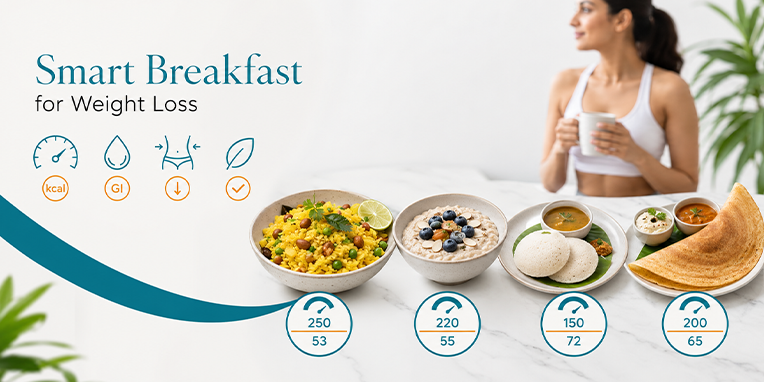
| Breakfast | Approx Calories (1 Serving) | GI Range | Protein (g) | Weight Loss Suitability |
|---|---|---|---|---|
| Vegetable Poha (40g dry, 1 tsp oil) | ~200 kcal | 55–65 | 5–6g (with peanuts) | ✅ Good |
| Rolled Oats with milk (40g + 100ml low-fat milk) | ~220 kcal | 40–50 | 9–10g | ✅ Very Good |
| Idli (3 idli, no sambar) | ~150 kcal | 70–80 | 5g | ⚠️ Moderate |
| Dosa (1 plain dosa, no filling) | ~120–160 kcal | 55–65 | 3–4g | ⚠️ Moderate |
| Upma (rava, 1 serving, 1 tsp oil) | ~200 kcal | 65–75 | 4–5g | ⚠️ Moderate |
| White bread + butter (2 slices) | ~220–260 kcal | 70–80 | 6g | ❌ Poor |
| Puri Bhaji (2 puris) | ~320–380 kcal | 75–85 | 5g | ❌ Poor |
| Paratha with ghee (1 large) | ~280–350 kcal | 60–72 | 6g | ⚠️ Moderate |
Poha is significantly superior to maida based or deep fried breakfasts and approximately on par with idli and dosa in terms of calories. It ranks below oats on fibre and protein as well. Key takeaway: ain;;;t a panacea, but it is a good option. If you cook it right, it's firmly in the "good for weight loss" territory; if you cook it poorly, it's tiptoeing over into "neutral at best" territory."
Three Poha Recipes Optimised for Weight Loss
These are not theoretical recipes — these are the versions we actually discuss with patients in our weight management programme at VK Allure. Specific measurements, specific reasons for each ingredient choice.
🍚 Classic Vegetable Poha — Weight Loss Edition
- 40g thick poha (dry, uncooked)
- 1 tsp cold-pressed groundnut or coconut oil
- ¼ tsp mustard seeds, ¼ tsp cumin
- 5–6 curry leaves, 1 green chilli (optional)
- ½ small onion, finely chopped
- 2 tbsp frozen peas (no need to defrost)
- ½ small capsicum, diced
- 1 tbsp raw peanuts (roasted dry separately)
- ½ tsp turmeric, salt to taste
- 1 tbsp lemon juice, fresh coriander to garnish
- Rinse poha, drain, let sit 4 minutes. Fluff with fingers — it should be soft but not wet.
- Heat oil in non-stick pan. Add mustard and cumin; let splutter. Add curry leaves.
- Add onion, cook 2 minutes. Add capsicum and peas, cook 2 minutes on medium.
- Add turmeric and salt. Add poha, mix gently. Cook 2 minutes, stirring.
- Off heat, add lemon juice. Top with dry-roasted peanuts and coriander.
Why this works: Capsicum and peas add fibre and volume for near-zero calories. Peanuts provide protein and healthy fat to slow gastric emptying. Lemon reduces glycemic response. Thick poha gives a lower GI than thin varieties.
🫘 Sprouted Moong Poha
- 30g thick poha (dry)
- 50g sprouted green moong (raw)
- 1 tsp oil, ¼ tsp mustard, ¼ tsp cumin
- ½ small onion, 1 tomato (small, diced)
- ½ tsp turmeric, ¼ tsp chilli powder, salt
- 1 tsp lemon juice, coriander
- Rinse and soak poha 4 minutes, drain.
- Temper mustard and cumin in oil. Add onion, sauté 2 minutes.
- Add sprouted moong, cook covered for 3–4 minutes on low heat.
- Add poha, tomato, turmeric, chilli, salt. Mix, cook 2 minutes.
- Finish with lemon and coriander.
Why this works: Sprouts add roughly 3–4g protein per 50g serving and significant fibre, dramatically improving the protein-to-carb ratio of the meal. This version is particularly good for patients managing blood sugar alongside weight loss.
🥣 Dahi Poha (Curd Poha)
- 35g thick poha (dry)
- 100g low-fat curd (chilled)
- ½ tsp sugar (or skip entirely)
- 1 tsp oil, ¼ tsp mustard, 5 curry leaves
- ½ tsp grated ginger, 1 green chilli (optional)
- Salt, roasted cumin powder, coriander
- 1 tbsp pomegranate arils or grated carrot (optional)
- Rinse poha, drain, rest 5 minutes until soft.
- Mix chilled curd with a tiny pinch of salt and sugar. Add poha, mix gently.
- Prepare tempering: mustard and curry leaves in oil, pour hot over the curd-poha mix.
- Add roasted cumin, coriander, grated carrot or pomegranate. Serve immediately.
Why this works: Curd adds 6g protein per 100g, probiotics for gut health, and calcium. The protein in curd significantly slows the glycemic response of the poha. This is a particularly good option for people who find conventional poha too heavy in summer — it is cooling and light.
What the Numbers Do Not Tell You — The Chennai Angle
Using standard laboratory analysis, poha such as an example of a product. This is not how poha is really consumed in Tamil Nadu or Chennai for that matter. Here are some real world observations learned from what we see in clinic:
Most of the poha sold in Chennai tiffin centres and makeshift canteens is a lighter version of the Maharashtrian dish — less potato, more tempering (curry leaves, green chilli, even a squeeze of lemon sometimes). That's actually a pretty good prep, that weight control.
However, Chennai has its own caloric discrepancy: it is the chai. Most eaters of poha have it along with 1–2 cups of teh (sweetened, full-fat), milk tea. But if you added one cup of regular Chennai style filter coffee or tea with full cream milk and two spoons of sugar, then it will cost you 80–100 calories. When to drink your caloriesTwo cups with breakfast turns a modest 200-calorie meal into one that could approach — or exceed — 400 or more. The breakfast itself is the problem. The beverage habit is.
A pattern that, we see, with patients who commute for long distances in Chennai — Thoraipakkam to Kilpauk, for example; or OMR to Nungambakkam. They have a light breakfast at home (poha, idli or something) at 7 AM and nothing until a heavy lunch at 1–2 PM. Skip a meal for six to seven hours and that quiet tummy roar turns into an Insatiable Hunger Beast, leading almost invariably to an excessive lunch, plus afternoon munching. Beyond this, the actual food for breakfast is less important for these patients than is timing of that meal and a snack strategy by mid-morning.
The Honest Limits of Poha for Weight Loss
This is the dirty secret that no food blog will ever put down in such words — poha is not going to magically make you lose weight. No food does. Long-term weight loss is heartburn when total energy intake is less than1495940000mj over a sustained period of time — it is that arithmetic which decides your breakfast, whether poha or oats or protein squeeze.
That is where poha comes in, a relatively low-calorie yet filling breakfast with the Indian palette. That is valuable. The first and most obvious place that weight loss plans often fail is simply dietary compliance — actually consuming the food you intended to consume, day in and day out, for months on end. If someone hates oats but loves poha, then poha is the winner for them & period.
But the common pattern we see at our slimming clinic is patients who have eaten "right" — poha for breakfast, salad for lunch, dal and sabzi for dinner — but are stuck on the scales. The caloric accounting is off in 9 out of ten cases. The oil is not measured. Dinner rice is larger than predicted quantities. You are not counting the couple of biscuits between meals. The size of meals across the weekend dwarfs weekday meals.
Dietary changes are the foundation. However, for many patients — especially those with a BMI >28–30 kg/m2, metabolic hormonal advancements or previous yo Yo dieting process — diet alone is not adequate. This is where clinical intervention comes into play.
When Poha Is Not Enough — Clinical Weight Loss Options at VK Allure
This is made evident to anyone we consult with; diet helps maintain an optimal bodyweight, but is not the whole picture for every person. Patients with considerable obesity, with unfavourable metabolic phenotypes to weight-loss and/or dieters on-off for years require in most cases clinical structure to observe real improvement.
At VK Allure Dermaclinic, our weight management and body contouring options include:
- EMS (Electromagnetic Muscle Stimulation) — produces supramaximal muscle contractions similar to thousands of situps or squats in a single 30-minute session. It can help you to build lean muscle mass, which increases your resting metabolic rate and improves insulin sensitivity as well. Especially beneficial for patients with joint problems, or a sedentary desk job who are unable to exercise.
- Cool Sculpting / Cryotherapy — Controlled cooling for the selective reduction of fat cells in targeted areas of unwanted fat, including abdomen, flanks and inner thighs. Fat cells have a particular sensitivity to temperature far below that which blazes nearby tissue. Lymphatic system clears the destroyed cells over 4–12 weeks. So it is not a full weight loss treatment as such — it is a body contouring tool for stubborn localised fat that has proved resistant to diet and exercise.
- Inch Loss Therapy — Techniques combining radio-frequency, cavitation and lymphatic drainage to facilitate inch loss in selected regions Complementary to dietary changes for clear visible change in shape.
- Structured dietary assessment — A thorough clinical diet assessment with consideration of actual body composition (not just what the scale says) along with metabolic factors, documented medication history and achievable goals. Here, is when the nearly universal "I have been eating healthy but nothing works" pattern gets solved.
Patients who get the best long-term results are those who integrate dietary modification with clinical support — not because clinical treatments work miracles, but because the combination provides accountability, addresses things that diet alone cannot resolve and sustains motivation through biological plateaus that are sure to occur.
The Right Mindset Around "Healthy" Foods
Something that should be directly addressed in addition (and is something I heard about throughout the week): this mental accounting with "healthy" foods. Even people who steadily pack on the pounds over years aren't necessarily gobbling down junk food all the time. They are consuming food they deem nutritious — yet in larger amounts than there caloric requirements. Poha, idli, roti, curd rice — all are truly healthy. They all can help add weight to excess levels.
Poha and is Poha Healthy? How much poha, made how, as part of what total daily intake, in what metabolic milieu. Is that a less enjoyable answer than pure yes no. But it is the accurate one.
At our weight loss programme At Chennai, we begin every patient with a dietary audit: NOT A DIET PLAN — AN AUDIT. How much (and what) are you actually eating when and in what context? The pattern is almost always revealed in the audit. The correction that follows is often much less dramatic than the patients anticipate once they grasp the pattern. You do not have to abstain from poha. You have to consume the correct quantity of it.
Five Common Poha Weight Loss Myths — Addressed
Myth 1: "Poha has no fat." Raw poha is around 1g fat per 100g. In your poha, the fat comes from whatever oil you are using — and for most homemade versions, that's going to be the primary source of fat. Measure the oil. The food itself is kilo-free, the preparation not.
Myth 2: "Poha has a lot of iron — great for weight loss." Iron content in Poha is the worst of the three, 1.5–3mg per 100g dry. Older literature and commercial manufacturers quote a figure of 20mg/100g, which is for an iron-fortified variety of poha [28], rather than standard poha. A common reason for fatigue and poor exercise capacity is low iron, which indirectly reduces the ability to maintain a healthy weight — but poha is not an iron booster in most individuals.
Myth 3: "Poha is low in carbs." It is not. Poha is a high-carbohydrate food at 70–76g carbohydrate /100g dry weight, similar to white rice. It is not in the macronutrient profile; it is a matter of portion control as well — poha is generally eaten in smaller quantities by volume and preparation habits.
Myth 4: "Poha is good for keto or low-carb diets." You are not compatible with kinotic or strict low carbohydrate diets. One relative portion offers 28–30g carbs — excess than the full everyday carb allowance on a strict keto eating regimen (20g net carbs). No matter how poha is prepared, it is not suitable if you are following carbohydrate-restricted approach.
Myth 5: "Eating poha twice a day will cause faster weight loss." Your calorie density drops, somewhat if they were higher calorie (and poha replaced them with rice in seafood and me) switching two meals out for poha. Whereas it is a recipe for boredom, inviting micronutrient deficiencies (poha has low amounts of protein, fat and several vitamins) and all but guarantees cravings & dietary compensation. A diverse diet is also more sustainable and more nutritionally complete.
Practical Tips — Getting Poha to Actually Work for Weight Loss
Rather than a vague "eat healthy" closing, here are the specific, actionable changes that translate to a meaningful caloric difference in practice:
- Buy thick poha (mota). Not thin. The GI difference is real. It is available at every grocery store.
- Measure oil with a spoon. One teaspoon. Every time. Non-stick pan is not optional for a low-oil preparation.
- Skip the potato. Replace it with peas or capsicum. You will not miss it after the first two times.
- Add a protein source. Peanuts (1 tbsp), or make it dahi poha with 100g low-fat curd, or eat an egg alongside. Protein at breakfast is the single most evidence-backed lever for appetite control through the morning.
- Limit to 40g dry weight. Weigh it once. Learn what 40g looks like in your measuring cup. Stop estimating.
- Eat before 9 AM. Morning insulin sensitivity means carbohydrates eaten early are handled more efficiently than the same meal eaten at 11 AM.
- Have a mid-morning snack planned. If your next meal is 5+ hours away, plan 100g of low-fat curd, a handful of nuts, or a fruit at 10:30–11 AM. Prevent the lunchtime hunger that leads to portion distortion.
- Count the chai. If you are having sweetened tea with breakfast, count those calories too. They are not free.
Final Thoughts
Why poha deserves to be a part of an Indian weight loss diet – really. It is light and fulfilling and culturally at home, too easily assembled at speed. With minimal oil, packed with veg and a protein pairing, even at 40g it nestles comfortably into the 180–220 calorie range and holds back hunger whilst enjoying a full morning. Not bad at all for an individual component that can be pulled together in twelve minutes.
But the context matters. Remember that Poha is not a strategy. To shed weight, you need a wider dietary pattern over the long term — caloric recognition, protein ramification, fiber, mealtime timing, exercise — that goes a ways beyond any one breakfast. The decision of the food is not usually the cause if you are feeding properly and not getting results; It will be the amounts that will be relatively high, those uncalculated variables or a dysfunction in your metabolism that needs clinical treatment.
If you want a structured approach rather than piecing together blog advice, our team at VK Allure Dermaclinic in Chennai can help. Book a consultation at our Kilpauk or ECR Uthandi branch — we will look at your actual dietary pattern, body composition, and metabolic context, and build a plan around what will genuinely work for you.
Get a personalised weight loss plan in Chennai
Stop guessing and start with a proper clinical assessment. Our team at VK Allure Dermaclinic combines expert dietary guidance with advanced body contouring treatments for real, lasting results.