The 40s is when most people first have a suspicious glance in the mirror and note that it is not only one wrinkle — it is also the whole face looking a bit deflated. Those high cheeks are softer now; have slid just a little. The lines from the nose to mouth are deepening. The under-eyes appear sunken even after a marathon of sleep. It's not your imagination and it's not just the skin. It's volume loss — and it is precisely what dermal fillers were created to target.
However, "best filler" is not a question with one answer, and anyonewho gives you one is selling. So ultimately when it comes to what constitutes the best filler — well, that depends upon the area, your face, your goal and most importantly who is holding the syringe. This guide takes an honest look at fillers — what they actually do, the best options for cheeks and lips, how long they last (for real!) the risks you should know, and if it's worth your time.. VK Allure Dermaclinic offers dermal filler treatments across our Kilpauk and ECR branches in Chennai, but this is a guide first and a clinic second.
Best dermal fillers for your 40s — the short version
For anti-ageing in your 40s, hyaluronic acid (HA) fillers are the mainstay — they're safe, natural-looking, and reversible. Firmer, higher-lifting HA fillers restore cheek volume and lift the mid-face; softer HA fillers suit lips and fine areas. Results typically last 6–18 months depending on the product and area. Fillers are worth it for volume and structure — but they don't fix skin quality or fine lines, and the injector's skill matters far more than the brand.
Why your face changes in your 40s (it's not just wrinkles)
Understanding the "why" makes every filler decision that follows make sense. Facial ageing isn't a single process — it's four layers changing at once.
The bone underneath quietly resorbs, so the scaffolding your face is built on shrinks — the eye sockets widen, the jaw and chin lose projection. The deep fat pads that gave you youthful cheek fullness shrink and descend, so volume drops from the mid-face and pools lower down. The muscles and ligaments loosen, letting everything sag a touch. And the skin itself thins as collagen declines, so it no longer holds its shape the way it did.
Now here is the big secret: fillers tackle both of the first two exquisitely — they fill volume and restore structure. They very fourth- — do little for the. If returns are actually your main fear, deflation and shadows, filler is frequently a suitable tool. And if it's crepey skin texture / fine lines, then filler is the wrong one (and something like HIFU tightening, skin PRP or resurfacing fits better. Knowing which problem you actually have is half the battle.
What dermal fillers actually are
A dermal filler is a gel injected under the skin to restore volume, smooth folds, or reshape a feature. The overwhelming majority used today — and the ones we'd recommend for almost everyone starting out — are hyaluronic acid (HA) fillers.
HA is a naturally occurring sugar molecule that your body already makes and that's what keeps skin plump and hydrated, in the first place. There were HA fillers being the most stabilised, gel form of it. They have the great advantages that they are semi-permanent (which is a comfort when starting out), They mimic the look and feel of genuine hair, and importantly, they are reversible — Also, if you dislike the outcome otherwise there's a complication, an enzyme referred to as hyaluronidase can dissolve them. That reversibility is a very real safety net, and it's why HA is the default.
Other filler types from which to choose include calcium hydroxylapatite, poly-L-lactic acid (a collagen stimulator), and even permanent fillers. These have uses in expert hands but, as true irreversible or semi-permanent fillers they increase the risks massively! The majority of us in our 40s embarking upon the anti-aging journey would choose HA simply because its the smartest Play and safest sit-in but the rest of this guide directs from there.
The dermal fillers guide: best options by area
This is the practical heart of it. In your 40s, a natural result usually comes from treating the cause (mid-face volume loss) rather than chasing individual folds. Here's how the areas break down.
Cheeks and mid-face — the foundation
This is where the bulk of rejuvenation in your 40s should begin. The process of putting in volume into the cheeks lifts the entire mid-face, and this additional fullness has a chain reaction effect of softening any folds or jowls below. You can go for the nose-mouth fold directly and often get a heavy, overstuffed appearance; If you replace the actually deflated cheek therewith, and the crease corrects itself naturally. The answer to this question is straightforward; firm, high-lift HA fillers.
Tear troughs (under-eyes) — powerful but unforgiving
Dark circles give the appearance of being tired all the time. Filler here can be life changing — but this is one of the most skilled (and riskiest) areas for filler on the face, being so close to big blood vessels and very prone to puffiness if done incorrectly. Do NOT scrimp in this area by using a novice injector — absolutely not.
Nasolabial folds and marionette lines
Often better softened indirectly by lifting the cheeks first, with only a little placed directly if needed. Over-filling folds directly is one of the commonest causes of an unnatural, "done" appearance.
Chin and jawline — the underrated ones
Restoring chin projection and jawline definition can dramatically improve profile and reduce the appearance of jowls and a "soft" lower face. Increasingly popular in the 40s, and firm structural HA is used here too.
Lips — subtle, in your 40s
Age gives lips a thinness and loosens their outline. It's in the 40s where it tends to be about restoration and hydration — rebuilding the cradle shape or border more so than, like, a big full lip look that was popular for some of us in our younger years. The softest and most flexible HA provides the most natural result.
| Area | Filler type | Typical goal in your 40s |
|---|---|---|
| Cheeks / mid-face | Firm, high-lift HA | Restore volume, lift the face |
| Tear troughs | Soft, low-swelling HA | Reduce hollows and shadows |
| Nasolabial folds | Medium HA (often via cheeks) | Soften folds naturally |
| Chin / jawline | Firm structural HA | Definition, profile, less jowling |
| Lips | Soft, flexible HA | Restore shape and hydration |
Cheek fillers, in depth
If someone in their 40s asked me where to start, the honest answer is almost always the cheeks — not because it's trendy, but because it fixes the root of what's changed.
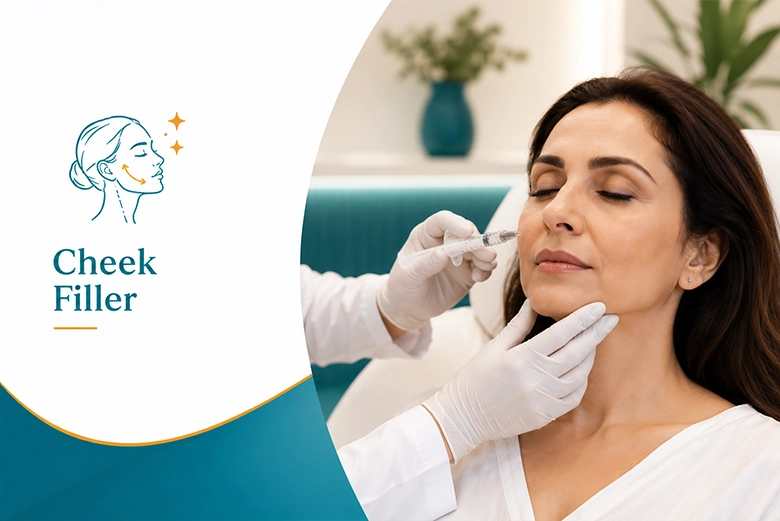
With the decrease and downward motion of your deep cheek fat pads, comes a flattening of the mid-face as well as drooping below. That newly lost volume is replaced in both the right location and at the ideal depth to satisfy 2 objectives: replacing youthful cheek contours, as well as lifting the lower face so that folds and minimal jowls are minimized without directly treating those areas. To illustrate how to most efficiently improve the way a patient appears at rest — often an experienced injector treating "tired, sagging" faces goes straight for the cheeks: it is still so high leverage on the face.
The technique matters enormously. Structural lift is given with Firm HA deep in the bone, and contour is created with softer product placed more superficially. But nail the product, depth and dosage and you almost look like you had a good nights sleep and shed a few years. Screw it up — too much, too shallow, wrong place — and you are left with the trained-‘chipmunk effect’ (ugly) or ‘pillow face that fair enough repels folks from fillers altogether. The only difference is the hands that are doing it.
Lip fillers in your 40s — restoration, not inflation
Lip fillers get a bad reputation from the extreme, over-inflated looks that go viral. In your 40s, done well, they're the opposite of that.
In addition, ageing lips become thinner and less prominent, the border becomes indistinct, the corners slump and there are fine "lipstick lines" in the mouth area. The 40s objective is reclamation — reconstruct the shape, reshape the border, softly hydrate to make the mouth look like a younger version of itself and not somebody else's mouth. Lips are always in motion so soft, flexible HA fillers are used as stiff product would not only feel uncomfortable but look wrong as well.
In this cohort, a good injector will typically be more conservative (over multiple sessions if possible), ensuring the result looks natural. You, of course, did not have lip filler in your lips but you're clearly "filled" when you walk out of the appointment. Subtlety is the whole point. That's the skill: realistic quantities, natural ratios, knowing when to call it.
One honest caveat: lips are among the shortest-lasting filler areas because they move so much, so expect to top up more often here than in the cheeks.
How long do dermal fillers last?
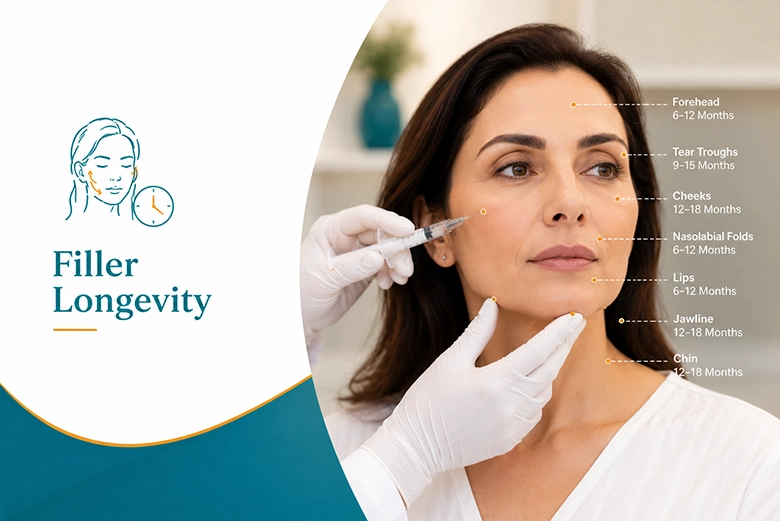
The most-asked question, and the honest answer is "it depends" — but here's a realistic picture. Longevity varies with the product used, the area treated, and your own metabolism (faster metabolisms break down HA quicker).
| Area | Typical longevity | Why |
|---|---|---|
| Cheeks / mid-face | 12–18 months | Firm product, relatively still area |
| Chin / jawline | 12–18 months | Structural product, low movement |
| Nasolabial folds | 9–12 months | Moderate movement |
| Tear troughs | 9–15 months | Varies; low-movement area |
| Lips | 6–12 months | Constant movement breaks it down faster |
Two honest nuances. To begin with, "lasting" is not a zero-sum game — fillers disappear stepwise (slowly fading away), which means effects lessen before they are gone altogether, and many individuals have touch-ups at points along the way to maintain an always-uniform aesthetic prior to its departure. Second, there are some studies suggesting that some HA sticks around longer than anticipated in specific places—another reason to err on the side of conservativeness and reassess rather than assume it has all dissolved. An ethical place reviews before re-treating rather than automatically refilling on a fixed schedule.
Are dermal fillers worth it? An honest answer
This deserves a straight answer rather than a sales pitch, so here it is: fillers are worth it for the right problem, done by the right hands — and not worth it otherwise.
Worth it if your true problem is volume loss perpetuated by deflation, hollows or a lost definition and you see a competent injector who will be cautious yet subtle. In that case, the impact on how well rested and youthful you appear — without surgery, with little recovery time involved — is truly high-leverage. For a lot of 40-something patients, just a little cheek and under-eye filler is more transformative to their face than any cream has ever been.
Not worth it if find your actual skin issue — texture, fine lines, dullness, laxity — because filler is not going to improve those and will only give a very strange face: new volume with no fill on the "surface" If you are chasing a trend rather than treating your own face as an individual, or if you can't afford the maintenance and the expense of topping up, this also isn't worth it — but especially, if you'd be tempted to simply pick an injector based on price. But, in untrained hands, a sub-par filler is the most costly blunder in aesthetics, since fixing it literally costs magnitudes much more than getting it right to begin with.
What a filler appointment actually involves
Knowing the flow takes a lot of the nervousness out of a first visit, so here's how a proper appointment runs — and what should happen at each stage.
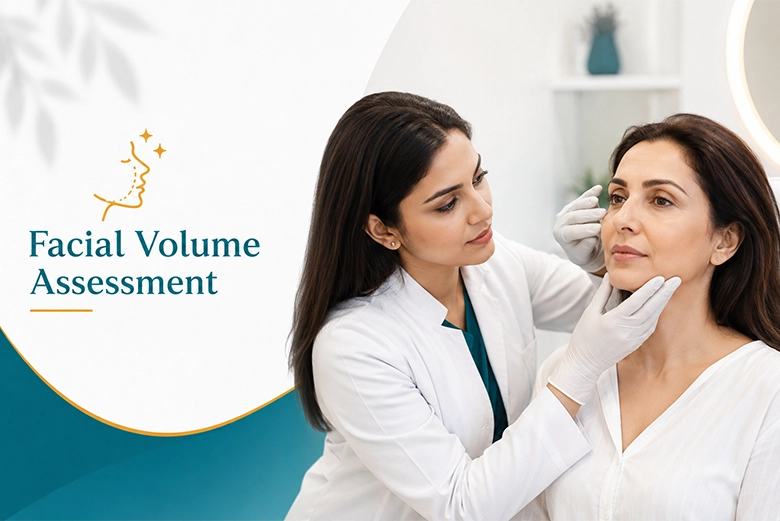
The consultation and whole-face assessment
Before even a needle, the best injectors take you at rest and moving, figure where volume has truly been lost (hint: it usually hasn't) and discuss what you will really want. It's at this point that your dermatologist with a well-honed bedside manner may tell you the unvarnished truth — that babying up those cheeks and/or using better skincare, or doing some kind of skin-lifting treatment like a resurfacing or glow treatment, would serve you better than the filler you came in asking for. That candour is a feature, not a deflection.
Numbing and preparation
The skin is cleaned thoroughly, and numbing cream or the local anaesthetic within the filler keeps discomfort mild. This is also when the injector maps the plan on your face and confirms amounts with you.
The injection itself
Originally published in 30 December, 2023 Placement is intentional – the correct product, at the correct depth, at the chosen position and using small increments while constantly assessing for symmetry. The other of fifteen to forty-five minutes, depending on the areas. The pressure you will feel; sharp or severe pain should never be ignored, for it is a warning system.
Aftercare and review
There will be some swelling; you may need to wear a pressure garment and should expect bruising, along with that heat exercise strenuous activity are not recommended for a day or two either. Most clinics offer a review after approximately two weeks to check that the result has settled and that any small top-up is required. The safety and the gradual build over visits is a more natural approach compared to trying to do everything in one sitting — it mirrors the measured philosophy we have towards skin-tightening and pigmentation plans.
If your first "appointment" is a five-minute upsell straight into a syringe with no assessment, that's the moment to walk out. Fillers are minor in time but medical in nature, and they deserve the full process.

Fillers are one tool — not the whole toolbox
The most natural results in the 40s rarely come from filler alone. A face that's aged has usually lost volume and skin quality, and treating only one looks incomplete. This is why experienced clinics think in combinations:
- Fillers and RF microneedling for volume plus skin tightening and texture.
- HIFU for non-surgical lifting when laxity, not just volume, is the issue.
- Skin PRP for a collagen-driven improvement in skin quality.
- Skin resurfacing for texture, fine lines and tone.
- HydraFacial and good daily skincare as the everyday foundation underneath it all.
Instead of knee jerk "more filler"I this, a dermatologist-led plan considers the entire face and sequences these judiciously. And if a clinic just does filler, then somehow every problem will be solved with filler — and that biased perspective is worth knowing about.
Safety, risks, and who should not have fillers
Fillers are medical procedures, not beauty treatments, and this section matters as much as any other.
Common, minor effects are normal: swelling, bruising, tenderness and redness for a few days. Lumpiness that usually settles or can be smoothed. These are expected and temporary.
Fillers are generally avoided or delayed if you are pregnant or nursing; have an active skin infection or inflammation at the inoculation site; suffer from specific autoimmune disorders, such as lupus, multiple sclerosis (MS), and spinal muscular atrophy (SMA); have a history of serious allergic responses to injectable medicines; take blood-thinning medication (higher risk for bruising—requires discussion); or are prone to keloid formation or atypical scars. Anyone struggling with body-image issues creating unrealistic demands should be met with a frank talk — not a syringe. A responsible clinic will screen for all of this again — being asked these questions is a sign of institutional integrity, not an inconvenience.
For balanced background reading, the American Academy of Dermatology and the FDA both publish patient guidance on filler safety and what to check before treatment — worth ten minutes before any first appointment.
Choosing where to have fillers in Chennai
Because the injector matters more than anything, this is the decision that actually determines your result. A few things to insist on, wherever you go.
Just be sure that it is a qualified doctor — dermatologist or trained cosmetic physician instead of technician doing the injecting. Inquire what product they are using, if it is one of the approved HA fillers; well established clinics will have no qualm in answering. Verify they have hyaluronidase available on site for immediate administration in the rare event HA needs to be reversed *this is a must!) Look for an in-depth consultation that thoroughly evaluates your entire face and provides realistic goals, NOT an overselling technique. And be ever so sceptical of prices that look too good — quality filler and experienced injectors come at a price, and the cheapest options are where complications gather.
Fillers at VK Allure are highly conservative, HA-based & dermatology-led - much prefer doing a little and reviewing than overfilling and correcting. Assessment is holistic, the plan thoroughly explained and we're honest enough to tell you that filler isn't what you actually need. You can see the fillers and injectables page or the full range of anti-ageing treatments, and we run the same protocols at both the Kilpauk and ECR Uthandi branches across Chennai.
Considering fillers in your 40s? Start with a proper assessment.
Book a consultation at VK Allure Dermaclinic — Kilpauk or ECR Uthandi, Chennai. We'll assess your whole face, explain your options honestly, and tell you if fillers aren't the right answer.
Book an Appointment Contact the Clinic📞 +91 96009 58060 · 💬 WhatsApp us
Final thoughts
Hyaluronic Acid dermal fillers are the best and safest, natural as well as reversible anti-ageing treatment for your 40s – but they must be perfectly matched to the area: firm gels for cheeks, chin and jawline while softer gels should be used for lips and delicate areas. AMAE last 6-18 months, depending on the area, and they're totally worth it when volume loss is an issue and right injector is chosen. What they fail to do is correct skin quality, hence the most natural rejuvenation (usually) involves filler combined with skin treatments. Most importantly, results reside in the hands and not in the brand – select a experienced, conservative injector to perform an initial consultation on the entire face and treat fillers as a relationship rather than a one-time fix. Your face is your own; the aim to appear as a more rested version of it, not someone else.
Frequently Asked Questions
What are the best dermal fillers for anti-ageing in your 40s?
Where should I start with fillers in my 40s?
What is the difference between cheek and lip fillers?
How long do dermal fillers last?
Are dermal fillers worth it?
Do fillers look natural or obvious?
What are dermal fillers made of?
Can dermal fillers be reversed?
Do fillers help with wrinkles and fine lines?
Are fillers safe?
What is vascular occlusion and how serious is it?
Does getting fillers hurt?
Is there downtime after fillers?
How much filler will I need?
Who should not have dermal fillers?
Are fillers better than a facelift in your 40s?
Can I combine fillers with other treatments?
How often will I need top-ups?
Why does the injector matter more than the brand?
Are cheap fillers a good deal?
Where can I get dermal fillers in Chennai?
Medically Reviewed & Written By

Dr. Lokeshwari
Dermatology Specialist · VK Allure Dermaclinic, Chennai
- ✓ Certified Dermatology Specialist
- ✓ 7+ Years of Clinical Experience
- ✓ 5,000+ Patients Treated
- ✓ Aesthetic & Medical Dermatology
Dr. Lokeshwari is a Dermatology Specialist at VK Allure Dermaclinic, specializes in advanced skincare, hair restoration including laser treatments and aesthetic dermatology. She works at Kilpauk and ECR (Uthandi) branches in Chennai, and follows an evidence-based approach tailored to our skin types & climate. She writes about what really works — dissecting skincare myth from clinical reality.
This guide to dermal fillers for anti-ageing has been reviewed by Dr. Lokeshwari to ensure every recommendation, safety note and expectation reflects current dermatology practice for injectable treatments.
Book a Consultation with Dr. Lokeshwari →📞 +91 96009-58060 · 💬 WhatsApp · 🏥 Kilpauk & ECR Uthandi, Chennai