Curd for hair is probably the most common question we hear in the context of home remedies — at both our VK Allure Dermaclinic branches. Patients mix it with everything: eggs, amla, methi, lemon, honey, coconut oil. Some swear by it. Others have been doing it for a year and can't tell if it's doing anything at all.
All fair: Curd contains the real, scientifically proven benefits for the hair and scalp. However, what most people ask for, and expect from it — is at odds with being able to use it as intended. This guide looks at either side of that gap.
You will know about the actual chemistry of curd and the action it has at hair and scalp level, right and exaggerated benefits, best DIY masks as combos, ingredients to include or avoid, when a curd mask is pointless and you need an assessment.
Topically applying Curd is actually beneficial for Hair. Contains lactic acid (its an AHA exfoliant but very mild one), proteins, probiotics, zinc and B vitamins. The benefits include exfoliation of the scalp, a mild anti-fungal effect on the fungus Malassezia which causes dandruff, conditioning for dry or chemically treated hair and temporary reduction of frizz. It does not directly promote hair telogen or treat clinically baldness. The right frequency is 20–30 minutes once a week; plain full-fat yogurt makes the best base for most homemade masks.
What Is Actually in Curd — and Why It Matters for Hair
Let us not rush into mask recipes, understand what is the action of curd on a bio-chemical level. This is the bit that the majority of home remedy articles on this subject gloss over, but it's what shows you which combinations are effective and which aren't.
Curd (dahi) is fermented milk. Fermentation - mainly by Lactobacillus bulgaricus and Streptococcus thermophilus - is responsible for lactose conversion (to lactic acid) and creation of many bioactive ingredients. Here is what a single 100g serving of Indian whole-milk curd contains and what each compound does topically:
| Component | Concentration | Hair / Scalp Function |
|---|---|---|
| Lactic acid | 0.6–0.9% (varies by set time) | AHA exfoliation of scalp dead skin, mild antifungal, pH-lowering (closes cuticle) |
| Proteins (casein, whey) | ~3.5g per 100g | Coats and temporarily fills porous hair cuticle; adds tensile strength |
| Lactic acid bacteria (probiotics) | 106–108 CFU/g | Competitive inhibition of Malassezia on scalp; microbiome balancing |
| Fat (triglycerides, phospholipids) | ~3.4g per 100g (full fat) | Lipid coating of hair shaft; reduces moisture loss; shine |
| Zinc | ~0.5mg per 100g | Anti-inflammatory for scalp; antioxidant protection of follicles |
| Vitamin B12 | ~0.3–0.4 mcg per 100g | Absorbed in small amounts topically; supports follicle cell turnover |
| Riboflavin (B2) | ~0.17mg per 100g | Follicle cell energy metabolism |
| Calcium | ~120mg per 100g | Minor role in scalp barrier integrity |
The most important active component topically is lactic acid. It's an alpha-hydroxy acid — from the same family tree as glycolic acid used in professional chemical peels, just with less potency and gentleness. Applied to the scalp, it performs these low level functions away from home 0.6–0.9%Lactic acid exfoliates dead skin cells and sebum plugs from follicle openingsopens hair cuticle changese on coverer 3 Surface pH (Malassezia fungus loves pH7 (baking soda); closing opening of haar-cuticle scale wavelength scales / soft hair increasing smooth & Shine Effectiveness).
The proteins — Whey protein: Whey is the most water soluble fraction of milk constituting approximately 20% of total milk protein. Essentially a diluted version of the protein hair treatments you would get in some salons. The effect is indeed real but also temporary: it fades with shampooing. It is also the reason as to why curd does not "fix" damaged hair for a long term — it gives nourishment, session after session.
The probiotic bacteria are worth a mention. Similar to the skin, the scalp has its own microbiome with Malassezia yeast overgrowth being the main culprit for seborrhoeic dandruff, one of Chennai's (humid weather) most common scaly scalp complaints. Among them, Lactobacillus species have been proven to inhibit the colonization of Malassezia competitively by producing lactic acid and other antimicrobial peptides. Now this is the reasons why curd works less as a real anti-dandruff agent.
The Proven Benefits of Curd for Hair and Scalp
Let's be specific about what curd can and cannot do. No vague "promotes healthy hair" language — actual mechanisms.
- Scalp exfoliation and pore-clearing Lactic acid breaks down the keratin holding dead skin cells and dried sebum onto your scalp, unclogging pore openings. This is particularly effective in cases of mild scalp congestion — something common to Chennai, where the heat generates excessive oil production. Not as potent as a dedicated scalp scrub or AHA toner, but more than sufficient for weekly maintenance.
- Dandruff reduction (Malassezia-driven) This is curd's best evidence base. The antifungal effect of lactic acid combined with probiotic competitive inhibition describe curd (lactic acid bacteria) as a mild but authentic antifungal scalp treatment against Malassezia. For mild to moderate dandruff, weekly uses genuinely decreases flaking and itching. In moderate to severe seborrhoeic dermatitis, it is adjunctive — not sufficient on its own.
- Conditioning and frizz reduction Curd coats the hair cuticle with protein and fat from outside. This is what produces frizz, and the protein coating combined with the mild acid pH hold scales flat temporarily smoothing away rough raised cuticle scales. You can see the effect immediately after one use, particularly on humidity frizz which is pretty much visible in Monsoon months back here in Chennai!
- Moisture retention for dry hair Both the fat and protein components of curd form a semi-permanent film over the hair shaft, which causes some reduction in transepidermal water loss from the strand. This translates to visibly softer & more manageable hair with every masque, especially ideal for dry, over-wash or sun-damaged hair — all common presentations here in Chennai.
- Scalp cooling and inflammation relief The most underrated practical benefit: cold curd on the scalp has a real cooling effect on hot, inflamed scalps. During peak times in Chennai, the period of April–June, for scalp folliculitis due to excessive sweat-inducted bacterial and fungal proliferation, a cold curd mask once weekly gives genuine symptomatic relief. This is not glamor, but basic thermodynamics and mild antibacterial action — effective however.
- Improved shine and surface texture The ability of the lactic acid to lower the pH at the hair surface has a tighter cuticle closure relative to rinse with just water. Normal Closed Cuticle = flatter surface = reflect more light = shinier hair. This explains why your hair looks much shinier post-curd-mask sans serum.
The Honest Limits — What Curd Cannot Do
Most articles about curd and hair will tell you it "promotes hair growth," "strengthens roots," and "treats hair fall." These claims need unpacking, because they're either overstated or wrong.
Curd does not directly stimulate hair follicle activity. To stimulate the growth of new hair, you need to intervene at the follicle level — increase blood supply to the dermal papilla which is responsible for circulation in your scalp and plays a crucial role in hair density, improve growth factor signalling (the building blocks of life that triggers cell differentiation), alter hormonal regulation or activate stem cells. Since the follicle bulb sits at a depth of 3–4 mm below the scalp surface, lactic acid and casein cannot penetrate to this location. They work only on the surface and this upper opening of the follicle.
Curd does not treat androgenetic alopecia. It is well known that the major cause of thinning hair in both men and women, pattern hair loss, is mediated by DHT sensitivity, follicle miniaturisation and genetic programming. A curd mask does none of these. It might marginally help the scalp environment, but it will not prevent or reverse hair loss due to pattern hair loss.
Curd does not repair structurally damaged hair permanently. The protein conditioning is on the surface and washes out. For hair that strained from bleach, heat styling or chemical processing, curd brings temporary reprieve — though it doesn't repair those broken disulfide bonds in the hair's cortex that structural damage severs. Well you need bond-building treatments (Professional Olaplex-type chemistry) or, practically, a good cut and prevention going forward.
None of this diminishes what curd genuinely does. It just means it belongs in the right category: a solid, accessible maintenance and conditioning tool — not a clinical treatment.
The Best Curd Hair Masks — With the Science Behind Each
Here are the combinations that actually make sense, with the rationale for each ingredient pairing. Not just recipes — the why matters.
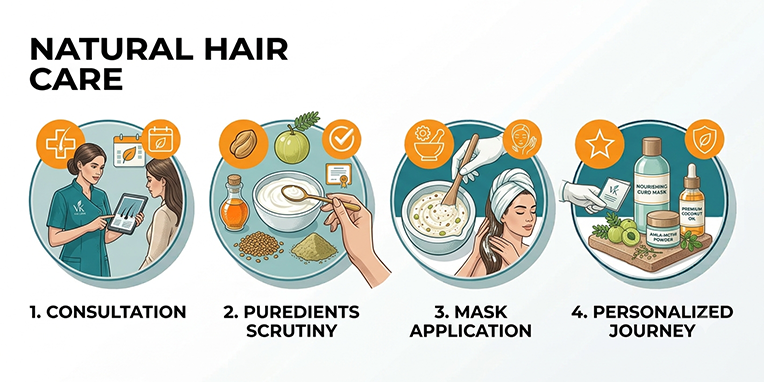
Best for: Suitability: Normal to Dry hair, Beginners, Chemically Treated Hair The easiest action — nothing to get agitated with, no need for irritation. Root to tip curd 25 minutes full-fat curd lukewarm rinse
Mix: 4–5 tbsp full-fat curd. Apply to clean, slightly damp hair. Cover with shower cap. 25 mins. Rinse with lukewarm water, mild shampoo.
Best for: Oily scalp, dandruff, scalp congestion. Citric acid in lemon enhances lactic acid of curd, resulting into more antifungal activity along with exfoliation. With further reduction in pH, you can inactivate Malassezia.
Mix: 4 tbsp curd + 1 tsp fresh lemon juice. Scalp-only application. 20 mins max. Avoid on coloured hair or broken scalp skin.
Best for: Hair loss, brittle hair, scalp irritation. Diosgenin (mild anti-androgenic), lecithin (strengthens shaft), iron etc.[2] Methi has a high content of phosphorus. Combined with the proteins and lactic acid of curd, this makes it the most complete mask for scalp health.
Mix: 2 tbsp soaked + ground methi paste + 4 tbsp curd. Apply to scalp and hair. 30 mins. Use 2x weekly for 8 weeks for best results.
Best for: You are due to premature greying risk, oxidative stress and dull hair. Vitamin C in amla counters free radicals that harm follicle melanocytes. Combines the protein from curd for a nutrient-rich, antioxidant treatment.
Mix: 4 tbsp curd + 1 tbsp amla powder. Mix well to a smooth paste. Apply root to tip. 25–30 mins. Rinse thoroughly — amla can stain light fabrics.
Best for: No matter whether the hair is dry, rough and porous because of damage due to chemicals or heat. When it comes to egg yolk, this is the type of fat that has a lot of lecithin which will be deeply emollient. Along with casein and lactic acid present in curd, this is one of the most fantastic DIY deep conditioner you can find.
Mix: 3 tbsp curd + 1 egg yolk + 1 tsp coconut oil. Apply mid-length to tips. 30 mins. Rinse with cool water first (egg proteins set with heat).
Best for: Hair textures that may benefit from advance: Frizz-prone strands, summer-damaged dryness or brittle ends. Coconut oil penetrates the hair cortex (only one of few oils to do so) prevents, and reduces protein loss. The same is reinforced by Curd's proteins and acid, that treated your surface conditioning and cuticle smoothing.
Mix: 4 tbsp curd + 1 tbsp warm coconut oil. Emulsify well. Apply to mid-lengths and tips. 30 mins. Good for a Saturday night mask before Sunday wash.
Best for: Ineffective hair fall, scalp circulation, poor early advanced receding علامت The sulphur compounds in onion juice support the synthesis of keratin and limit inflammation on the scalp. It smells — so you put a drop of rosemary or peppermint oil in. Apply scalp only.
Mix: 3 tbsp curd + 2 tbsp onion juice (fresh extracted). Scalp only. 20 mins. Double-shampoo to remove odour. Use 2x/week for 12 weeks.
Best for: Dry, dry, frizzy hair desperate for a burst of moisture. Honey is a natural humectant, and banana provides potassium along with natural butters that are great for the skin. This is the king of the DIY masks — ideal for a monthly intensive.
Mix: 3 tbsp curd + 1 tsp raw honey + half a ripe banana (mashed smooth). Blend well to avoid banana chunk residue. Apply full length. 30 mins. Rinse thoroughly.
Curd for Dandruff — Does It Really Work?
Dandruff. This is where curd gets its most vocal advocates, and honestly, they're not wrong — though the mechanism is often misunderstood.
Seborrhoeic dermatitis is the most prevalent type of dandruff — a condition caused by an influx of Malassezia yeast on the head. Malassezia is a normal scalp flora, but in predisposed individuals (i.e. those with oilier scalps, skin barrier dysfunction and/or personal or family history of seborrheic dermatitis) it undergoes pathologic overgrowth which induces inflammation that leads to the typical flaking, itching and erythema.
Curd addresses this through two mechanisms:
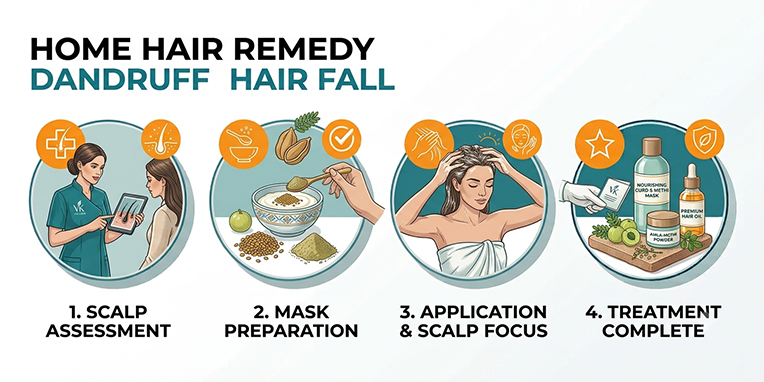
- Lactic acid lowers scalp surface pH from the neutral-alkaline range (which Malassezia prefers) to a mildly acidic range (pH ~4–4.5), which inhibits fungal growth directly.
- Lactobacillus bacteria compete with Malassezia for the same scalp surface resources, producing bacteriocins and lactic acid that create an inhospitable environment for the yeast.
In our practice, patients with mild dandruff who use a weekly curd mask consistently for 4–6 weeks report meaningful improvement. Some resolve entirely. This is real. But.
For moderate to severe seborrhoeic dermatitis — thick yellow scaling, significant redness or involvement outside the hair line of the scalp — medication is required. These topical agents are far more powerful antifungals than lactic acid at dietary concentrations, such as zinc pyrithione shampoos, ketoconazole (1–2%), selenium sulphide or ciclopirox olamine. Curd as an adjunct to these? Fine. You?Recommended for a stubborn case in place of them! Not effective enough.
We also see patient with scalp psoriasis who present as dandruff. Psoriatic plaques may ostensibly resemble seborrhoeic scales but are caused by a very different biological process (T-cell-mediated inflammation, not fungal), requiring entirely different management. Curd is only helpful for not inflamed scalp you cannot do it for psoriatic scalp it will worsen the balance there. "Dandruff that fails to respond to shampoos or home remedies within 3-4 weeks" is thus the indication for a dermoscopy-guided assessment prior to further trial and error.
Curd and Hair Fall — What the Connection Actually Is
Here's where we need to be careful about the claims.
This even applies to the best hair loss treatment as it is not a way of treating hair loss — curd. Doesn't stimulate follicles, doesn't inhibit DHT, doesn't boost dermal papilla activity. You may want to keep away from urad dal on your skin because if you have major hair fall — greater than 80–100 strands a day, dynamic thinning of the hair, busy scalp — then curd masks will not really make a sizeable difference in the underlying process.
However, there is a tenuous yet real connection that warrants acknowledgement. Hair loss due to dandruff is really common — and massively underreported. Chronic seborrhoeic dermatitis provides a low-grade inflammatory environment around hair follicles which shorten the anagen (growth) phase and result in premature shedding. If your hair fall is somewhat related to an inflamed, itchy scalp, controlling the dandruff — including with curd masks as well—for it can mitigate the shear loss of hair.
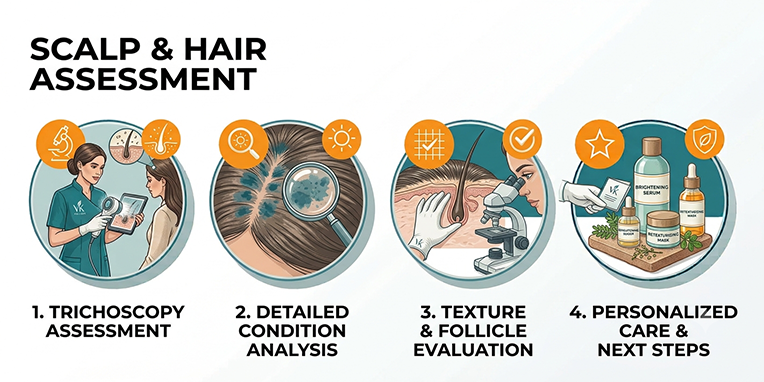
At the Kilpauk clinic, we commonly see this scenario — a patient comes in with hair fall, trichoscopy in hands shows significant perifolicular inflammation consistent with active seborrhoeic dermatitis, we treat the dermatitis with antifungal shampoos and sometimes topical corticosteroids (if severe), control of inflammation leads to marked reduction in hair fall. Curd on its own might not have got there — but it can enable the maintenance phase when medical management has controlled the disease.
For hair loss beyond what scalp care can address, our hair loss treatment programme covers the full spectrum — from advanced hair PRP treatment to GFC hair treatment, hair mesotherapy, and low-level laser therapy (LLLT) — all calibrated to the actual cause identified at assessment.
Curd for Hair in Chennai's Climate — Specific Considerations
Most hair care content is written for temperate climates. Chennai is different, and those differences matter for how you use curd effectively.
The humidity factor: For the most part of the season, relative humidity in Chennaivaries from 70–90% This promotes excess sebum production, increases the likelihood of Malassezia overgrowth and fungal scalp disorders become more chronic. Thus Curd's antifungal properties here gets continuously useful than in a drier climate — week-to-week scalp application year-round seems practical.
The monsoon issue: July–September brings intense humidity. Which can result in limp hair, greasy scalp and dandruff flare-ups. The curd and lemon mask as a weekly scalp treatment should be done most consistently this season. The cooling effect ameliorates the dish/swamp-induced heat rash and folliculitis other patients can have at the scalp-neck interface due to sweat being trapped underneath wet hair.
Hard water: Minerals in water are notorious for being high with the levels of water supply to Chennai. Hard water increases the surface pH of hair, causes the cuticle to be more rough, and leaves a film of minerals that dulls or weighs down hair. The saltiness of curd balances this — a light rinse or mask just before shampooing is an effective Chennai hair hack that few associate with the hardness of the water.
Sun damage: Excessive UV exposure bleaches and dehydrated hair protein. It speeds up into a porous, rocky cuticle state that the protein conditioning of curd can only maintain temporarily. A weekly curd conditioning mask is truly a useful dry skin remedy during Chennai's summer (March–June), not to ward off UV damage (it doesn't) but to restore the surface protein layer that UV exposure erodes.
How to Use Curd for Hair — Application Guide
Step-by-step for a standard curd mask
- Choose full-fat, freshly set curd. Not sour curd (lactic acid concentration too high, can irritate), not flavoured yogurt, not low-fat. Plain full-fat dahi, preferably homemade or purchased fresh. Cold from the fridge is fine — actually better for scalp cooling.
- Apply to slightly damp hair. Not dripping wet (dilutes the mask) and not bone dry (harder to distribute). Towel-dried post-wash hair or simply dampened with a spray bottle.
- Start at the scalp. Work the curd into the scalp with gentle fingertip circular massage — not nails. This stimulates blood flow and ensures the lactic acid contacts the scalp surface where it does most of its work.
- Pull through the lengths. After the scalp is covered, work the remaining curd from root to mid-length. If your ends are particularly dry, apply a bit extra there.
- Cover with a shower cap or warm towel. This creates a mild occlusive environment that helps the proteins and fats absorb more effectively.
- Wait 20–30 minutes. Set a timer. Not 10 minutes (too short for meaningful protein adsorption) and not 2 hours (the curd dries out, becomes sticky, and is harder to rinse).
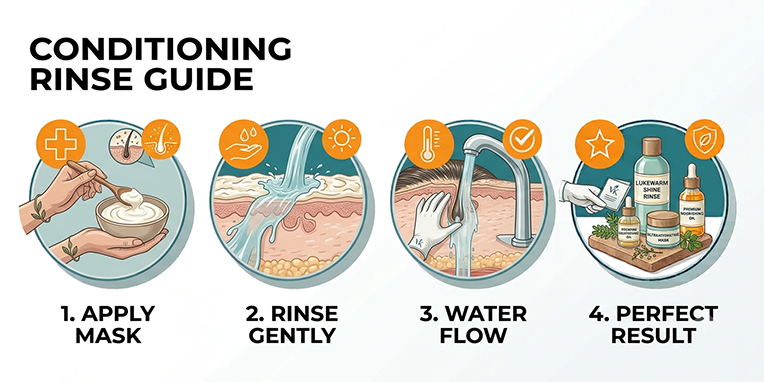
- Rinse with lukewarm water. Not hot — hot water lifts the cuticle scale, partly reversing the smoothing effect you just created. Start with cool-to-lukewarm, then shampoo once with a mild, sulphate-free shampoo. You generally don't need to shampoo twice.
- Air dry where possible. Heat styling immediately after a curd mask reduces its benefit — the protein coating begins to degrade with high heat.
Frequency guide
- Normal hair maintenance: once a week
- Dry, damaged, or chemically treated hair: once a week, twice if hair is very depleted
- Oily scalp or active dandruff: twice a week (scalp-focused application)
- Sensitive scalp or scalp conditions: once every 2 weeks, or consult first
What to Avoid When Using Curd on Hair
A few things that either reduce effectiveness or cause problems:
Using sour curd. This means that curd left to ferment beyond the optimal point has much higher lactic acid concentration. This can lead to irritation, burning, or worsened dryness on a scalp that is already sensitive. The perfect balance is fresh, slightly sour curd — not the type you left in your refrigerator for five days.
Applying to broken scalp skin. If you have wounds on your scalp, pustules of folliculitis or plaques of psoriasis do not use curd masks. The acidity of the pH irritates open/sore skin, and while you can find many bacteria beneficial on healthy scalp or skin, bringing these new things to compromised skin leaves it open to all kinds of complications.
Combining too many actives at once. Now you have these comprehensive one-mask recipes like curd + lemon + onion + methi + coconut oil, but they end up creating an inconsistent pH and are difficult to wash out completely. Choose one or two complementary additions as fitting for what ails your game. Simple combinations work better.
Expecting results in one session. Important thing to say, given that after one use patients often say "it didn't work". The scalp microbiome does not change after one application. One wash is not going to affect the follicle environment, at least for home remedies it should be used 4–8 weeks of consistent weekly use in order to evaluate whether or not it is actually contributing positively.
Using flavoured yogurt or probiotic yogurt drinks. In fact, the sugar, flavouring agents and additives in flavoured commercial yogurt alter the pH and can!again, what you hoped to be a probiotic answer!feed rather than inhibit Malassezia. Plain, unsweetened, full-fat dahi only.
Curd vs Clinical Hair Treatments — Knowing the Difference
This is the section most articles about home remedies don't include, and it's probably the most important one from a clinical standpoint.
Curd works at the surface and upper follicle: lactic acid on the scalp skin, proteins on the hair shaft, probiotics on the scalp microbiome. All of this is in the top 0.5–1mm of scalp tissue.
Clinical hair treatments operate at completely different depths and through completely different mechanisms:
- Hair PRP delivers concentrated growth factors (PDGF, VEGF, IGF-1) directly to the follicular bulge region at 4–6mm depth, stimulating stem cells that curd never comes close to reaching.
- GFC treatment does the same at 8–12× the growth factor concentration of standard PRP.
- Mesotherapy injects precise nutrient blends — B12, biotin, copper, zinc, minoxidil — directly into the scalp, bypassing the gut and skin absorption barrier entirely.
- LLLT uses specific wavelengths of light (650–670nm) to stimulate mitochondrial activity in follicle cells, improving cellular energy production and anagen phase duration — a mechanism with no dietary or topical equivalent.
- Anti-dandruff treatment at the clinic level involves medicated protocols, dermoscopy-guided diagnosis, and prescription antifungals where appropriate — significantly more targeted than any home remedy.
None of this means curd is useless. It means it belongs in the right tier of the hair care pyramid: daily and weekly home maintenance. Clinical treatment is the tier you move to when home maintenance is not sufficient for the problem you're dealing with.
When to Stop Using Home Remedies and See a Dermatologist
This is where we are direct, because many patients delay getting proper help by cycling through home remedies when a clinical issue is present.
Stop the home remedies and book a proper consultation if:
- You are losing more than 80–100 hairs daily for more than three weeks, and the pattern is not seasonal (post-illness, post-stress, post-partum seasonal shedding tends to self-resolve in 3–6 months)
- You have visible thinning at the crown or temples, or your parting has noticeably widened
- Dandruff does not respond to consistent curd or over-the-counter antifungal shampoos after four weeks of use
- Your scalp has patches of redness, inflammation, pain, or burning — these suggest seborrhoeic dermatitis, psoriasis, or folliculitis, none of which a curd mask treats adequately
- You have circular bald patches — this pattern suggests alopecia areata, an autoimmune condition that requires medical intervention
- Hair loss is rapid — weeks, not months — which suggests a systemic cause (thyroid, nutritional, medication side effect) that needs investigation
The majority of patients visiting either our ECR Uthandi or Kilpauk branches, who delayed a consultation by many months all say they wish they had been sooner. The biology of hair follicles is ephemeral — a follicle still in early miniaturisation responds very well to PRP or GFC, while one that has been left for 2 years showing no signs of life will have hardening of the tissues around skewing any attempt at diffusion. The perfect period to get an expert evaluation is every time you see the trouble, not when the internet has told you that your options are exhausted.
Final Thoughts
Curd is perhaps the most classic and best home remedy for hair, because it has become fashionable, but because the chemistry holds up. Lactic acid exfoliates the scalp. Proteins condition the shaft. Probiotics support the scalp microbiome. Fat adds shine and moisture. You're not placebo, these are real effects.
But the honest context matters. Curd serves as a restoring agent for good scalp health and working of hair. This is not which cures baldness, clinical dandruff, scalp psoriasis or even folliculitis. As a part of a general hair care routine — even more so in Chennai's climate, it earns its place with use on a weekly basis. As an alternative to clinical investigation when there is actual issue, it postpone the necessary remedy you require.
The practical takeaway: use curd, enjoy it, combine it with the ingredients that make sense for your specific concern — and visit VK Allure Dermaclinic if anything suggests the problem is beyond what good home care can address. We have branches in Kilpauk and ECR Uthandi. Book a consultation anytime — Monday to Sunday, 10 AM to 8 PM.
Hair concerns that go beyond home remedies?
If your hair fall, scalp condition, or dandruff hasn't responded to consistent home care, a dermatologist assessment can identify the actual cause and recommend a targeted solution. Available at both our Chennai branches.