Attracting more people through our doors than almost anything else, hair loss has become a small part of everyday life for the past few weeks now, most of them already coming in with the same three letters on their mind: GFC. They heard it online, a friend told them about it, and they want to know if it's the same thing or just PRP with a snazzier title. Fine question — and it requires an honest answer, not a sales pitch.
So here you have the roadmap for this article. What is Growth Factor Concentrate, does it really work for hair loss, how is it different from PRP in a meaningful way, and — the part that clinics like to avoid discussing: who won't benefit. The Problem: Baldness in men and women is not a single disease nor does one injector cure it all. VK Allure Dermaclinic offers GFC hair therapy at our Kilpauk and ECR Chennai branches, so we use it regularly — which is exactly why we'd rather set honest expectations than oversell it.
GFC hair therapy — the short answer
Growth Factor Concentrate (GFC) is a hair restoration treatment in which your own blood (which contains special proteins that assist in healing) is processed to activate and concentrate growth factors stored within platelets. Intra-scalp injections of growth factors work by enriching existing hair follicles and is clinically shown to reduce shedding and improve density in early-to-moderate pattern hair loss. It is most effective with remaining follicles, requires a simultaneous 4-6 sessions for optimal results and cannot restore hair from completely bald scarred scalp. Similar to PRP, but provides a higher, more uniform concentration of growth factors.
First, why are you losing hair?
This has to come first, because it's the question that decides whether GFC will help you at all. "Hair loss" is a symptom, not a diagnosis, and the cause changes everything.
The most common reason, in both men and women, is androgenetic alopecia — Androgenic alopecia or male pattern hair loss, caused by genetic and hormonal factors. This appears as a receding hairline and thinning of the crown in men; in women, as a widening parting and diffuse thinning over the top whilst often maintaining the frontal hairline. That is why GFC performance is maximised — the follicles are still alive albeit miniaturising.
But plenty of hair loss isn't that. Telogen effluvium is sudden diffuse shedding triggered by illness, childbirth, crash diets, thyroid problems, iron deficiency or major stress — and it often resolves once the trigger is fixed, no injections needed. Alopecia areata is autoimmune, patchy, and treated differently. Scarring alopecias destroy the follicle permanently, and no growth-factor treatment brings back a dead follicle.
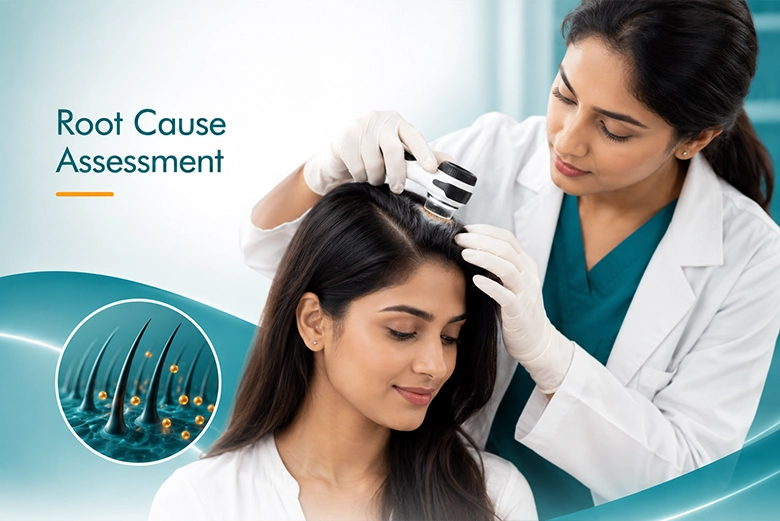
And this is why any decent clinic does its homework before injecting. We get a history, look at the scalp and commonly some bloodwork — ferritin, thyroid, vitamin D, occasionally hormones too because GFC plus iron-deficiency shedding is about as effective as treating a woman with an iron-concerning of their hair irrespective of the iron. If a clinic grabs GFC without ruling these causes out, they are skipping the crucial first step. A proper hair loss assessment is the foundation everything else sits on.
What is GFC hair therapy, exactly?
Growth Factor Concentrate is what's called an autologous treatment — it comes from your own body, so there's no foreign material and no rejection risk. Here's the sequence, in plain terms.
For this, your blood is taken, probably more whole than in PRP. Some super-signalling proteins — all the growth factors such as PDGF, VEGF, EGF, IGF and FGF are tucked within your platelets. Platelets are activated in the lab to release their growth factors, and the sample is then processed to obtain a concentrated, mostly cell-free liquid with these proteins. Then that concentrate is injected into the thinning areas of your scalp, near the follicles.
What Are Those Growth Factors Actually Doing Up There? Broadly speaking, they tell the follicle to remain in — or go back into — its active growth phase; support the little blood vessels that nourish each follicle; and encourage miniaturizing follicles towards thicker, fuller hair. This is not just generically applying fertiliser to bald skin; this is biologics signalling those hair follicles unaffected by the symptom of male or female pattern loss.
How is GFC different from PRP? The comparison that matters
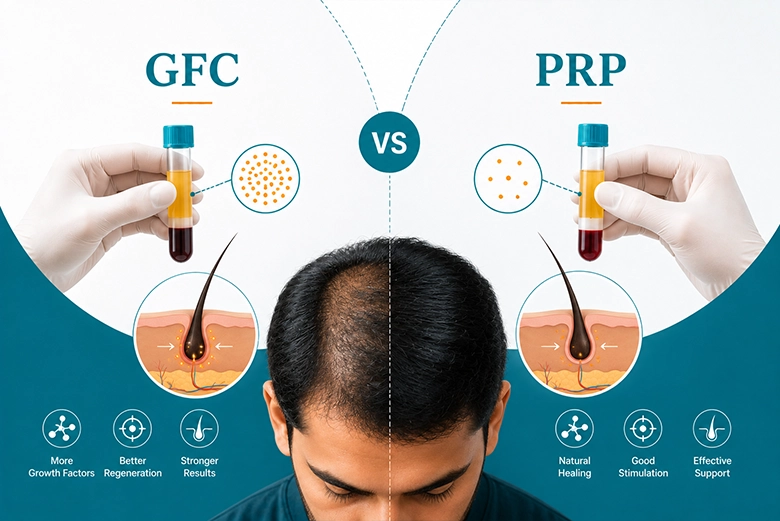
We get asked this question the most so here it is stripped of its tribalism. Since both GFC and PRP are autologous (your own platelets) therapies utilizing growth factors from your own platelets, and treat the same primary condition. They're cousins, not opposites. The differences are real but all too easily oversold.
What PRP is
PRP — platelet-rich plasma — is blood that has been spun in a centrifuge to separate platelets from other components in plasma. The plasma containing the growth factors is injected in the scalp, and those platelets release their growth factors right after they are injected. It is the most traditional treatment and has a longer history than any of its competitors, with ample published evidence for pattern hair loss.
What GFC does differently
GFC goes one step further: the platelets are activated prior to injection, whereby they release their growth factors; and the concentrate is processed into a largely cell-free form with an increased concentration of these growth factors at a much more standardised level. The pitch is that because you are using a standardised kit, your active ingredient will be more pure, more consistent, and bigger dose, execution between batches wonky when prepared by different hands.
| GFC (Growth Factor Concentrate) | PRP (Platelet-Rich Plasma) | |
|---|---|---|
| Source | Your own blood | Your own blood |
| What's injected | Concentrated, largely cell-free growth factors | Platelet-rich plasma (cells + plasma) |
| Growth factor release | Activated before injection | Released after injection, in scalp |
| Concentration | Higher, more standardised | Variable, depends on prep |
| Blood drawn | Usually a larger volume | Smaller volume |
| Evidence base | Newer; growing but less long-term data | Longer track record, more studies |
| Best for | Early-to-moderate pattern hair loss | Early-to-moderate pattern hair loss |
Here is the raw bottom line that most marketing will not tell you. In theory, this very standardised concentration in GFC is a real advantage and rational sense. PRP however has several more years and studies behind it. GFC is more contemporary, has even more upside potential and market momentum – the case is growing rather than resting. Both are valid, effective options for the right patient; in practice, the larger variable is not which of the two you choose but whether you're a good candidate and complete treatment. When a clinic claims one is better than all of the rest, that is an oversimplification to make a conversion.
Does GFC hair therapy actually work?
Patients want to know yes or no. The short, shameless answer is: for the right person absolutely — with realistic expectations. Now let me explain what "works" means here, terrible expectations are either the least or most of disappointment.
If you have early-to-moderate pattern hair loss (shrinkage of the follicle but still alive), a well-designed course of GFC can slow or stop shedding, strengthen existing hairs, improve density and thickness of terminal hairs, and in some casses regrow miniaturised areas. Most clients experience a decrease in hair fall before anything else — often the first indicator that it is doing something — then slowly thickening for months. Real, tangible improvement for candidates of the right fit.
It is not a hair transplant in a syringe. It will not regrow new hair follicles on bald scalp, it does not reverse advanced baldness when the follicle has gone and moreover results are far from permanent without maintenance. Instead of making hair from thin air, think making the most of what you have and getting more from lazy follicles.
And there is also a truth that should be told bluntly: GFC works best as part of a conjunction usually (for the last time, not in isolation). When combined with fixing the underlying reasons, sometimes even needing medications for that, good scalp care and treating (with relative ease) the nutrition or hormonal imbalances causing the loss it works far better than as an isolated therapy. Patients who do well use it as just one strategy among many, not a magic bullet.
GFC for men vs women — same treatment, different context
Both men and women get GFC, and the injection itself is the same. But the surrounding picture differs enough to matter.
For men
The male baldness pattern is an expected road map — it begins with a receding hairline and crown thinning. This is better as men do present earlier than they used to, and GFC works its best when follicles are still functioning. The sooner you get in on a receding-but-living hairline, the better your chances of volume. GFC is often used in conjunction with medical therapy to achieve a more robust and long-lasting outcome.
For women
Female pattern hair loss tends to be more diffuse, and most importantly, much more likely to have a treatable driver lurking out back: iron deficiency, thyroid dysfunction, PCOS, post-pregnancy sheddingor the stress of it all. This is exactly why a workup matters all the more in women. GFC is able to really help female pattern thinning only after the mechanisms of disease have been dealt with. Throwing in growth factors with a woman whose ferritin is sitting in the basement is a losing battle. First things first, get the bloodwork right, GFC has something to work with.
In both cases, the treatment respects the same principle: viable follicles, realistic expectations, and a plan that treats the cause, not just the symptom.
What a GFC session actually involves
People are often nervous about "injections into the scalp," so here's the reality, start to finish.
- Assessment first. On the first visit, we examine the scalp, confirm the type of hair loss, and check whether bloodwork is needed. No responsible clinic injects on day one without understanding the cause.
- Blood draw. A sample is taken, much like any routine blood test — a slightly larger volume than PRP.
- Processing. The sample is processed to activate the platelets and concentrate the growth factors. This takes a little time while you wait.
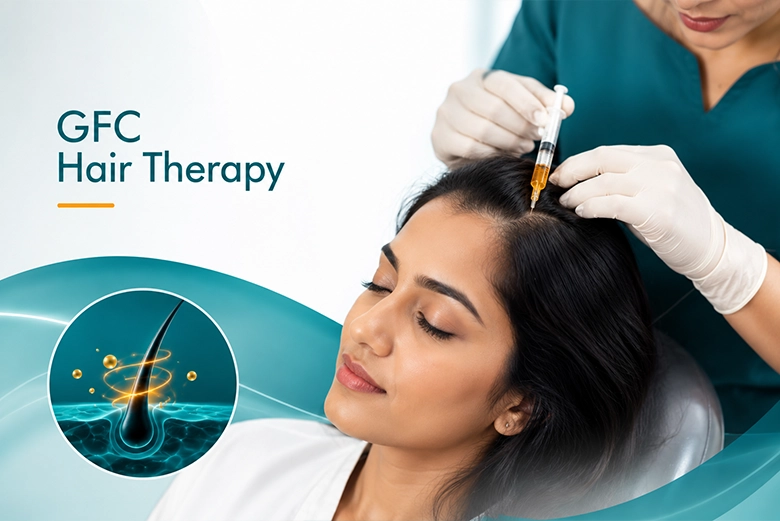
- Injection. The concentrate is injected into the thinning areas of the scalp with a very fine needle. It's quick, and while there's some discomfort, most people find it very manageable; numbing can be used for sensitive patients.
- Home you go. There's essentially no downtime. Mild tenderness or slight redness at the scalp for a day is normal. You can return to your day.
Sessions are spaced weeks apart across a course, then maintenance follows. It's an in-and-out treatment — no surgery, no bandages, no time off work.
Who is GFC not right for?
A treatment that suits everyone usually helps no one much. GFC is genuinely useful, but it isn't for every case, and an honest clinic tells you when it won't help.
- Advanced baldness. Where follicles are gone and scalp is shiny and smooth, there's nothing to stimulate. A hair transplant is the relevant conversation there, not GFC.
- Scarring alopecia. The follicle is destroyed; growth factors can't revive it.
- Untreated underlying disease. Uncontrolled thyroid, severe iron deficiency, active illness — fix these first, and sometimes the hair recovers on its own.
- Certain medical conditions. Some blood disorders, active scalp infections, or specific medications may make you unsuitable — which is exactly why the medical screening happens.
Pregnancy and breastfeeding usually mean we postpone elective treatments as a precaution. And if you have unrealistic expectations — hoping to regrow a full head from a bald crown — the kindest thing a clinic can do is tell you the truth before you spend money.
GFC alongside other hair treatments
GFC rarely works alone at its best. Depending on your case, it may sit alongside:
- Medical therapy — the mainstay for pattern hair loss, often combined with GFC for a stronger, more durable result.
- Hair mesotherapy — micro-injections of nutrients and vitamins to support the scalp environment.
- Low-level laser therapy — light-based stimulation used as an adjunct.
- Scalp and dandruff management — because an inflamed, flaky scalp undermines everything else. Hard water, common in Chennai, feeds this more than people realise.
- Nutrition and lifestyle — correcting iron, vitamin D, protein and the sleep-and-stress factors that quietly drive shedding.
This combination approach is why a proper clinic assesses the whole picture rather than selling a single injectable. The full range of hair treatments exists precisely because hair loss is multifactorial.
Three people, three different plans
Composites, but real patterns from our Chennai chairs.
The 28-year-old man with an early receding hairline
Detection is early — temples thinning, crown looks okay still Most GFC candidate — a good reason for the follicles to be viable. We used a short cycle of GFC with medical management and optimal scalp hygiene. Dropping was reduced in a couple of months and density continued to improve (Wang & Fong, 2005). This was why it worked so well — the key part had been acting early.
The 34-year-old woman shedding after her second pregnancy
Frightened it was permanent. The story was authenticated by bloodwork — low ferritin + postpartum telogen effluvium. All she required was iron, time and some reassuring, but not shots. We have withheld GFC and addressed the etiology as a priority. His hair had already bounced back months later, and she'd been saved from a useless round. And sometimes, the truthful answer is "not yet."
The 45-year-old man hoping GFC would regrow a bald crown
Hope to be sure, but his dome was polished and glistening — the follicles had abandoned ship long ago. GFC had little to do with it there. It was clear cut: this was not a GFC case, and if he wanted density back on that part of the scalp, a transplant was really the right way to go here. We lost a sale and won his trust by telling him.
Same three letters, three different answers. That's exactly why an assessment beats a menu.
Getting the most out of GFC — what you do between sessions
One thing clinics downplay is that most of what determines a positive outcome from GFC isnot just in the chair but what happens between the injections. It signals to your follicles, But you must ensure the rest of the environment is conducive for them too Patients tend to do worse when they view GFC as the complete answer, rather than one of the parts.
Fix the fuel
Follicles are greedy, rapidly dividing entities — and if nutrition is not optimal, they suffer first. Having low vitamin D or protein intake, or ferritin, is much less optional to correct; this is your foundation! The low-iron problem is even more plausible in women, where the majority of analagous treatments are undermined by it throughout pregnancy. The GFC on a severely nutrient-deficient head of hair is an uphill battle.
Look after the scalp itself
A scalp that is inflamed, flaky or has itch as symptoms is not a great ground to regrow hair. With Chennai's weather being significantly hard water and humid, scalp issues and dandruff are rampant, and a neglected scalp upends everything else. A shower filter, for example; but what will make you take off your shoes is sometimes just a small. dandruff and scalp health — does more groundwork than people expect.
Be gentle right after a session
Keep it simple for the first day or so after GFC – steer clear of harsh chemical treatments, heavy heat styling, rigorous scrubbing of the scalp etc. Mild tenderness fades almost immediately, and there's nothing you can do that's really dramatic on the scalp, but letting it settle is helpful.
Manage the things that drive shedding
Sleep, stress and crash dieting all show up on the scalp weeks later. You can't out-inject a lifestyle that keeps triggering shedding. GFC works best when the tap of ongoing loss is turned down at the same time.
Stay consistent
Quite simply, completion is the best predictor of a positive outcome. Inconsistency with long delays between scrums prevents forward momentum. Hair operates in slow motion: months of consistent signalling will convert to visible density.

Myths about GFC hair therapy
"GFC regrows hair on a bald head."
No. It strengthens and revives viable follicles. Where follicles are dead, there's nothing to stimulate. GFC preserves and improves; it doesn't manufacture hair from bald scalp.
"One or two sessions and I'm done."
It's a course, with results building over months and maintenance afterwards. A single session won't transform anything. Consistency is what delivers, which is why finishing the plan matters.
"GFC is completely different from PRP and always better."
They're closely related, both from your own platelets. GFC offers a higher, standardised concentration; PRP has more published evidence. "Always better" is marketing, not medicine.
"It's risky because it's injections."
Because it uses your own blood, GFC has a strong safety profile with no rejection risk. Side effects are usually limited to mild, short-lived tenderness or redness. It's minimally invasive with no downtime.
"If I stop, my hair falls out worse than before."
Stopping means you lose the ongoing benefit and the natural progression of pattern hair loss resumes — but it doesn't make things dramatically worse than they would have been. Maintenance holds the gains; stopping simply lets the underlying condition continue.
How we approach GFC at VK Allure, Chennai
Our approach is deliberately un-flashy. Initial consultations are evaluative — your history, scalp visualisation and blood testing if required is all about determining if GFC in fact, is the appropriate instrument given the class and cause of your loss. Sometimes it is. You may be better off trying a different (set of) drug(s), or treating an underlying cause first—that is, sometimes the honest answer to the question.
You explain the course, what a realistic timeline is, and the maintenance that is involved when GFC is right because managed expectations are the difference between a happy patient and a disappointed one. We tell it like it is: results are limited (because they vary from person to person), treatment isn't permanent and GFC needs a plan behind it, not just be a miracle in isolation. And since we run the same protocols at the Kilpauk and ECR Uthandi branches, wherever you are in Chennai, there's a branch that's easily accessible to home — and it matters (a course that is convenient for you to complete is a course that works).
Wondering if GFC is right for your hair loss?
Book a hair assessment at VK Allure Dermaclinic — Kilpauk or ECR Uthandi, Chennai. We'll examine your scalp, identify the cause, and tell you honestly whether GFC fits — or what does.
Book an Appointment Contact the Clinic📞 +91 96009 58060 · 💬 WhatsApp us
Final thoughts
Is GFC hair therapy genuine / useful: Yes, GFC hair therapy is a real step forward for the right person as it is an ointment of your own growth factors in equal amounts that can reduce shedding as well as make you stronger follicles and provide higher density from early-to-moderate pattern loss, both men and women! Very similar to PRP, it has a higher concentration and shorter evidence base but in practice doesn't really matter too much which of the two you choose just that they are good candidates for the treatment and done correctly. What GFC cannot provide, is to restart dead follicles or be an hair transplant replacement on bald scalp and works best under a protocol which treats the actual cause of the problem. You're unique so your issue in hair loss involves something that is distinct to you, and therefore the real step one is not a book an injection but actually discovering what causes your loss and matching that with treatment.
Frequently Asked Questions
What is GFC hair therapy?
Does GFC hair therapy really work for hair loss?
How is GFC different from PRP for hair regrowth?
Is GFC better than PRP?
Is GFC hair therapy safe?
Is GFC suitable for both men and women?
How many GFC sessions will I need?
How soon will I see results from GFC?
Does GFC regrow hair on a completely bald scalp?
Is GFC painful?
How much blood is taken for GFC?
Are GFC results permanent?
Do I need blood tests before GFC?
Can GFC be combined with other hair treatments?
Who should not have GFC hair therapy?
Is GFC good for female hair thinning?
What growth factors are in GFC?
Is there any downtime after GFC?
Does GFC work for telogen effluvium or stress-related shedding?
How early should I start GFC for hair loss?
Where can I get GFC hair therapy in Chennai?
Medically Reviewed & Written By

Dr. Lokeshwari
Dermatology Specialist · VK Allure Dermaclinic, Chennai
- ✓ Certified Dermatology Specialist
- ✓ 7+ Years of Clinical Experience
- ✓ 5,000+ Patients Treated
- ✓ Aesthetic & Medical Dermatology
Dr. Lokeshwari is a Dermatology Specialist at VK Allure Dermaclinic, as the Director of Newport Derm Sdn Bhd, with a wealth of experience in sophisticated skincare, hair restoration, laser procedures and aesthetic dermatology. She works out of Mumbai and Chennai both Kilpauk and ECR (Uthandi) branches and specializes in a customized evidence-based approach to skin with respect to Indian morphology, physiology, nutrition and weather (hot & humid conditions). She writes about what works — dismantling the myths of skin care from the clinical realities.
This guide to GFC hair therapy has been reviewed by Dr. Lokeshwari to ensure every claim about growth factor concentrate treatment, the GFC-versus-PRP comparison and candidate suitability reflects current dermatology practice.
Book a Hair Consultation with Dr. Lokeshwari →📞 +91 96009-58060 · 💬 WhatsApp · 🏥 Kilpauk & ECR Uthandi, Chennai