Laser hair removal was once a specialty service youwere seeking out at dermatology office. These days, it is available at salons and spas, "beauty labs", franchise chains and clinics all over Chennai — from Anna Nagar to OMR — with the price difference being as much as three or four times for what seems like a similar service. It isn't the same service. Whether you get silky, low-maintenance skin or a new patch of hyperpigmentation to spend the next few months treating can often come down to the choice of laser, settings and the quality of grip from the person holding the handpiece. This guide, from the team at VK Allure Dermaclinic, is about choosing well.
We will leave the marketing to the side and speak as if we were in a consultation room. Which laser is suitable for Indian skin What a good clinic does before it even FIRES A SHOT. Honest cost in chennai for what this And the questions that discreetly distinguish a genuine laser hair removal clinic from somewhere that bought a machine and an Instagram page. If you only read one section, read the checklist near the end — it is what patients tell us they wish they would have had.
Choosing laser hair removal clinics in Chennai — the short version
Pick a clinic that uses an Nd:YAG or diode laser (safest for Indian skin tones), runs a patch test before your first full session, is supervised by a qualified dermatologist, and is honest that laser gives long-term hair reduction, not permanent removal. Be wary of very cheap "unlimited" packages, IPL sold as "laser", and clinics that skip skin assessment.
First, the honest truth: it's reduction, not removal
Let's clear this up before anything else, because half the disappointment in this field starts here. The industry says "laser hair removal." The accurate term is laser hair reduction. A course done correctly permanently clears out a percentage of the hairs and reduces the thickness of those that are left, therefore ensuring that just periodic maintenance is needed in the majority of areas. The science does not support "zero hair for life after six sessions," and any clinic that promises it is either incompetent or in the business of selling you something.
Why? Hair grows in cycles — anagen (active), catagen (transiton) and telogen (rest). Laser treats only those follicles that are in the active stages of hair growth (anagen) at the time of treatment. The simple answer is that only a small percentage of your hair is in that state at any one given time, which is why you will require several sessions space several weeks apart and also explains why hormonal areas such as the face and chin are often left with permanent makeup after a full course but still need ongoing top-ups. This is what we try to make clear on every consultation for laser hair reduction — set the expectation right, and patients are far happier with real, excellent results.
The single most important factor: is the laser right for your skin?
This is where most bad outcomes come from. Not the brand of machine — the type of laser and whether it suits your skin tone.
More melanin in the skin means Indian skin belongs to Fitzpatrick IV-VI types. Laser hair reduction is a fine beam of light that turn to heat which target the melanin in hair follicle. THE PUZZLE: lasers cannot distinguish between the melanin in your hair and the melanin in your skin, so it heats both, which ends up causing burns or postinflammatory hyperpigmentation (PIH) — stubborn dark patches. Therefore the optimal wavelength for darker skin is that which can penetrate to the follicle without over-heating the surface.
The three lasers you'll hear about
| Laser type | Wavelength | Best for | Indian skin notes |
|---|---|---|---|
| Nd:YAG | 1064 nm | Darker skin (Fitz IV–VI) | Safest for Indian skin — long wavelength bypasses surface melanin, lowest PIH risk |
| Diode | 810 nm | Medium to dark skin, large areas | Good workhorse for legs, arms, back; with cooling it suits most Indian skin |
| Alexandrite | 755 nm | Lighter skin (Fitz I–III) | Effective but higher burn/PIH risk on darker skin — used cautiously, if at all |
In our practice we lean on Nd:YAG for deeper skin tones and diode for larger body areas, Each individual had their energy and pulse duration fine-tuned instead of one setting for everyone. A decent clinic will make adjustments to suit you. A good one runs an oracle and makes a wish. That sort of difference isn't reflected in the brochure, but it is definitely much more apparent on your skin.
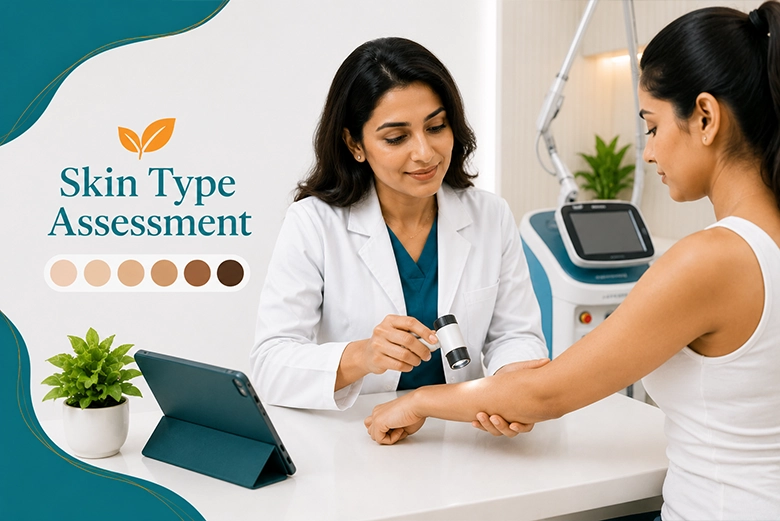
What a good laser hair removal clinic does before the first shot
Here's a quiet test. Watch what happens before the laser touches you. A proper clinic runs a sequence; a rushed one skips straight to the handpiece.
1. A real skin and hair assessment
The plan is also altered depending on your Fitzpatrick type, hair colour and thickness, if there is pigmentation history, hormonal conditions (like (PCOS), or current medications. Lasering is not for someone on isotretinoin (for acne) and many photosensitising drugs should be avoided until they are off them. A clinic that does not ask is a clinic that does not know — or care.
2. A patch test
Patch test on a small area, treated at the desired levels, observed in 24 to 48 h for a reaction. For dark skin types, this is not the place for compromising as first-time formalities. We insist on it. The cost to a clinic is measured in a few minutes, it prevents the worst outcomes. If a place brushes it off, that communicates something.
3. Honest expectation-setting
How many sessions (usually 6–8 spaced 4–6 weeks apart for the body, sometimes more for the face), realistic reduction levels, if maintenance is required and what it will actually cost in total. This is not a high-pressure "buy the platinum package today" sales pitch — this is your plan.
4. Medical supervision
Laser is a medical device. The individual operating it must be trained, and a certified dermatologist should guide the protocol. Laser plans at VK Allure happen under dermatologist supervision at our Kilpauk and ECR Uthandi branches — when something unusual goes bump in someone's skin, you want the doctor to be in house, not just the receptionist.
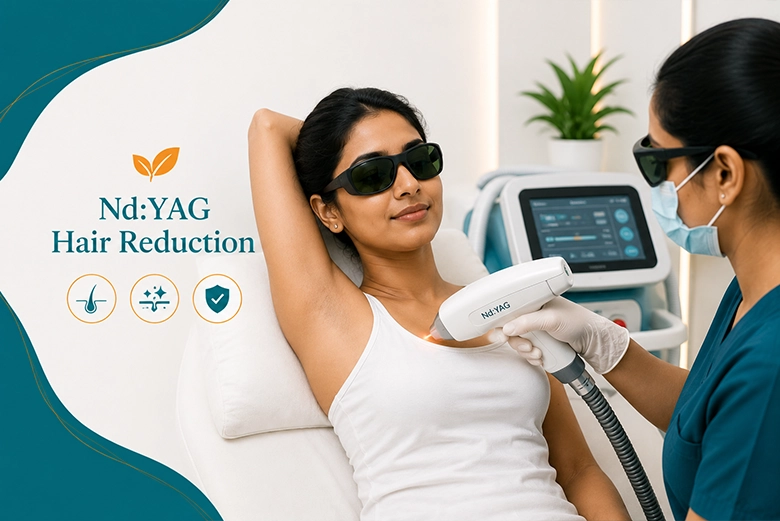
How laser hair reduction actually works (in plain language)
Something worth knowing, as it accounts for almost all the rules here. This approach is based on a theory called selective photothermolysis — or more simply, heating with light while trying not to cook everything else on the plate. The targets here are melanin, specifically the pigment localized in both the hair shaft and internal follicle.
That pigment absorbs the light energy from the laser firing, and that gets translated into heat. A lot of heat, to the growth point in the follicle — the bulge and dermal papilla where the follicle's stem cells sit — and you'll badly damage enough so that it stops making healthy hair or produces a finer weake one. That's the whole game. The rest is all about transferring that heat to the follicle while keeping it out of the neighboring skin.
And this is precisely why the skin tone is so important to us. In fair skin, the dark hair against pale skin creates a great contrast, and so can be "targeted" by laser. With darker Indian skin, more melanin is present in the surface itself, resulting in a bad chromophore for a given wavelength that results in heating both skin and hair. Nd :YAG is the go-to for Fitzpatrick IV–VI since its longer 1064 nm wavelength penetrates deeper and is less absorbed by surface melanin; in structural terms, this is why it was so. Cooling systems — contact plates, cold air, cryogen spray, for example — provide an extra level of protection by cooling the skin surface while the follicle is heated. A clinic that gets this will not only own the machine — they know why each dial is where it is.
It also makes clear the number of sessions. Since only anagen-phase follicles are susceptible, and about 20 to 25 percent of your hair is in that phase at any given time, one session simply can't get every single target. By spacing the sessions four to six weeks apart, you allow the next group of follicles to cycle into this fragile stage. In this logic, skipping it results in either over-treatment (adverse to the skin) or under-treatment (the waste of funds). It's not the clinic's calendar that sets the schedule, it's the science.
Three people, three different laser plans
The same "laser hair removal" request means very different things depending on who's asking. A few we see often at our Kilpauk and ECR branches.
The 24-year-old fed up with monthly waxing
Type of hair- Dark, coarse leg and arm hair, Medium Brown Skin, without medical problems This is the so-called creating an archetype great candidate. Diode laser for the bigger areas, Nd:YAG where indicated, an average six to eight session course and she should get away with good long term reduction and only having occasional touch-ups. The top job is keeping it real about how long the effect lasts, and helping to keep the Chennai sun off her skin between appointments.
The 32-year-old with PCOS and stubborn chin hair
Here the conversation is different. Laser assists — often quite significantly — but due to her hormones awakening new follicles, we are open about the fact that facial hair typically requires ongoing upkeep versus a one-off treatment. We also encourage her to handle the PCOS itself as well as taking treatment. It would be easiest to sell this patient on some grand promises, but the quickest way to lose her trust.
The 40-year-old who got burned at a discount salon
Came for hair reduction elsewhere, wrong laser for her skin and came out with dark patches on upper lip. To begin, we address the pigmentation — perhaps with some topical work, potential laser toning — before even broaching the idea of recommencing hair reduction, now on the correct device and one with a patch test. And she, along with the thousands of people in similar circumstances, is why this article exists at all. The technology did not let her down — the clinic did.
Notice the thread. The device, the schedule, the honesty and the aftercare all shift per person. A clinic running one protocol for everyone is a clinic that will suit some patients and quietly harm others.
How much does laser hair removal cost in Chennai?
Simple answer: it ranges widely, and low-cost works out pricey. Skin laser quote in Chennai is based upon area, number of sessions and the type of laser being used & whether one involves a dermatologist. The smallest of all areas such as upper lip or chin are at the very low end; full legs, full arms & entire body tend to be much higher owing to surface area as well as session time.
What you should look at isn't the per-session sticker price alone — it's the cost per completed course, and what's included. Some traps to watch:
- "Unlimited sessions" packages that sound generous but often mean low-energy, under-treatment so you keep coming back. More sessions isn't better if each one is too weak to work.
- Bargain single-session rates that balloon once you're committed, or use IPL priced as laser.
- No mention of maintenance — a realistic quote accounts for occasional top-ups, especially for hormonal facial hair.
The self-explanatory candid framing to patients: 6–8 sessions per area is a full course budget, expect great long-term reduction and not miracle one session result, no doubt be suspicious of any price "too good to be true". Low-cost clinics that weaken treatments ultimately cause greater costs via repeats and restoration, at times — if they get it wrong — with pigmentation. Get a quick quote for a custom consultation is far more accurate than any online price list.
Safety, side effects and who should wait
Done right, laser hair reduction is well-tolerated by most people. But it's a medical procedure, and pretending it's risk-free is dishonest.
Normal, temporary effects
Mild erythema and slight swelling around the follicles (perifollicular edema) for a few hours to 1 day is expected — it in fact means that the follicles absorbed the laser energy. It is okay to have a bit of sensitivity on treatment day, it would be like a mild sunburn type feeling.
Rare but real risks
If settings are incorrect, or the wrong laser is adopted based on your skin a patient could experience burns, blistering or post-inflammatory hyperpigmentation — aka the very brown patches people visit laser to rid themselves of. Paradoxical hypertrichosis (increased hair) has been described on extremely rare occasions, commonly occurring on the face. These reasons do not suggest to stop on laser, instead they highlight a need to pick an experienced clinic performing the procedure. When pigmentation does occur, it tends to be possible to work with (typically a few months on) but in more tricky cases steroid creams like laser toning for pigmentation.
Who should postpone or avoid it
It is contraindicated (or should be postponed) for: pregnant and breastfeeding women (simply wait — there is no rush worthy of taking), patients with any active skin infection or open lesions localised in area, patients on isotretinoin or photosensitising medication, moon tanning a sunburnt land surface or fresh tanned skin (this all raises the risk of burning sharply), and some photosensitive diseases. Anyone with PCOS or other hormonal drivers is definitely a candidate but must be aware that facial hair may require ongoing upkeep since the latent hormone signal continues to stimulate follicles. In fact, full disclosure clinics indicate this from the start; hormones influence to the facial hair response according to both IADVL and AAD.
The 10-point checklist for choosing a laser hair removal clinic in Chennai
Print this, screenshot it, whatever helps. Run any clinic — including ours — against it.
- Does it use Nd:YAG or diode lasers suited to Indian skin (not just IPL sold as "laser")?
- Is there a qualified dermatologist supervising the treatment protocol?
- Do they insist on a patch test before your first full session?
- Do they assess your skin type, hair, medications and hormonal history first?
- Are they honest that it's long-term reduction, not permanent removal?
- Do they give a realistic session count (usually 6–8) rather than a one-session promise?
- Is the pricing transparent, per course, with maintenance mentioned?
- Is the equipment properly maintained and the operator trained?
- Do they discuss side effects and aftercare openly, not just benefits?
- Do they avoid pressure tactics and "buy today only" package deals?
A clinic that clears eight or more of these is worth your trust. One that stumbles on the medical ones — supervision, patch test, skin assessment — isn't worth the discount, whatever the price.
Common myths about laser hair removal
Myth: "Laser removes hair permanently after one course."
Long-term it reduces hair and thins regrowth, but "permanent" can be misleading — hormones and hair shape recovery imply some maintenance is to be expected; notably on the face. A successful result is a silky skin with the least occasional updates.
Myth: "Laser darkens or damages Indian skin."
The right laser, correctly used, is safe for Indian skin. Damage comes from the wrong device or settings, not from laser as a category. Nd:YAG in particular was developed with darker skin tones in mind.
Myth: "You can laser a fresh tan."
No. Treating tanned or sunburnt skin sharply raises the risk of burns and pigmentation. Good clinics postpone until the tan settles — which, in sunny Chennai, is a real scheduling consideration.
Myth: "Salon laser is the same as clinic laser, just cheaper."
Not reliably. The only difference comes from medical assessment, device quality and operator training & monitoring. Occasionally salons do good work, but at some point you realise the savings are coming directly out of exactly the protections you'd want. The checklist above is more important than what the venue is called.
Aftercare: what to do (and skip) between sessions
Results aren't only about the session — the days around it matter too.
- Avoid sun and skip tanning before and after. Sunscreen on exposed treated areas is essential in Chennai's climate.
- Don't wax, thread or pluck between sessions — laser needs the follicle intact. Shaving is fine, and usually recommended, before a session.
- Skip hot showers, saunas, heavy workouts and swimming pools for a day or two after, while the skin calms.
- Moisturise gently and hold off on active exfoliants (retinoids, strong AHAs) on the treated area for a few days.
- Expect some shedding over the following week or two — that's treated hair falling out, not new growth.
Simple rules, but the sun one especially trips people up here. We'd rather reschedule a session than laser skin that's just been baked on a beach trip down ECR.
How VK Allure approaches laser hair reduction in Chennai
Our approach is deliberately un-flashy. Assess first, patch-test always, calibrate to the individual, and be honest about outcomes. We run laser hair reduction under dermatologist supervision at both branches — Kilpauk in central Chennai and ECR Uthandi in the south — so wherever you are in the city, there's a location within reach.
We can also take care of any additional needs that arise since we are not only a laser shop but a full service dermatology and aesthetics clinic. We can always fix pigmentation from other clinics. a of hair reduction along with glow work (if they want) HydraFacial or tackle related concerns such as dark spots and melasma, it's all under one roof. We also run other laser-based services — tattoo removal and scar and stretch mark reduction — so the same medical rigour applies across the board. You can see the full range of treatments if you want the bigger picture.
No hype, no permanence promises, no pressure packages. Just calibrated treatment and straight talk. That's the whole pitch.
Thinking about laser hair reduction? Start with a proper assessment.
Book a no-obligation consultation at VK Allure Dermaclinic — Kilpauk or ECR Uthandi, Chennai. We'll check your skin type, run a patch test, and give you an honest plan and price.
Book an Appointment Contact the Clinic📞 +91 96009 58060 · 💬 WhatsApp us
Final thoughts
The differences amongst laser hair removal clinics in Chennai largely boil down to a few things left behind by the advertising: the ideal laser for your skin tone, an clinic that evaluates and patch-tests before treating, proper versus questionable certification of personnel to supervise treatments, transparency in pricing vs flyers touting exclusionary rates; perhaps even the spatial maturity to admit it is long-term reduction as opposed to permanence fantasy. Your skin, your hair kind and your hormones are yours alone so irrespective of how nicely the plan works for your buddy in all likelihood it can not be suitable for you. The cheat-sheet: checklist, ask the awkward questions, do not allow a discount to talk you out of the safeguards. When done right, good laser work is life-changing for the person who needs it.
Frequently Asked Questions
How do I choose the best laser hair removal clinic in Chennai?
Is laser hair removal permanent?
Which laser is best for Indian skin?
Is laser hair removal safe for dark skin?
How many laser sessions do I need?
How much does laser hair removal cost in Chennai?
Does laser hair removal hurt?
What's the difference between IPL and laser?
Why is a patch test important before laser hair removal?
Can I get laser hair removal during pregnancy?
What are the side effects of laser hair removal?
Can laser hair removal cause dark patches?
Is laser hair removal good for PCOS-related facial hair?
Should I shave or wax before a laser session?
Can I do laser hair removal in summer in Chennai?
How long do laser hair removal results last?
Is salon laser as good as clinic laser?
What should I avoid after a laser session?
Does laser hair removal work on light or grey hair?
Where can I get dermatologist-supervised laser hair reduction in Chennai?
Can men get laser hair removal too?
Is laser hair removal covered by insurance?
How do I know if a clinic's laser is well maintained?
Medically Reviewed & Written By

Dr. Lokeshwari
Dermatology Specialist · VK Allure Dermaclinic, Chennai
- ✓ Certified Dermatology Specialist
- ✓ 7+ Years of Clinical Experience
- ✓ 5,000+ Patients Treated
- ✓ Aesthetic & Medical Dermatology
Dr. Lokeshwari is a Dermatology Specialist at VK Allure Dermaclinic, specialized in advanced dermatology, hair restoration, laser treatments and aesthetic dermatology. Currently she works at the Kilpauk and ECR (Uthandi) branches in Chennai and adopts an evidence-based approach specific to Indian skin types and climate of the city. She writes about that matters — skincare myths versus clinical realities.
All laser parameters, safety notes and treatment expectations in this article have been reviewed by Dr. Lokeshwari to match international dermatology standards adapted for Indian skin.
Book a Consultation with Dr. Lokeshwari →📞 +91 96009-58060 · 💬 WhatsApp · 🏥 Kilpauk & ECR Uthandi, Chennai