Melasma comes with the most frustration that walks through our doors in Chennai of all the pigmentation concerns. So they have typically used three creams, two home remedies and one "permanent solution" from an unknown source that so-called promised the world — only for them to find the patches returning or worse still, returning darker. I understand the exhaustion. So this isn't a hype piece. By the way you would hear it spoken across the desk, it's the truth of how melasma is really treated.
We will discuss what melasma is (and why it's different from regular old hyperpigmentation), why Chennai's climate determines its tough to budge nature, the complete range of professional treatment choices, what happens when dermatologists battle with a bit too much stubbornness in case of melasma and the daily care regimen while approaching it on your face. VK Allure Dermaclinic At both our Kilpauk and ECR branches, we, therefore, base your entire approach on one painfully honest truth: melasma is not cured—it is managed. When you come to terms with that, then the rest is easy — and better.
Melasma treatment — the short version
Melasma is a chronic pigmentation condition driven by sun, heat and hormones. Dermatologists treat it with a layered plan: strict sun protection, topical agents (like azelaic acid, kojic acid and prescription combinations), chemical peels, laser toning for resistant cases, and sometimes oral therapy e.g. tranexamic acid under supervision Melasma is different from a typical dark spot, in that it frequently returns after fading; therefore treatment approaches are generally lightening and long-term management as opposed to cure. The combination may be determined by an assessment from a dermatologist.
What is melasma, exactly?
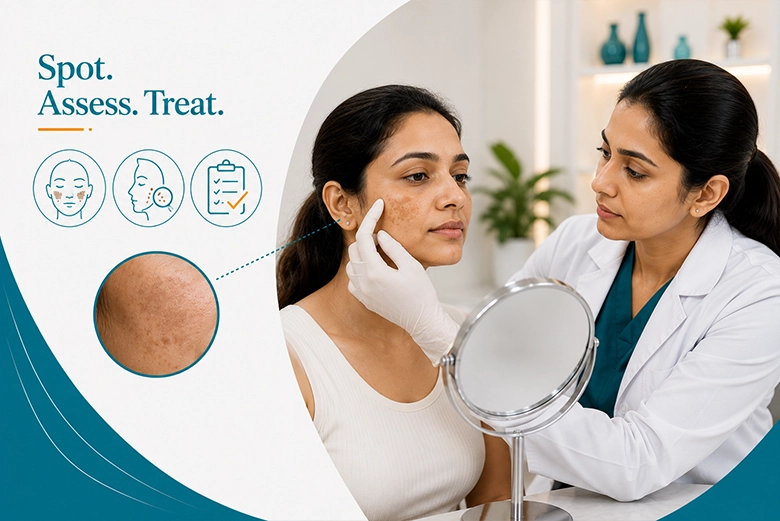
Melasma most common pigmentation disorder is defined by brown, grey-brown or tan patches of discolouration and appears mostly symmetrically on the cheeks, upper lip, forehead, bridge of the nose and occasionally also jaw. It occurs when the pigment-producing cells of skin, called melanocytes, are overactive and produce too much melanin. It's harmless to your health. It's a maddening thing to look at and it's almost impossible for the bagfiller to see it right away.
What makes it different from a suntan or a single dark spot is the why. What separates it from a suntan or isolated dark blemish is the why. Melasma is more than sun damage lying on the skin surface. This is a state in which the pigment machinery has become hyper-responsive, and consequently set off by UV, heat, hormones. And why it flares during the summer, gets worse in the winter and how it can come back after treatment if you don't control the triggers. This makes all the difference in how you were originally going to approach it.
Melasma is also much more prevalent in individuals with medium to darker skin tones — exactly the Fitzpatrick III–V range most patients from Chennai are grouped into — and by far more prominent in women especially during pregnancy or hormonal upheaval. None of that is your fault. It is biology plus environment and both can be treated, even if neither is "cured" in the neat way people want it to be.
Melasma vs hyperpigmentation — what's the difference?
This fools almost everyone, and if you get it wrong, you're treating them inappropriately. "Hyperpigmentation" is used as an umbrella term to refer to any darkening of the skin due to excess production of melanin. One of those types is melasma — but it works quite differently from the others, and that makes a clinical difference in what we do for patients.
| Melasma | Post-inflammatory hyperpigmentation (PIH) | Sun spots / freckles | |
|---|---|---|---|
| Cause | Hormones + sun + heat | After acne, injury or inflammation | Cumulative sun exposure |
| Pattern | Symmetrical patches, both cheeks | Wherever the injury was | Scattered individual spots |
| Recurrence | High — relapsing by nature | Fades over months, usually for good | Stable, slow to worsen |
| Treatment | Long-term management | Time + targeted lightening | Laser / topical, often lasting |
The practical take home message: PIH and sun spots usually resolve and remain resolved after treatment. Melasma is not so compliant — it needs to be continually managed. Thus, if a patient got treated for 'pigmentation' with a single approach and it keeps coming back, the real diagnosis was most likely melasma to begin with. Not sure which you have, well that's precisely and simply what a dermatologist evaluation identifies, worth it before investing on the wrong treatment. Our melasma and dark spot reduction service starts precisely there — with the correct diagnosis.
Why melasma is especially stubborn in Chennai
Location matters more than patients expect, and Chennai is close to a worst-case environment for melasma.
Relentless UV
Chennai provides near-vertical, severe sun most a year that is not occasionally fearfully from March to July one surface of UV lighting comes the single tohader of melasma. Even short doses — the walk to the car, the commute, the school run — keep the pigment-making machinery firing. And this is why treating without strict sun protection is akin to bailing a boat while ignoring the hole.
Heat, not just light
This part hardly anyone knows about: melasma reacts to heat (not just UV). Infrared and ambient heat can set it off as well, which is why just standing near a hot stove – or the raw thermal load of a Chennai summer day–can increase it independently of sunlight. That is a really hard trigger to escape from in this environment, and it's one of the things that helps make sense out of the seasonal flare-and-fade cycle patients talk about.
Visible-light exposure
Even visible light — screen light or daylight through windows, even background light coming in from behind us can indeed push melasma deeper into the skin in darker tones. And this is why we regularly recommend tinted sunscreens containing iron oxides for our melasma patients as these physically block visible light in a manner that regular broad spectrum sunscreen simply does not.
All of this does not mean that melasma is untreatable in Chennai – we treat it successfully all the time. It means you have to put serious thought into the sun-and-heat-side of your plan as the environment is working against it every single day. The American Academy of Dermatology maintains that sun protection is the unnegotiable backbone of any melasma regimen — and in a climate like ours, that advice rings twice as true.
How dermatologists treat melasma: the full menu of options
There is no best treatment; most clinical studies show that melasma responds best to a sequential combination based on how deep the pigment resides in the skin and how your skin heals. A quick and brutally honest rundown of what's actually used, sorted somewhat vaguely from gentlest to most intensive.
1. Sun protection — the foundation, not an afterthought
Every effective plan starts here. SPF 30–50 broad-spectrum sunscreen applied and/or reapplied during the day, preferably tinted with iron oxides (to absorb visible light). Less well-known is that physical shade — hats, cover generators, and tinted car windows — also matter. This is not an uneventful prelude to the 'actual' treatment. That is half the treatment, and missing that is why most melasma treatments fail.
2. Topical agents
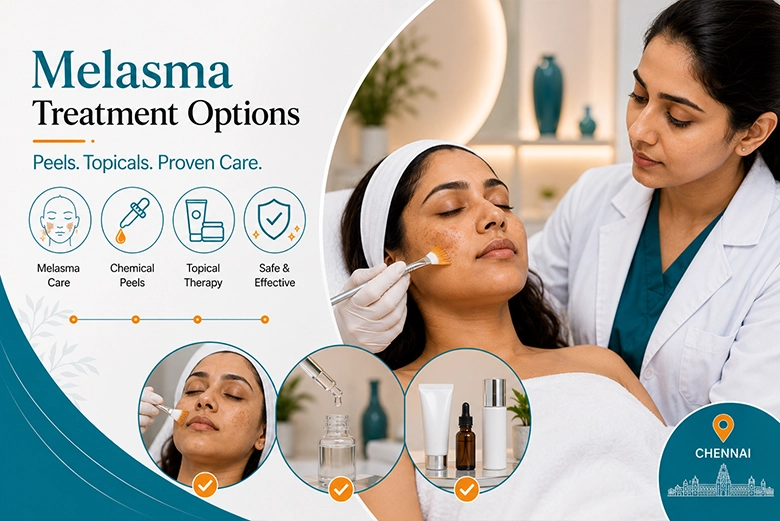
The workhorses of melasma care. Prescriptions that work to reduce melanin production, such as azelaic acid, kojic acid and vitamin C or niacinamide, can also be helpful depending on the skin. They're employed judiciously and under supervision — some powerful lighteners can lead to irritation or, ironically, rebound pigment change when used inappropriately (which is precisely why melasma topicals need to be prescribed rather than picked off a pharmacy shelf at random).
3. Chemical peels
Controlled chemical peels — Mild chemical peels, typically mandelic, lactic or custom pigment peels — gently increase turnover to lighten all the pigment over a course of treatments. When it comes to darker Indian skin, gentler acids are best as harsher acids can cause further pigmentation. Peels are a staple, albeit introduced in slow doses—not aggressively as melasma-prone skin takes no prisoners with overstimming.
4. Laser toning
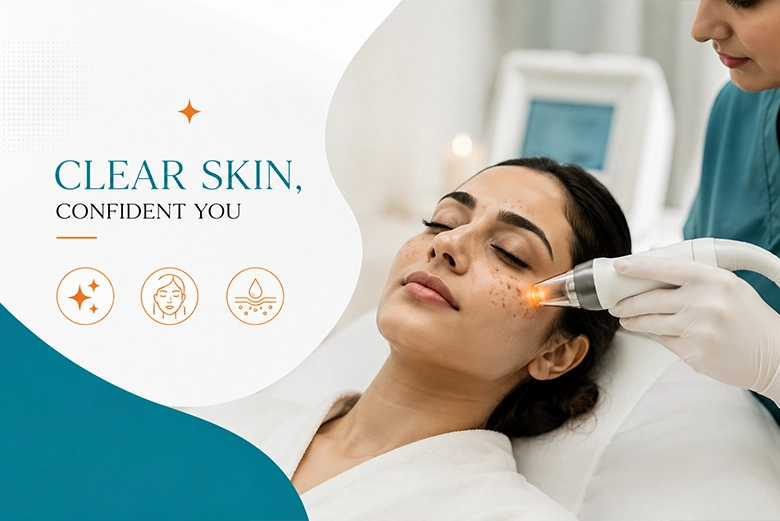
For pigment that resists topicals and peels, laser toning A Q-switched Nd:YAG laser is an important tool. It offers gentle low-power passes that gradually fragment surplus pigment over several treatments. Importantly, melasma laser treatments should be performed conservatively with experience — aggressive laser settings can drastically exacerbate your melasma, thus making this not a price-shopping service. If it works, it actually does in really persistent situations.
5. Oral therapy
For widespread or resistant melasma, dermatologists may add oral tranexamic acid, which reduces pigment activity from within, or glutathione in appropriate cases. These are medication decisions of their own, and they require screening and warnings — tranexamic acid is not a good fit or appropriate for everyone, and it is always something supervised by your physician. Which is basically why melasma is a medical concern and not purely cosmetic.
What is the best professional treatment for melasma?
You want me to actually answer this, and so let me: there is no best treatment, there better be no clinic that claims a schtick – as they are over-selling. The optimal is the specific mix for your kind of melasma — how deep it lies in, what skin type you have, what are your triggers and history with regenerative medicine.
That said, here's the honest framework dermatologists use. For most patients, the best-proven approach is a combination of rigorous sun protection and topical therapy, because that addresses both the cause and the pigment together and has the strongest evidence behind it. Where that isn't enough, gentle chemical peels are layered in to accelerate results. And for genuinely resistant melasma, laser toning and/or oral tranexamic acid are added under supervision. The "best" isn't a product — it's the sequence, matched to you and adjusted as your skin responds.
This isn´t the ideal pro approach, no matter what marketing suggests: heavy-handed one-off lasers, lacerating peels or unmentored high-strength lightening creams. These often backfire on melasma-prone Indian skin, leading to rebound pigmentation that is much more difficult to treat than the initial condition. When it comes to melasma, less often beats more—with the gold star for slow and steady over fast and furious. And that isn't us being cautious for the sake of it — it's the behaviour is a pattern we see adjusted in our chairs week in, week out.
How do dermatologists treat melasma that won't go away?
Resistant melasma — the kind that shrugs off creams and keeps returning — is one of the commonest reasons people finally come to a clinic. Here's what actually changes when a dermatologist takes over a stubborn case.
First: confirm it's actually melasma
At times "melasma that won't resolve"is never melasma-- but PIH, a drug side effect or an unrelated pigmentation disorder requiring a completely different treatment. Identify with examination (often by Wood's lamp to determine how deep the pigment lies, as this alters your management) - what is a classic first step?
Second: audit what's been sabotaging treatment
Melasma described as "resistant" is most often melasma that was under-treated. The three common culprits: A) inconsistent or no sun protection, B) discontinuation of treatment too early in courses that looked effective and C) use of irritating products which aggravated the skin into developing more pigment. Many of the, ahem, "stubborn" cases open right up when only these are fixed.
Third: escalate carefully and combine
With truly resistant melasma, dermatologists will layer treatments, including adding laser toning, introducing oral tranexamic acid, adjusting the topical regimen and tightening the sun-protection strategy with increased visible-light cover. The escalation is controlled and slow because that exact thing, too much force too rapidly, is just what makes resistant melasma worse. Here, patience is not a consolation prize to receive in return for trying hard; it is the actual strategy.
Fourth: reset expectations honestly
The uncomfortable part. Unlike zero history, resistant melasma is brought down to a controlled manageable version — only not gone from the memory. Achieving significant lightening and then maintaining it at that level long-term is realistic. Those Patients who get this do much better emotionally and practically than those chasing a full cure for something that just doesn't offer it! But better, though — much better and stable (long-term) is actually life-changing, in terms of appearance + feeling.
How to treat melasma on the face day to day
Alongside clinical treatment, what you do at home decides how well it holds. This is the practical, face-level routine that protects your results — none of it dramatic, all of it essential.
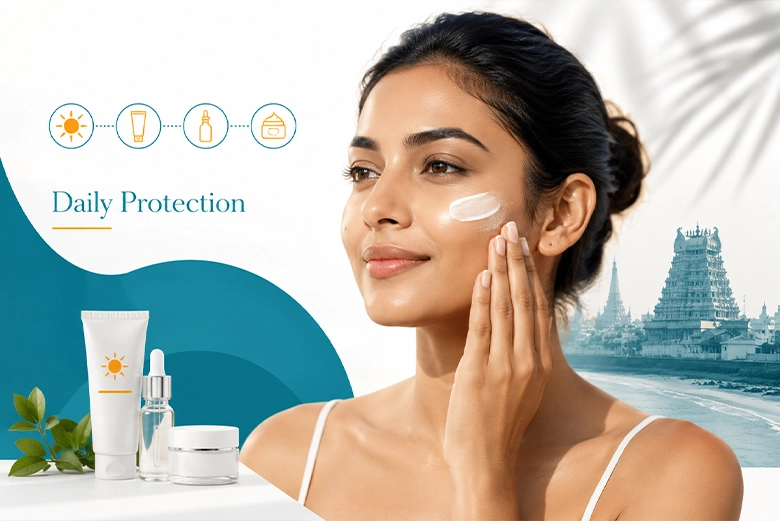
- Sunscreen, every single morning. Any broad-spectrum SPF 30–50, preferably tinted with iron oxides, reapplied every few hours outside. What you will do the most important thing of all Not an "on sunny days" optional, but a EVERY SINGLE DAY thing yes preferably indoors and out of doors.
- Keep the routine gentle. Melasma-prone skin hates irritation. Dare to avoid the harsh scrubs, aggressive actives and DIY acid experiments. All you need — a mild cleanser, your given treatment, a basic moisturiser, and sunscreen.
- Use only what your dermatologist prescribed. Layering random lightening creams from the pharmacy is how rebound pigmentation starts. More products is not more progress.
- Manage heat where you can. Since heat is a trigger, a little awareness helps — cooler showers, distance from direct cooking heat, shade during peak hours.
- Be patient and consistent. Melasma improves over months, not days. The people who see results are simply the ones who kept going when it felt slow.
- Don't stop the moment it improves. The biggest self-sabotage in melasma. It's fading because the treatment is working — stopping is how it comes back.
Realistic expectations: why "managed" is the honest word
I get back to this because it is the most crucial thing to glean inner wisdom on, and one of the things that patients are least often directly told. Melasma is a common, chronic and relapsing condition. It can be brightened a lot and managed and maintained — but it still tends to come back, particularly with sun, heat and hormonal changes. That is not a treatment failure. Such is the workings of the disease.
What good treatment actually gives you is, if it works at all, visible and meaningful lightening — often a significant improvement — along with the regimen and means of sustaining that improvement for the long haul. Patients coming in expecting "much better and stable" are always happier, and boringly do better results than those seeking a complete permanent wipe out that no treatment frankly provides. A clinic that "cures" or can "permanently remove" melasma is saying what you want to hear not the truth.
Three melasma stories from our chairs
Composites, but familiar patterns at both branches.
The 34-year-old with post-pregnancy melasma
During pregnancy born Cheeks and upper lip, every summer worse She had attempted a "permanent" solution previously in other ways and lost hope when it came back. A year on, with expectations reset and a plan that revolved around uncompromising sun avoidance, topical retinoids (low-dose 0.025% tazarotene) and gentle peels, she's holding firm at about 60-70% clearer. Not erased—managed, and she really loves how her skin looks now.
The 41-year-old with "resistant" melasma
Convinced nothing worked. The real story: no sun cream and a drawer full of irritating creams. We did a damaged routine with disciplined sun protection and one topical prescribed, then added layers of laser toning. That "resistant" melasma had not been resistant but rather under-treated and over-irritated. We fixed the basics, and progress followed.
The 29-year-old who actually had PIH, not melasma
Came in for "melasma," but it was post-inflammatory pigmentation from old acne — a different condition with a much more hopeful outlook. A targeted plan, including acne scar and mark treatment, cleared it far more completely than melasma ever would, because it wasn't melasma. The lesson: the diagnosis changes everything, which is why guessing at home wastes time.
Myths about melasma
"A strong enough cream will cure it."
No cream cures melasma, and the strongest ones can worsen it through irritation and rebound. Melasma responds to a careful combination and long-term management, not a single potent product.
"Laser is a quick fix for melasma."
However, one of the fastest way to worsen melasma is for you to do aggressive laser. Conservative, specialist laser toning is the only solution - and even that forms part of a comprehensive strategy. This is especially true in the case of melasma, where "more powerful laser" is often the exact opposite of what you should.
"If I stay out of the sun for a week, it'll clear."
Sun protection should be permanent and daily, never for just one week. The pigment has been laid down, and continued protection prevents new triggering from occurring while the lightening agent targets what's there. Both have to happen, continuously.
"Lemon and home remedies will lighten it naturally."
Raw citrus on the face plus sun is a known cause of pigmentation reactions. On melasma-prone skin in Chennai, home acids frequently darken rather than lighten. Skip them entirely.
"Once it's gone, it's gone."
Melasma is relapsing by nature. Even after excellent improvement, maintenance and sun protection keep it controlled. Treating it as "done" is the surest way to see it return.
Who needs caution, and when to see a dermatologist
Not every case of melasma is the same, and there are instances that will require more consideration when treating the condition. If you are pregnant or nursing, let your dermatologist know — multiple melasma therapies (notably topical ones and oral tranexamic acid) are avoided then, and the strategy is conservative. Since melasma can be provoked by hormonal rises, partly due to some contraceptives, it is something to talk about. And you must do a couple of laser or peel that is suited to your complexion in order not darker pigment.
Also seek out a dermatologist instead of self-treating if: the pigmentation came on quickly (as with that famous "mask of pregnancy" it can but often doesn't appear gradually over time) and/or is continuing to spread rapidly, any patch looks unusual or raised or changing in a way that's clearly not consistent with melasma's typical symmetrical appearance, or what you'd assumed was melasma isn't responding to sun protection at all. Correctly diagnosing it is the difference between months of progress and months spent spinning your wheels, and it really is — by far — the highest leverage step in the entire process.
How we treat melasma at VK Allure
We are taking our time and we are doing it honestly. From there, even in a case of melasma, we start with an assessment to confirm the diagnosis (yes — it is melasma), and assess depth, triggers, sun habits, hormonal factors and treatments thus far. At this point we can establish a multilayered regimen: with sun protection at the top, topical agents tailored to your skin next, then gentle peels as appropriate, and reserve laser toning or oral therapy for resistant cases under strict trail.
We're clear that melasma is something you control rather than cure, multiple treatments take months to build up an effect and that maintenance and everyday sun protection are included in the compromise not add-ons. We won't pretend you'll never be able to find it again — that's not an honest promise. What we do have is a practical, fact-based strategy that brightens melasma substantially while also maintaining it. You can read more about our melasma and dark spot reduction approach, explore related laser toning, glutathione and skin resurfacing options, or see the full range of skin treatments. We treat melasma at both the Kilpauk and ECR Uthandi branches in Chennai.
Struggling with melasma that won't fade?
Book a consultation at VK Allure Dermaclinic — Kilpauk or ECR Uthandi, Chennai. We'll confirm the diagnosis, explain your realistic options, and build a plan that actually holds.
Book an Appointment Contact the Clinic📞 +91 96009 58060 · 💬 WhatsApp us
Final thoughts
Melasma is notoriously difficult to treat, but it is not impossible! The ideal pro treatment is not a stand-alone product — it is an iterative tailored multi-faceted strategy based on meticulous sun protection, carefully chosen maxims of topicals, stricter peels and laser or balmy treatment when needed. This is different from the average hyper pigmentation, its sun and heat related ( especially prevalent in Chennai) and I prefer the word 'managed' rather than cured - which to me is honest not disheartening. When left untreated this slowly expands and ultimately fades meaningfully when treated patiently and thoroughly by a dermatologist who tells you the truth. Your skin is uniquely your own, and the absolute most important step that can be taken is getting the diagnosis and plan right from day one.
Frequently Asked Questions
What is the best professional treatment for melasma?
What are the treatment options for melasma?
How do dermatologists treat melasma that won't go away?
What is the difference between melasma and hyperpigmentation?
How do I treat melasma on my face?
Can melasma be cured permanently?
Why does my melasma keep coming back?
Is laser treatment safe for melasma?
Do chemical peels help with melasma?
Does sunscreen really matter for melasma?
What triggers melasma?
Is melasma caused by hormones?
How long does melasma treatment take to work?
Can I treat melasma with home remedies?
Is oral medication used for melasma?
Can melasma be treated during pregnancy?
Why is melasma worse in summer?
Will melasma go away on its own?
Can men get melasma?
Is melasma harmful to my health?
Where can I get melasma treatment in Chennai?
Medically Reviewed & Written By

Dr. Lokeshwari
Dermatology Specialist · VK Allure Dermaclinic, Chennai
- ✓ Certified Dermatology Specialist
- ✓ 7+ Years of Clinical Experience
- ✓ 5,000+ Patients Treated
- ✓ Aesthetic & Medical Dermatology
Dr. Lokeshwari is a Dermatology Specialist at VK Allure Dermaclinic, which also specializes in key areas such as advanced skincare, hair restoration, laser treatments and aesthetic dermatology. Well versed with evidence based approach to treat Indian skin types in Chennai weather, she practises at Kilpauk and ECR (Uthandi) centres. Her writing cuts through the aesthetic BS, and skirts clinical truth — aka what actually works.
This guide to melasma treatment has been reviewed by Dr. Lokeshwari to ensure every option, caution and expectation reflects current dermatology practice for Indian skin and Chennai's climate.
Book a Consultation with Dr. Lokeshwari →📞 +91 96009-58060 · 💬 WhatsApp · 🏥 Kilpauk & ECR Uthandi, Chennai