Another form of slightly maddening are acne scars. It actually was terrible acne, but when that is resolved it makes a map in your skin — small hollows, rolling darkness, uneven surface the makeup adheres to. And when you go looking for fixes, you hit a wall of overconfident contradictory advice. The gold standard is CO2 laser (1 page) The next cites microneedling as just as effective for a fraction of the price. So what is true and ultimately, is CO2 laser resurfacing worth it?
The honest answer, as usual, is "it depends" — but on things you can actually assess. This guide walks through what CO2 laser resurfacing really does for acne scars, how it stacks up against microneedling for skin texture, what drives the cost, and crucially, who each treatment suits and who should skip it. VK Allure Dermaclinic offers both across our Chennai branches, so we've no reason to oversell one — the right choice is the one that fits your scars and your skin.
Is CO2 laser worth it for acne scars? The short answer
For moderate to severe acne scars, CO2 laser resurfacing is often worth it — It brings about the most powerful single treatment improvement, usually 50–70% over a few days. However, it causes proper downtime (one week or thereabouts) and, on darker Indian skin particularly, a more serious pigmentation risk that needs to be handled very meticulously. Microneedling is more gentle, less expensive and safer for darker or sensitive skin, but is effective on mild scars and requires additional sessions. This depends on the scar type, skin tone + downtime that you can do.
First — not all acne scars are the same
This is where most confusion starts, because the "best" treatment depends entirely on which scars you have. Lumping them together is how people end up disappointed.
Atrophic scars (the depressed ones)
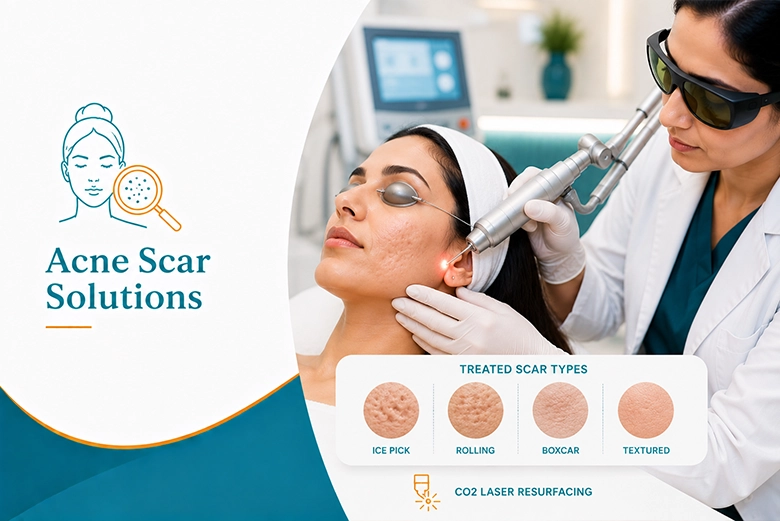
These sit below the skin surface and are the most common. They come in three flavours: ice-pick (narrow, deep, like a tiny puncture), boxcar (wider with sharp edges), and rolling (broad, shallow, giving a wavy, undulating look). Resurfacing treatments like CO2 laser and microneedling target these.
Hypertrophic and keloid scars (the raised ones)
Less common on the face, more on the chest and back. These are raised, not depressed, and need a different approach entirely — resurfacing isn't the answer for them.
Post-inflammatory marks (not actually scars)
The brown or red flat marks left after a pimple heals — these are pigmentation, not texture scars, and they often fade on their own or respond to pigment-targeted treatment, not resurfacing. People frequently mistake these for scars and pay for the wrong treatment. If your "scars" are flat and coloured rather than dented, read that sentence twice.
What CO2 laser resurfacing actually does
The CO2 (carbon dioxide) laser is an ablative laser—which means it vaporizes tissue. A fractional CO2 laser, which is what we use for scars today, sends thousands of tiny columns of laser into the skin — vaporising small channels of damaged tissue. Here the critical word is fractional: it only targets a fraction of skin, column by column leaving healthy tissue between cavities and thereby facilitating healing.
Two things happen. The laser is performed in two steps, the first involves resurfacing the top layers by physically smoothing out these scars. Most require a controlled injury that then initiates deep wound-healing within the skin—a flood of new collagen in subsequent weeks and months that essentially pushes depressed scars upwards from beneath (the process lasts for several months). The collagen remodelling is also why results continue to shift and refine for months after the sessions finish.
It's the most powerful resurfacing tool we have. For the right patient, a course of fractional CO2 laser — A minimum of three to four sessions spaced six to eight weeks apart can improve moderate to severe atrophic scarring 50–70%. There is no other single treatment that comes close to that ceiling. And this is why it earns the moniker "gold standard" regardless of what follows.
The trade-off: real downtime. You can expect several days of redness, swelling, a sandpaper texture and a little peeling—prepare to be unpresentable five to seven days. Plus, on darker skin there's a significant chance of post-inflammatory hyperpigmentation, which is precisely why operator skill and settings appropriate for the skin type are not optional.
What microneedling does — and how it differs
Microneedling goes the complete opposite way to achieve a similar end. It does this by creating thousands of very fine mechanical punctures in the skin, using a device with dozens of needles, instead of vaporising tissue with heat. No tissue is removed. Those micro-injuries elicit a similar collagen-building healing response — but more delicately, and without the need for ablation.
There are variations. Standard microneedling is purely mechanical. RF microneedling incorporates radiofrequency energy through the tips of the needles, heating the papillary and reticular dermis to enhance collagen production — a in between plain Microneedling and laser. Microneedling is another treatment that is often combined with PRP (platelet-rich plasma), using your own growth factors to enhance healing.
The big differences (for skin texture): gentler with much shorter downtime (generally a day or two of redness) and, less potential in-pigmentation risk — therefore super safe in darker Indian skin. The price of that safety is power. It is perfect for mild to moderate scarring, particularly rolling scars however requires more treatments (usually four to six) and results will not reach the levels of fractional CO2 with deep, severe scarring.
CO2 laser vs microneedling — the direct comparison
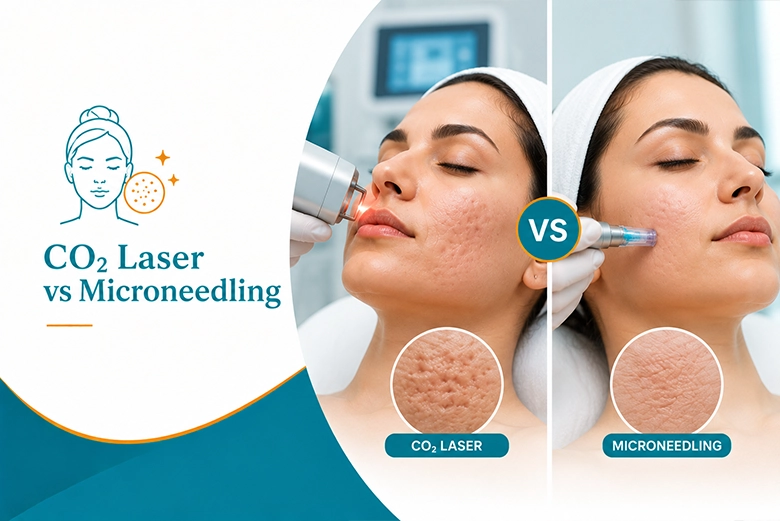
Here's the whole thing side by side. This is the section people come for, so it's the honest version, not the flattering one.
| CO2 laser resurfacing | Microneedling (incl. RF) | |
|---|---|---|
| How it works | Ablative — vaporises tissue + collagen surge | Mechanical micro-injury + collagen surge |
| Best for | Moderate–severe scars; boxcar, deep atrophic | Mild–moderate scars; rolling scars, texture |
| Power / results ceiling | Highest (≈50–70% over a course) | Good, more gradual (≈30–50%) |
| Sessions needed | Usually 3–4 | Usually 4–6 |
| Downtime | ~5–7 days (redness, peeling) | ~1–2 days (redness) |
| Pigmentation risk on darker skin | Higher — needs careful management | Lower — safer for Fitzpatrick IV–VI |
| Relative cost per session | Higher | Lower |
| Discomfort | More (numbing cream used) | Moderate (numbing cream used) |
The data have reached this table and, reading it, it becomes obvious that the CO2 laser is the heaviest tool: more power, longer downtime, higher cost of treatment and greater respect for skin problems specific to Indian skin. Microneedling is the kinder instrument - safer, less expensive and more subtle with additional appointments. Neither is "better." They're designed for different tasks and in many cases the smartest strategy is to use both.
What's the difference between CO2 laser and microneedling for skin texture, specifically?
Since texture is what most people actually care about, let's zoom in on that. Both improve texture by building collagen — but the way they improve it differs, and that changes who should pick which.
CO2 laser resurfaces from the top down. That's because it literally sculpts away the outer damaged layers and is aggressive in remodelling; it's best for smoothing those sharp-edged, well defined texture — boxcar scars, deeper pits, the sort of texture that casts a clean shadow. In a single pass, it also enhances skin surface quality, pore size and fine lines since it works on the entire surface rather than only on any scarring.
Microneedling it acts internally without shaving the surface. It's especially good at gentle, soft, rolling undulating texture — the kind of wavy irregularity where you would want to plump and lift from below not sand down from above. It preserves the surface barrier due to lack of ablation, which is why it's fantastic for darker skin types and less aggressive. That's why Cognac sponge will never be my enemy!
Summary for skin texture: sharp, pronounced, shallow texture = CO2; soft, rolling & diffuse texture = microneedling. And real, genuinely mixed texture — which most real faces are — usually works best with a combined or sequenced strategy: this is where one of proper acne scar assessment earns its keep over any online comparison, including this one.
What affects laser skin resurfacing cost?
Everyone asks for a number, which is reasonable — but the price named before anyone's clapped eyes on your dermis is moot; it really depends on your scars. So instead of telling you a number that won't be relevant to your specific account, here are the variables that actually move it so by the time you get a quote you'll know what you're getting.
| Cost factor | Why it changes the price |
|---|---|
| Number of sessions | Deeper/more extensive scarring needs more sessions; cost is per session |
| Area treated | Full face costs more than cheeks-only or a small patch |
| Scar severity & type | Mixed or severe scarring may need combined techniques |
| Device & technology | Newer fractional CO2 systems cost more to run than older lasers |
| CO2 vs microneedling | CO2 is generally higher per session; microneedling lower but often more sessions |
| Clinic & expertise | Dermatologist-led care with proper aftercare is priced differently from a technician service |
| Add-ons | PRP, numbing, post-care products can be bundled or separate |
Two honest points. Important note: Compare total cost of a course, not per-session — if you need 2 sessions for that cheaper one, it is not cheaper. The second reason: the cheapest quote is often cheap for a reason: an old device, fewer passes, or a technician rather than a dermatologist. That saving comes to a much greater price later on in terms of correcting pigmentation or post-laser effects with ablative laser on Indian skin. To get a precise number, you must have an assessment — a following value per session that we will be pleased to remix directly on paper in a consultation, but we won't publish a one-size number that misleads you.
So — is CO2 laser resurfacing worth it? A straight verdict
Worth it for whom, is the real question. Here's the honest breakdown.
CO2 laser is likely worth it if…
- You have moderate to severe atrophic scars — boxcar, deep pits — that have plateaued with gentler treatment.
- You can take about a week of downtime and plan it around work or events.
- You want the biggest improvement from the fewest sessions and understand it's still a course, not a one-off.
- You're being treated by a dermatologist experienced with Indian skin, using settings that respect your skin tone.
CO2 laser is probably not worth it if…
- Your "scars" are actually flat pigmentation marks — you need pigment treatment, not resurfacing.
- You have very mild texture that microneedling could handle more safely and cheaply.
- You can't take downtime right now, or have an event in the next two weeks.
- You have active acne — it must be controlled first, always.
- You're prone to keloids or have certain skin conditions that raise the risk.
CO2 laser is one of the few legitimately satisfying treatments in dermatology can visibly soften scars that someone has been bothered by for a decade, provided you have the right candidate. It is expensive, uncomfortable and risky for the wrong candidate for no good reason. The entire value is predicated on accurate evaluation, so we're not going to tell you if it's worth it or not until we see your face.
The Chennai factor — why skin tone changes the calculation
This in itself deserves its own section because this is where A LOT of generic advice go wrong. Many of the CO2 laser things you read on give some consideration to lighter, Western skin. For Chennai patients — the majority Fitzpatrick IV–V — the calculation changes.
As a result, those with darker skin have many more active melanocytes which means any harsh, heat-based treatment would have a greater likelihood of causing post-inflammatory hyperpigmentation — essentially the skin over-reacts to an injury developing brown patches. CO2 laser, which is the most aggressive resurfacing type, contributes the greatest portion of this risk. It is doable, but only with extreme measures: conservative settings, pre-treatment skin priming, strict avoidance of sun exposure and careful aftercare. Chennai's blistering UV just makes post-laser sun care essential to the result rather than a mere counsel.
This is precisely why microneedling has become such a popular scar treatment in India — requiring fewer sessions to achieve meaningful texture improvement and with dramatically lower risk of pigmentation on darker skin. In the case of many Chennai patients with mild to moderate scarring, it is absolutely the right first step while CO2 is relegated to more harsh accompaniment for what microneedling does not fully fix. A clinic that instinctively jumps to aggressive CO2 on fitz v skin without having a conversation about this is not being thorough — they're being reckless.
What treatment actually looks like, start to finish
Demystifying it, because fear of the unknown puts people off treatments that would genuinely help.
Before
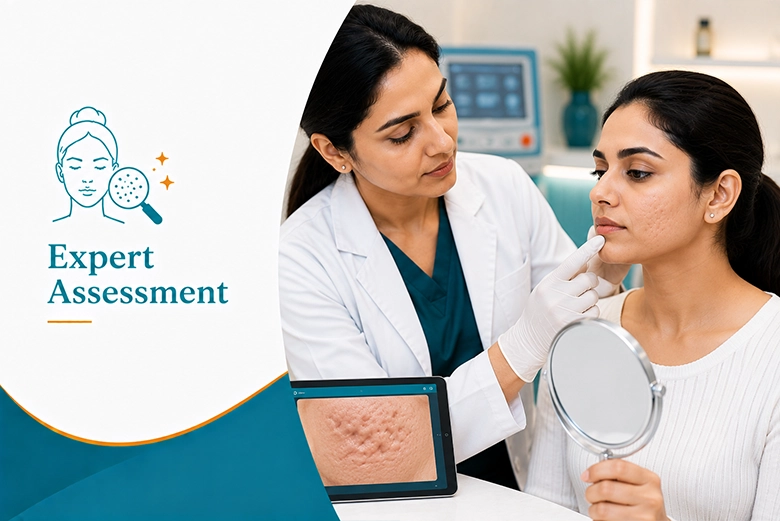
An assessment grades your scars and scans the skin type, tone & history, as well as possibly prepping the skin for several weeks to reduce pigmentation risk: (@CO2). We treat the active acne — no ifs or buts, that comes first. You will also be given realistic expectations and the number of session.
During
Numbing cream is also applied initially too, which means you can experience as discomfort rather than pain. However, CO2 sessions are short: you feel heat and a prickling. Microneedling is like a little bit of pressure and vibration. It also is not the ordeal people might expect.
After
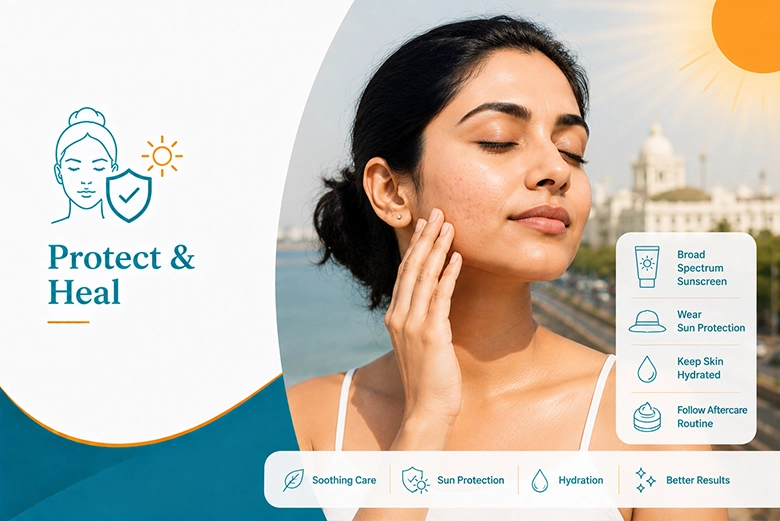
CO2: Multi-day of Redness, Swelling you are Expecting to Peel. This is Microneedling, 1 or 2 days of redness (like mild sunburn). Gentle aftercare and sun protection protect both of these results, but one fast way to undermine those good efforts in Chennai is to skip wearing sunscreen.
The waiting part
What no one wants to hear is that collagen remodelling takes time. The real change takes three to six months after your sessions. Scars do not disappear overnight, and no clinic that says they can deliver you immediate results is telling you the truth. After all, being patient is part of the treatment.
Myths about laser scar resurfacing
"CO2 laser removes scars completely."
While they make a drastic improvement to atrophic scarring, the notion of "full removal" is unrealistic. You have your eyes set on improvement, and not perfection, which will leave you happy instead of disappointed.
"Microneedling is just as powerful as CO2 for a fraction of the cost."
Half true. Microneedling is cheaper and safer, but it's not as powerful on deep or severe scars. For mild scarring the results can be comparable; for severe scarring they're not. Cost isn't the only axis.
"One session will fix my scars."
Neither treatment is one-and-done. Both are courses, and the collagen results build over months. Anyone selling a single-session scar cure is selling a story.
"Laser will thin or damage my skin."
Fractional laser stimulates collagen — skin typically becomes thicker and better-quality over months, not thinner. The redness and peeling afterwards are healing, not damage.
"I can get it done right before my wedding."
Please don't. Scar treatment needs months to show results and, for CO2, a week of downtime. Start scar treatment well ahead of any event — three to six months minimum — never in the final weeks.
Who should be cautious, and safety notes
Both procedures are considered elective, which means that screening is important. Inform your dermatologist whether you are pregnant or breast-feeding (this treatment is deferred), on isotretinoin currently or within the last half year (skin is more delicate — a regular explanation behind holding up), inclined to keloids, susceptible to cold sores (possible preventive drugs required) and/or have dynamic skin infections or irritation. There are other exceptions depending on the presence of some disease states or medications that modifies this plan. If a clinic never asks any of this, they are not screening you well - and with ablative laser proper screening can actually protect you.
How we approach acne scars at VK Allure
Very clinical and un-flashy matched to Indian skin all of which for ninthousand 9k. A first appointment helps you determine the type of your scars as carefully, examines your skin colour and history before outlining a proposal — which can be CO2, microneedling, RF microneedling and PRP, chemical peels, subcision, or typically a series of these staged over many months. We're honest about how there is no one-size-fits-all answer to fixing every scar type, that results take time and patience, and that on darker skin tones prevention of pigment change is almost as important as the resurfacing itself.
We have also been transparent about candidacy—if CO2 would better benefit you than microneedling (with less risk and cost), we will tell you so; and if your actual issue is pigmentation not texture, then we do not want to sell you a laser but rather direct you towards the proper category of treatment! You can explore skin resurfacing, acne scar treatment and the full service range, and we run the same protocols at both the Kilpauk and ECR Uthandi branches in Chennai.
Want to know if CO2 laser is right for your scars?
Book a scar assessment at VK Allure Dermaclinic — Kilpauk or ECR Uthandi, Chennai. We'll type your scars, factor in your skin tone, and recommend CO2, microneedling, or the combination that actually fits — with a clear written quote.
Book an Appointment Contact the Clinic📞 +91 96009 58060 · 💬 WhatsApp us
Final thoughts
So is CO2 laser resurfacing for acne scars worth it? Often, on a patient who can take the downtime, in skilled hands — yes for moderate to severe atrophic scarring and few treatments are more satisfying. If you have milder scars or somebody with darker skin who prefers less risk, or anyone even just dealing with pigmentation vs. texture, microneedling or something else is the better choice hands down in terms of safety, efficacy and overall outcome. CO2 versus microneedling is not a battle of ultimate champions, but rather a fight of different tools for distinct scars and the best result very often comes from mixing them both. Your scars are particular, your skin colour recalibrates the math and Chennai sun has its laws too. You should see a dermatologist to get those types of scars properly classified and then the correct treatment follows from that, an article like this can do no more.
Frequently Asked Questions
Is CO2 laser resurfacing worth it for acne scars?
What is the difference between CO2 laser and microneedling for skin texture?
CO2 laser vs microneedling — which is better for acne scars?
What affects laser skin resurfacing cost?
How many CO2 laser sessions do I need for acne scars?
How long is the downtime after CO2 laser resurfacing?
Is CO2 laser safe for Indian and darker skin?
Does microneedling really work for acne scars?
Can CO2 laser remove acne scars completely?
Which is cheaper, CO2 laser or microneedling?
What type of acne scars does CO2 laser work best on?
Can I combine CO2 laser and microneedling?
Are my marks acne scars or pigmentation?
Does CO2 laser resurfacing hurt?
How soon will I see results from CO2 laser?
Can I have scar treatment if I still have active acne?
Is CO2 laser resurfacing safe during pregnancy?
What are the side effects of CO2 laser resurfacing?
Why is sun protection so important after laser resurfacing in Chennai?
Can I get CO2 laser before a wedding or event?
Where can I get CO2 laser or microneedling for acne scars in Chennai?
Medically Reviewed & Written By

Dr. Lokeshwari
Dermatology Specialist · VK Allure Dermaclinic, Chennai
- ✓ Certified Dermatology Specialist
- ✓ 7+ Years of Clinical Experience
- ✓ 5,000+ Patients Treated
- ✓ Aesthetic & Medical Dermatology
Dr. Lokeshwari is a Dermatology Specialist at VK Allure Dermaclinic, Specializing in Advanced Skincare, Hair Restoration, Laser Treatments and Aesthetic Dermatology for many years. She works at the Kilpauk and ECR (Uthandi) branches in Chennai, focusing on an evidence-based approach unique to Indian skin types and city climate. She writes about what really works — cutting through the malarkey of skincare myths to clinical reality.
This guide comparing CO2 laser resurfacing and microneedling for acne scars has been reviewed by Dr. Lokeshwari to ensure every claim, result range and safety note reflects current dermatology practice for Indian skin.
Book a Consultation with Dr. Lokeshwari →📞 +91 96009-58060 · 💬 WhatsApp · 🏥 Kilpauk & ECR Uthandi, Chennai