Walk into our VK Allure Dermaclinic consultation room on any given day and you'll spot a pattern. Patients come in for hair loss, dull skin, stubborn weight, brittle nails — separate complaints, separate treatments. But around the eighth or ninth question, when we ask about a regular day's eating, almost everyone describes the same plate. Rice. Dal. A vegetable. Maybe some curd. And that's it.
It's a fine plate. It's just thin on protein. And in clinic, that thinness shows up in places people rarely link to food — the texture of their hair, the speed at which a chemical peel heals, how much lean muscle holds during a body-contouring plan. So before any treatment, we talk protein. Specifically, high protein vegetarian foods — what counts, how much, how to fit them into an Indian kitchen without buying a single tub of powder.
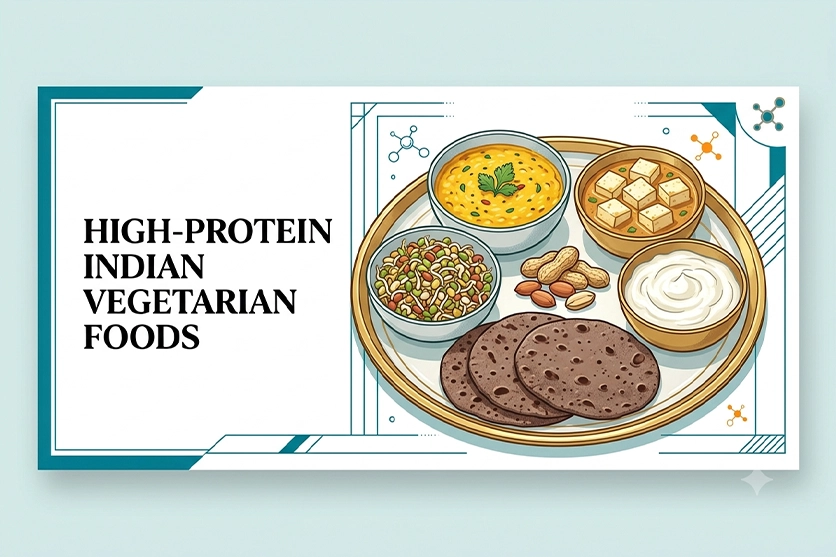
A healthy Indian adult needs roughly 0.83 g of protein per kg of body weight per day (ICMR-NIN 2020), but most vegetarian diets in India deliver only 40–50 g a day — well below need. The densest vegetarian protein sources in an Indian kitchen are soya chunks, paneer, urad dal, moong dal, rajma, chickpeas, tofu, Greek yogurt, peanuts and pumpkin seeds. Distributing protein across three meals — not just dinner — gives the best results for skin, hair and weight.
Why a dermatologist is talking about your dal
Skin, hair and nails are mostly protein. Hair is roughly 95% keratin. Skin's structural strength comes from collagen and elastin. Nails are keratin too. Every cell that turns over — and skin turns over every 28 days or so — needs amino acids to rebuild. Run short on amino acids long enough and the body prioritises essentials (organs, muscle) over the cosmetic stuff. Hair thins. Skin loses bounce. Wound healing slows. That's not theory; that's the slow drift we watch in patients who eat well in volume but light in protein.
The American Academy of Dermatology lists protein deficiency among the modifiable causes of telogen effluvium — diffuse hair shedding — alongside iron and vitamin D. The IADVL guidelines on nutritional dermatology echo the same priority order. Most of our 30–45 cohort respond noticeably faster to GFC hair treatment when we fix the protein gap simultaneously. Skip the food piece and the in-clinic work still helps — it just helps less, and the results don't hold as well between sessions.
So: not a nutrition lecture. A practical primer on what to eat, in the volumes you actually eat them, anchored in what we see at the clinic.
How much protein do you actually need?
The number most people quote is wrong. They've heard "1 gram per kg" and run with it. The ICMR-NIN 2020 recommendation for a healthy sedentary Indian adult is closer to 0.83 g per kg body weight. For a 60 kg adult, that's roughly 50 g a day. For a 70 kg adult, around 58 g. Sounds modest, but the NNMB national surveys repeatedly show urban Indian vegetarians averaging below this — sometimes by 20% or more.
The numbers shift upwards if you're not sedentary. Here's the rough framework we use at VK Allure when sketching a baseline for a patient:
- Sedentary adult: 0.83–1.0 g per kg per day
- Regular gym-goer / 4–5 workouts a week: 1.2–1.6 g per kg
- Active weight-loss patient on an EMS or cool-sculpting plan: 1.2–1.5 g per kg (to protect lean mass)
- Severe hair-fall workup or post-bariatric: 1.2–1.4 g per kg
- Pregnant or lactating: follow obstetric guidance — typically an additional 13–25 g per day
A worked example. A 65 kg sedentary woman in Chennai who comes in for melasma treatment and a general skin-glow plan: target around 55 g a day. That's about 18–20 g per meal across breakfast, lunch and dinner. Most patients are clearing breakfast at 6–8 g (idli sambar, dosa with chutney). That's the leak. Fix breakfast and the daily total often jumps by 10–15 g without any effort elsewhere.
The 12 highest-protein vegetarian foods in an Indian kitchen
A ranking is useful only if it reflects what you can actually buy at a Chennai supermarket and a corner kirana. None of these are exotic — most are already in your kitchen. The numbers below are per 100 g of the raw food unless noted. Cooked portions deliver less; we'll get to that.
| Food | Protein (per 100 g) | Notes |
|---|---|---|
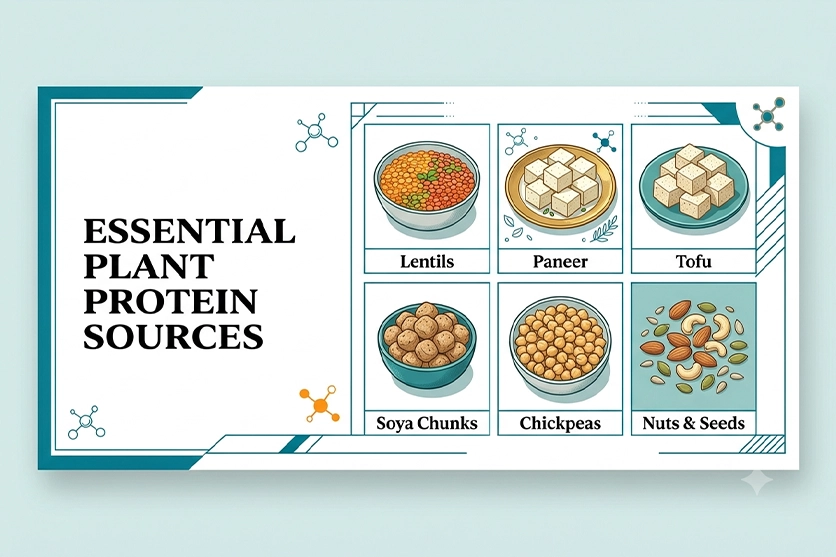
| Soya chunks (dry) | 52 g | The densest plant protein widely available. Rehydrates 3x. |
| Urad dal (raw) | 24 g | Backbone of idli, vada, dahi vada. |
| Moong dal (raw) | 24 g | Easiest to digest of all dals. |
| Toor / arhar dal (raw) | 22 g | The default South Indian sambar dal. |
| Rajma (raw) | 22 g | Soak overnight; pair with rice. |
| Chickpeas / chana (raw) | 19 g | Black or kabuli; both work. |
| Paneer (full-fat) | 18–20 g | Calorie-heavy; portion matters. |
| Peanuts | 26 g | Often called the "poor man's almond" — and rightly so. |
| Pumpkin seeds | 30 g | Iron and zinc bonus for hair growth. |
| Tofu | 8–10 g | Half the protein density of paneer, a fraction of the fat. |
| Greek yogurt | 9–10 g | About twice the protein of regular curd. |
| Quinoa (raw) | 14 g | One of the few complete plant proteins. |
Now the important footnote — those numbers are for the raw ingredient. A standard katori of cooked dal has about 18–22 g of cooked dal solids, delivering roughly 6–9 g of protein. A 100 g serving of paneer in a sabzi is usually 30–40 g of paneer in real life, delivering 6–8 g. The trick isn't just what you eat — it's recognising that one katori is rarely enough.
The "complete protein" myth — and why you can stop stressing about it
For decades the rule was: combine cereals and pulses in every single meal to get all nine essential amino acids. Beans and rice. Khichdi. Idli and sambar. The logic was correct; the urgency wasn't. Modern nutrition has moved on.
A 2019 review in the Journal of the Academy of Nutrition and Dietetics, and the longstanding AAD/American Dietetic Association position paper on vegetarian diets, both confirm what the science actually shows: as long as your overall daily intake covers all essential amino acids, your liver maintains a 24–48 hour amino acid pool that handles meal-to-meal variation. You don't have to engineer every plate. You have to engineer the day.
So the practical version: across a full day, eat from at least three of these five buckets — pulses, dairy, soya/tofu, nuts/seeds, whole grains. If you hit three buckets, you're getting all nine essential amino acids in usable proportions. Stress less about which protein lands at which meal.
Honestly? The patients who get tied up in "is this a complete protein" tend to undereat protein overall. The patients who simply pile in dal, curd, paneer, soya and nuts across a day rarely have a deficit.
High protein vegetarian foods, organised by category
A category-by-category walk through, with the practical pointers we give patients. Skim the categories you eat from. Skip the ones you don't.
1. Pulses and legumes — the South Indian workhorses
Dal isn't optional in an Indian protein plan; it's the floor. Moong, urad, toor, masoor, chana — all sit at 22–24 g of protein per 100 g raw. The catch: a typical katori at lunch carries 6–9 g. To meaningfully shift your day's protein from dal alone you usually need two katoris, not one. Rajma and chickpeas double up as legumes and add fibre and resistant starch — important for skin because gut health and skin clarity are linked far more than the popular skincare conversation gives credit for.
2. Soya and its derivatives — the protein density champion
Soya chunks are the densest single ingredient most patients can buy. 50 g of dry soya chunks delivers 25–26 g of protein — almost half a day's requirement for a sedentary adult, in a single dish. Tofu is gentler in flavour and lower in calories per 100 g but with about half the protein density. We use soya chunks heavily in our weight-loss plans because they're filling and protein-dense, with one caveat — patients on thyroid medication should space soya at least four hours from their levothyroxine dose, since soy isoflavones can reduce absorption (per AAD and endocrinology guidance).
3. Dairy — paneer, curd, milk
Paneer delivers 18–20 g of protein per 100 g and the casein in it digests slowly — useful for satiety. Greek yogurt (curd that's been strained) carries roughly double the protein of regular curd. Milk gives about 3.3 g per 100 ml. A glass of milk plus a katori of curd plus 100 g of paneer across the day easily adds 25 g of protein.
A nuance worth flagging — full-cream dairy in large quantities can flare hormonal acne in some patients. We've seen this often enough to mention it routinely during acne scar consultations. The fix isn't to drop dairy entirely; it's to switch to low-fat milk and lean on Greek yogurt and paneer instead, in moderation.
4. Nuts and seeds — the upgrade ingredient
A 30 g handful of almonds carries about 6 g of protein, peanuts roughly 7 g, pumpkin seeds 9 g, hemp seeds 10 g. The trade-off is calorie density — 30 g of nuts is around 175 calories. For a weight-loss patient, we cap nuts at 30 g a day. For a hair-loss patient with no weight issue, we double it. Pumpkin seeds get extra airtime because they bring iron and zinc — the two micronutrients most often deficient in our hair-fall consultations.
5. Whole grains and millets
Most people don't think of millets as protein, but ragi delivers 7 g per 100 g raw, bajra about 11 g, quinoa around 14 g. Swap one rice serving a day for a millet equivalent and the day's protein quietly rises by 4–6 g. Chennai households used to do this naturally — ragi koozh at breakfast, bajra rotis in winter. The trend has reversed, and we'd quietly like to see it come back.
6. Protein supplements — when they're worth it, when they're not
Plant-based protein powders — pea, soya, brown rice — are useful when daily targets cross 1.2 g per kg and you can't physically eat the food volume. Most patients reach 60–70 g a day from food alone with the right planning. Powders become genuinely useful for athletes, post-surgical recovery, severe hair-loss workups, or older patients whose appetite is limited. Whey-based powders are fine for ovo-lacto vegetarians; we usually recommend a third-party-tested brand rather than the cheapest tub on Amazon. And no, powder isn't a substitute for food — it's a top-up.
A simple high-protein vegetarian day, Chennai edition
Numbers without a plate look meaningless. Here's what a real day at around 65–70 g of protein looks like, built around food you can buy at any Sunday market within ten minutes of either of our clinics.
Breakfast (around 18 g): Two moong dal chillas filled with paneer bhurji and a small katori of curd. Or, three idlis with a generous serving of sambar made with extra toor dal, plus one boiled egg if you're ovo-vegetarian. Coffee on the side as usual.
Mid-morning (around 8 g): A small bowl of sprouted moong with chopped onion, tomato and a squeeze of lemon. Or a fistful of peanuts and a handful of roasted chana.
Lunch (around 20 g): A small portion of rice or ragi roti with two katoris of dal, a paneer sabzi (around 80 g paneer), a vegetable, and a katori of curd. The two-katori rule for dal is the lift here, not anything fancy.
Evening (around 6 g): Buttermilk with roasted jeera, or a Greek yogurt bowl with a teaspoon of pumpkin seeds and chia.
Dinner (around 18 g): A dry soya chunk curry (50 g dry, rehydrated) with two phulkas, a vegetable, and a small katori of dal. Or rajma chawal with a curd-based salad on the side.
Total: somewhere between 68 and 72 g. Across the day, you've hit pulses, soya, dairy, seeds and whole grains — the five buckets. Amino acid balance is sorted automatically. No counting required.
Protein and your skin — what actually changes
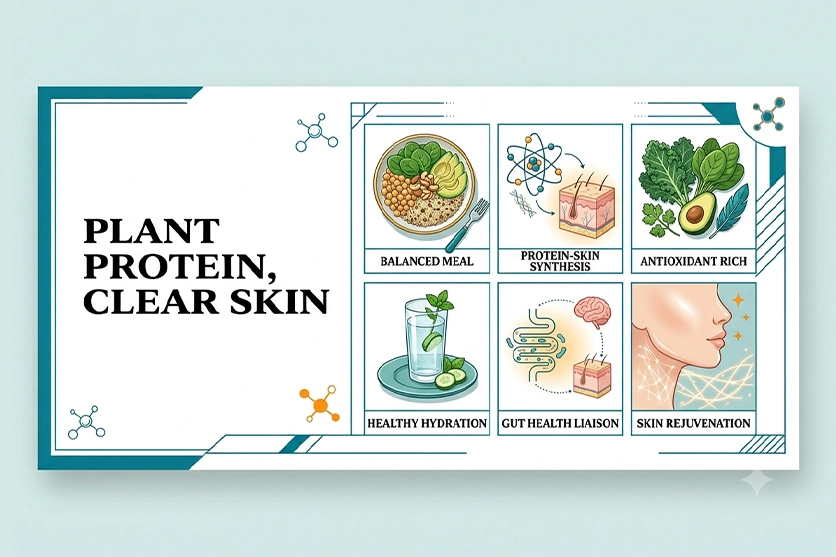
Skin runs on amino acids. Collagen — the structural protein that gives skin its bounce — is built primarily from glycine, proline and hydroxyproline. Elastin handles recoil. Keratin sits in the outer layer and in nails. When dietary protein drops below need, the body conserves amino acids for organs and muscle; skin and hair are first to lose.
What patients notice first isn't dramatic. It's the slow drift — a dullness that no facial seems to fix. Slower wound healing after a chemical peel or a CO2 laser session. A papercut that takes a week to close instead of three days. Brittle nails that flake at the tip. Nine times out of ten in our practice, fixing the protein gap improves all three within a 12-week window.
To be clear — protein alone won't deliver a glow. The IADVL nutritional dermatology consensus is explicit: protein is necessary but not sufficient. You also need vitamin C (for collagen cross-linking), zinc (for wound healing), iron, vitamin D, and the antioxidant flavonoids in coloured vegetables. But protein is the foundation. Without it, the rest doesn't compound.
And no — collagen powders aren't magic. Most of them are hydrolysed bovine collagen, not vegetarian, and the evidence that oral collagen meaningfully outperforms a balanced high-protein diet is thin. We don't routinely recommend them.
Protein and hair — the connection patients always underestimate
Hair is keratin, full stop. The hair follicle is one of the most metabolically active mini-organs in the body — when nutrient supply tightens, follicles down-shift first. The result: increased shedding (telogen effluvium), slower regrowth, and reduced response to in-clinic treatments like advanced hair PRP, GFC, mesotherapy and low-level laser therapy.
Most of our hair-loss consultations include a quick dietary screen because we've watched the same pattern repeat — a patient invests in 6 sessions of growth factor therapy but eats 35 g of protein a day. The therapy works; the regrowth is slower than it could have been. The patient blames the protocol. The protocol was fine.
For hair specifically we look beyond just protein. The trio we mention to almost every hair patient: protein, iron, zinc. Vegetarian sources of iron (especially the haem-equivalents from green leafy vegetables, dates, sesame) absorb better when eaten with vitamin C — squeeze a lemon over your sambar. Zinc shows up well in pumpkin seeds, sesame, peanuts and whole grains. Biotin gets a lot of marketing airtime but is rarely the limiting nutrient in a normal Indian diet.
A no-hype admission: even with perfect nutrition, hair loss driven by androgenetic alopecia, PCOS or thyroid dysfunction needs medical management, not just diet. Food fixes nutritional hair loss. It supports the rest. Anyone selling food as the cure for genetic hair loss is overselling.
Protein for weight loss and body contouring
Protein has three properties that make it the single most useful macronutrient for weight loss: it's the most satiating per calorie (you stay full longer), it has the highest thermic effect (your body burns ~25% of its calories just digesting it, compared to ~5–10% for carbs), and it preserves lean muscle while you lose fat. That last bit is critical — losing 8 kg of which 2 kg is muscle leaves you smaller but weaker, with a lower resting metabolic rate. Losing 8 kg with protein-supported lean-mass preservation leaves you smaller and stronger.
Our weight loss programmes and body-contouring plans built around EMS and cool sculpting almost always come with a 25–30% calorie-from-protein framework. EMS in particular drives substantial muscle activation per session — without enough dietary protein, the muscle simply can't capitalise on the stimulus.
We don't promise dramatic outcomes from any one intervention. What we do promise is that the combination — adequate protein plus the right in-clinic plan — outperforms either piece alone, by a fairly visible margin in our clinical observation.
Five things people get wrong about high protein vegetarian foods
Patterns we see often enough to call out plainly.
One — assuming dal alone is enough. A single katori of dal carries 6–9 g of protein. Most South Indian lunches and dinners include one katori. That's nowhere near a meal's protein quota. You need two, or pair it with paneer/tofu/soya.
Two — over-trusting "high protein" packaged products. A high-protein biscuit might carry 6 g protein and 220 calories. A handful of peanuts gives more protein at lower calorie cost. Most packaged "protein" snacks are marketing.
Three — loading all the protein at dinner. Muscle protein synthesis works better when protein is distributed across three meals. A 60 g daily total split as 10/15/35 is less effective than 20/20/20. The breakfast leak is the single biggest lift available to most patients.
Four — fearing soya. The "soya causes hormonal problems" narrative is largely overstated outside of very high-dose, isolated soy isoflavone supplementation. Soya chunks in normal food amounts (25–50 g dry, three to five times a week) are safe for the overwhelming majority of adults — including our women patients with PCOS, where soya in moderation has actually been associated with neutral or mildly positive metabolic markers.
Five — adding protein powder before fixing food. Most patients should hit their target through food first. Powders are useful at the margins, not as a foundation. If your day's food provides 35 g of protein, two scoops of powder isn't a fix — it's a band-aid.
How VK Allure approaches the diet–derma connection
We don't run a nutrition clinic. We run a dermatology and aesthetics clinic — but we've learned over seven-plus years of practice in Chennai that the in-clinic work hits its ceiling faster when patients aren't supporting it with the basics at home. So nutrition guidance is built into our consultations across:
- Hair loss treatment plans — every patient gets a basic protein-iron-zinc framework alongside the in-clinic protocol
- Weight loss and inch loss therapy patients — a 25–30% protein calorie target along with the EMS, cool-sculpting or programme they're on
- Melasma, acne scar and Hydrafacial patients — a brief talk about protein, hydration, vitamin C and zinc, because peel and laser recovery moves faster on adequate nutrition
- Anti-aging consults including HIFU, RF microneedling and vampire facial — collagen-supporting diet is part of the home-care plan
What we don't do: hand patients a rigid 14-day diet plan to follow in isolation. Diets that ignore your existing eating habits, your work pattern, your family kitchen — they fail within four weeks. We work with what's already on your plate and adjust the protein lift accordingly. A patient who eats only South Indian gets one set of suggestions; a Marwari household gets another; a flat-mate cooking for one gets a third.
Book a consultation tailored to your skin, hair or weight goals
Dr. Lokeshwari and the team at VK Allure Dermaclinic review your skin, hair and lifestyle holistically — including the food piece. Two locations in Chennai: Kilpauk and ECR Uthandi. Walk-in consultation or pre-book — both work.
Final thoughts
Most of what we treat in clinic — the dullness, the shedding, the stubborn weight — has a thin protein layer hiding behind it. Fix that layer and the in-clinic care lands harder, holds longer, and costs you less in repeat work over the years.
Eat across the five buckets — pulses, dairy, soya, nuts/seeds, whole grains — every day. Distribute your protein across three meals, not just dinner. Don't be afraid of soya. Don't over-rely on dal alone. And don't expect overnight change; 8 to 12 weeks is the realistic window for skin and hair to respond to dietary work, because that's how long the cell turnover takes.
If you're in Chennai and you've been bouncing between treatments without quite getting the result you wanted — come in. We'll look at your skin or hair, ask about your week, and figure out together whether the next step is in the clinic, in the kitchen, or both.