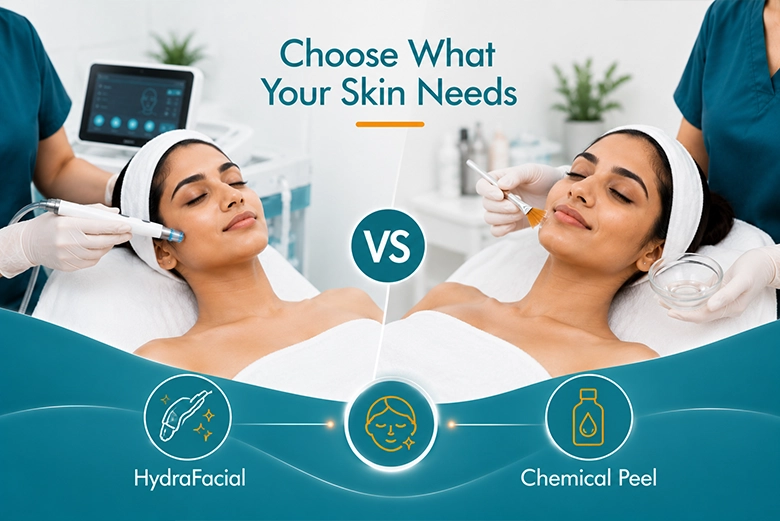
"So the first and foremost question you must have is "HydraFacial or chemical peel — Which one for Dull Skin?" It's one of our top questions we get, and sadly the honest answer has few fans. They don't compete; they perform different tasks. HydraFacial Hydrate, detox, deep-clean and glow without the downtime. The resurfacing — a series of overlapping applications that clears away dull surface cells to rectify tone and texture. If you were to ask better, the hidden question is better for what exactly and whose skin..
This guide compares the two behaviours accurately — what each does, its advantages regarding HydraFacial, which is good for the skin that can make you glow and how regular sessions of HydraFacial orders is to be there to assure durable results! If you only ever want the best facial for clear and glowing skin, caller-calling it a facial will get you there too. VK Allure Dermaclinic offers both across our Kilpauk and ECR branches, so we've no reason to favour one — the right pick is whichever fits your skin.
HydraFacial vs chemical peel — the short answer
A HydraFacial cleanses, exfoliates, extracts and hydrates in one no-downtime session, giving instant glow — ideal for dull, dehydrated, sensitive or first-time skin. A chemical peel performs resurfacing with a controlled acid, correcting tone, texture and mild pigmentation over a series of course (typically leading to short-term flaking). HydraFacial vs Peel: Pure hydration and an instant glow treatment on dull skin, HydraFacial wins; an uneven tone or texture is better served with a peel. Most utilize both for different tasks. A HydraFacial will usually be performed every 4 weeks for optimal results.
What is a HydraFacial, exactly?
A HydraFacial is a four-in-one treatment delivered by a vortex-suction handpiece. This allows for sure degreasing and gentle exfoliation, painless suction of pore congestion through the vacuum (no more manual squeezing!), and straight infusion of hydrating and antioxidant serums all at once. A twofer of a deep-clean-and-feeding if you would.
The key characteristics are that it is non-invasive, works for almost every skin type and provides glow sufficient to walk right out — no peeling, no rawness, and really no downtime beyond perhaps a 30-minute flush. That is the exact reason it has been so many people's go-to first clinical facial and the safe option pre-event.
HydraFacial benefits — what it actually does for your skin
Since "HydraFacial benefits" is one of the things people most want spelled out, here they are honestly — the real ones, without the marketing gloss.
Instant, visible glow with zero downtime
This is the headline benefit. Immediately afterwards, skin appears brighter and plumper and fresher again with no redness to hide and no flaking to wait out; you can get on straight back to your day. Nothing is more convenient than that for a Tuesday boost or pre-event pick-me-up.
Deep hydration
This is why it works wonders for dull, dehydrated skin since the serum infusion really hydrates. In an air-conditioned, sedentary, hundreds of hours staring at screens Chennai work life, this tackles the dehydration that dulls better than we give it credit for.
Painless pore extraction
The suction clears congestion — blackheads, oil, debris — without the trauma of manual extraction. In Chennai's humidity, where pores clog faster, this is one of the most useful parts of the treatment.
Gentle exfoliation without irritation
It removes dead surface cells for smoothness, but gently — no acid sting, no downside for sensitive skin. This is the key difference from a peel: exfoliation without the shedding.
Suits almost every skin type
Oily, dry, combination, sensitive, first-timers — it's one of the hardest treatments to go wrong with. That broad safety is a real benefit, especially if you don't yet know how your skin reacts to actives.
Customisable boosters
Serums can be tailored — brightening, hydrating, anti-ageing — so the same base treatment can lean toward your specific goal. Your dermatologist matches the booster to your concern.

What is a chemical peel, and what does it do?
A chemical peel works differently — by resurfacing. This involves the use of a controlled acid, in specific concentrations and at specified pH levels, to exfoliate and slough off layers of dead, sluggish skin cells to expose fresh skin underneath; and optimally improve tone, texture & mild pigmentation over time. This is where actual correction and "glow" cross streams.
The acid is selected to find out which one matches your skin, and that makes a lot difference in Indian skin. Mandelic acid – often our choice for sensitive or darker skin types, this is a larger molecule that works slowly and gently in the tissue thus reducing the chances of irritation and post-inflammatory pigmentation. Men that have oily Prone to acne skin tend toward salicylic acid. Glycolic→ Glycolic is the OG brightening agent for stubborn, tough skin. Lactic is gentle and hydrating.
Chemical peel benefits
What Peels Do That a HydraFacial Cannot: Fade mild pigmentation and dark spots over time, smooth rough or uneven texture, help clear/correct acne (salicylic specifically!), and provide deeper more cumulative brightening that occurs across a series. Light peels come with the trade-off of causing a few days of effulgent flaking, and require planning ahead — you wouldn't book your first chemical peel two days prior to a wedding.
HydraFacial vs chemical peel — side by side
Here's the whole comparison in one view. Match the row to what your skin actually needs.
| HydraFacial | Chemical peel | |
|---|---|---|
| How it works | Cleanses, exfoliates, extracts, hydrates | Acid resurfaces / sheds dull surface layer |
| Main strength | Hydration + instant glow | Tone, texture, mild pigmentation |
| Downtime | None | A few days of possible light flaking |
| Results | Immediate, temporary | Cumulative over a series |
| Best skin types | All, incl. sensitive & first-timers | Chosen by acid; caution on very sensitive skin |
| Corrects concerns? | No — maintenance/glow | Yes — mild pigmentation, texture, acne |
| Before an event | Ideal (no downtime) | Plan weeks ahead, not last-minute |
Notice there's no overall "winner" — because there isn't one. The best choice is a match to your skin type, concern and timeline, not a ranking.
What is better for dull skin — a HydraFacial or a chemical peel?
This is the crux question, so let's answer it properly rather than fudge it. It depends on why your skin is dull, and dullness has two main causes.
If your dullness is dehydration and buildup
Rehydrate, cleanse and restore that light reflection freshness in a single session. HydraFacial is often the better and safer choice for this type of banality, particularly if your skin is nicotinic or you haven't had clinical care before.
If your dullness is uneven tone and rough texture
If the dullness is really about pigmentation, sun damage, rough texture or a grey cast that hydration alone doesn't lift, a chemical peel does more, because it actually resurfaces and evens things out over a course. A HydraFacial would brighten it temporarily; a peel addresses the cause.
And often, the honest answer is both — An initial course of peels to rectify the skin tone and texture, complemented with HydraFacials in between and for hydration post-treatment. They supplement each other instead of competing. When we're talking deep, stubborn stuff — the kind of melasma that's been around since 2100 B.C. laser toning or dedicated pigmentation treatment instead.
How often should you get a HydraFacial for best results?
Another question with a real answer. For most people, the sweet spot is once every four weeks — Well, almost with skin's natural renewal cycle which takes approximately 28 days. Because at that frequency, every session is cumulative, skin stays plump and hydrated and clear and glowing instead of having wild rises then crashing.
That said, it flexes to your skin and goals:
- Maintenance / general glow: every 4 weeks is ideal for lasting results.
- Oily or congestion-prone skin: some benefit from every 3–4 weeks, since pores re-congest faster in Chennai's humidity.
- Before an event: a session 2–3 days beforehand for peak glow, ideally after a couple of baseline sessions so skin is already in good shape.
- Occasional pick-me-up: even one session helps, but a single facial gives a temporary result — consistency is what makes glow last.
The real truth: no facial delivers everlasting radiance. One HydraFacial is gorgeous but quickly wilts over the course of one to three weeks with cell turnover. The folks who have the most gorgeous and consistent skin are those who make this a regular monthly ritual in addition to their daily at-home care and sunscreen — not as an occasional rescue. If someone promises you a permanent glow from one session, they are selling you the wrong story.
So — what's the best facial treatment for glowing skin?
If you came here just wanting the best facial for glowing skin, here's the umbrella answer. For most people in Chennai, a HydraFacial is the best all-round glow facial — safe, instant, no downtime, suits nearly everyone. If your "dull" is really tone and texture, a chemical peel gives a deeper, more corrective glow over a series. And they're not the only options — a carbon laser facial suits oily, congested skin, while a glass skin facial chases that dewy, pre-event radiance.
This is not a ranking, but rather a match made in heaven with "Best." You achieve the most luminous skin by selecting a treatment tailored to your type and worry — and making sure you sustain it with the foundations that work every day. Nothing tells you which one is yours better than a five-minute test.
How Chennai's climate tips the decision
Local factors genuinely change the calculation, which is why generic advice only gets you so far.
Chennai's heat and humidity keep skin oilier and pores more congested, which plays to the HydraFacial's extraction strength — a big reason it's so well-matched here. The city's high UV load, This is why we time our chemical peels carefully – peeled skin is relatively more fragile, and aggressive/medium-depth peels in full summer increase the risk of post-treatment pigmentation (and boy were those months brutal from about March to July). That could be a justification to not get peels however, it's truly an inspiration to schedule them and a motivation to wear sunscreen afterward like it's the law. And Chennai's hard water and pollution to the everyday dullness burden, evergreen clean-and-hydrate can combat this. This is why a lot of our patients in practice are running HydraFacials as the year-round ground suite with peel courses in cooler, less-UV months.
Who should choose which — and who should be cautious
A quick matching guide, then the safety notes that matter.
Lean HydraFacial if you have dull, dehydrated or sensitive skin, want zero downtime, have an event soon, or it's your first clinical facial. Lean chemical peel if your main concern is uneven tone, rough texture, mild pigmentation or acne-prone skin, and you can allow a few days for possible flaking. Consider both if you have more than one of those going on — which is common.
About safety: notify your dermatologist if you are pregnant or nursing (we play it safe, and certain peel agents escape protocol), on isotretinoin now or in the last six months (skin is more delicate — peels are often not advised here), prone to cold sores, as well as active eczema, rosacea stirs up trouble or even broken along with infected skin. Peels especially need this screening. If a clinic never asks, they're not assessing you correctly. On an Indian dark skin, too aggressive of a peel can bring on the very pigmentation you schooled your self to alleviate — which is why propitious acid selection and deftness matters much more than strength.
Three people, three different answers
Composites from our chairs, to show how the same question resolves differently.
The 27-year-old with dull, dehydrated, sensitive skin
Skin flat and fatigued, sensitive to strong actives Screen-heavy job A peel would just aggravate her; she needed hydration and sloughing of buildup. Regular monthly HydraFacials along with a simple at-home regimen revived the glow, softly. For her it was obviously the HydraFacial that was better.
The 35-year-old with uneven tone and rough texture
Years on sun bait, which a HydraFacial provided only eased for a week after gospel of dullness. Timed with sunscreen and in the colder months, this course of mandelic peels actually evened her tone – with optional HydraFacials in between for comfort and hydration. The peel corrected; the one and only HydraFacial maintained.
The 31-year-old bride-to-be, three months out
You are fit, you do not have a nasty skin, and you want to hit your best on the day. We did a mini peel series early to build the texture but worked out what we both liked and switched totally to HydraFacials near the wedding — there couldn't be anything flaking in the week itself, though, so maximum safe glow on the morning! Her response was both, one after the other.
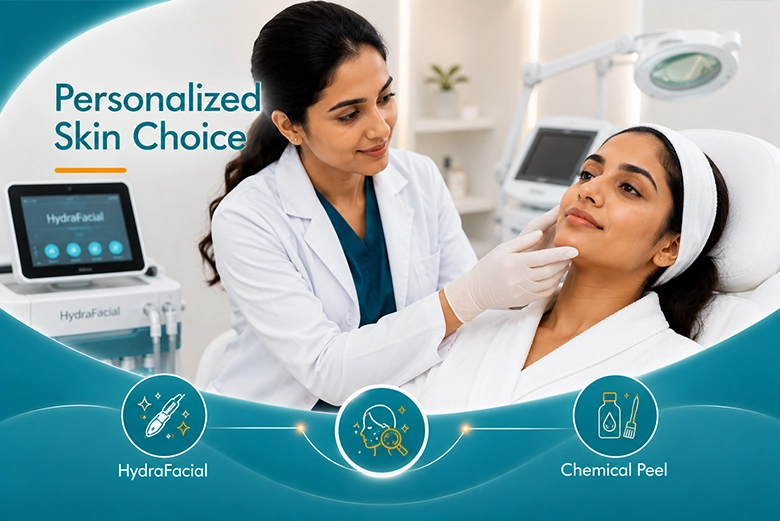
Same question, three plans. This is exactly why the assessment matters more than the label on the treatment.
Building a glow routine that uses both
Since the honest answer is so often "both," here's how the two actually fit together over a year rather than as a one-or-the-other choice. Think of it as correction and maintenance working in shifts.
Phase 1 — correct
If there's tone or texture to fix, this is where a chemical peel course That does the trick — a couple of sessions separated by 2-3 weeks ideally in Chennai cooler lower UV months. This is the transformation phase not just a refinement phase. If it is found to be of more concern — established pigmentation or scarring — this also may be when a dermatologist will step in scar treatment, laser toning or, for overall tone, glutathione, because a facial was never going to reach those.
Phase 2 — maintain
Once the baseline is where you want it, monthly HydraFacials keep skin hydrated, clear and glowing without further resurfacing. This is the low-effort, year-round rhythm most people settle into — and it's where the "every four weeks" frequency earns its keep.
Phase 3 — the daily foundation
This is not optional because neither treatment functions without it. Gentle cleanser, an appropriate moisturiser, a single well-chosen active only if your dermatologist recommends it (but note that I do not believe in layering), and — most importantly for Chennai — broad-spectrum SPF 30+ every day as non-negotiable. The quickest way to derail a course of peels is skipping sunscreen — fresh skin pigments more easily when you have unprotected exposure to gnarly rays. To promote even more youthful collagen synthesis over time, some patients also elect to combine skin PRP in the background, but that's a separate track, not part of the facial rhythm.
Correct, then maintain, all resting on a daily foundation. That's the framework — and where you start on it depends entirely on what your skin needs, which is the assessment's job to work out.

Myths about HydraFacials and peels
"A chemical peel burns your skin off."
A controlled clinical peel isn't skin burning — it's the loosening of dead surface cells at an exact depth. Light flaking is natural and surface level. The intense peeling people envision is reserved for deep peels (a completely different, supervised category) — versus what a glow peel entails.
"HydraFacial results are permanent."
No facial is permanent. A HydraFacial's glow lasts one to three weeks; consistency plus home care and sunscreen is what sustains it. Treat it as a habit, not a one-time fix.
"The more it tingles or peels, the better it worked."
Discomfort isn't a measure of effectiveness, and on Indian skin, aggressive irritation can cause post-inflammatory pigmentation — the opposite of glow. Gentle and appropriate beats harsh almost every time.
"You have to pick one or the other forever."
You don't. Many people rotate — peels for correction in phases, HydraFacials for ongoing maintenance. They're tools for different jobs, not lifelong loyalties.
How we approach it at VK Allure
Our approach is deliberately un-flashy. During your first visit, they talk about what type you are, how is ur skin when looked under a proper light — dullness means dehydration or tone? — and even Chennai-specific ones like just how much sun you get and what the water you bathe with is. It is only after that we recommend HydraFacial, a peel or BOTH — and at times not even, if pigmentation or scarring is the real issue, not surface dullness.
We're upfront that results vary between people, that maintenance matters, and that no single session is permanent. You can see the full range of skin and glow treatments, and we run the same protocols at both the Kilpauk and ECR Uthandi branches, so wherever you are in Chennai there's a location within reach. If you're unsure which to choose, a consultation sorts it in minutes.
HydraFacial, peel, or both — not sure which is right?
Book a consultation at VK Allure Dermaclinic — Kilpauk or ECR Uthandi, Chennai. We'll assess your skin and match you to the treatment that actually fits your kind of dullness.
Book an Appointment Contact the Clinic📞 +91 96009 58060 · 💬 WhatsApp us
Final thoughts
HydraFacial vs chemical peel is hardly a competition — it's about finding the right treatment for you. If you need help with dullness from a combination of dehydration and debris, HydraFacial provides immediate, safe, no-downtime glow that lasts longer when performed every 4 weeks. A chemical peel corrects dullness from uneven tone and texture over a series of treatments. For different jobs, most people get the best of both worlds. And when the dullness goes beyond skin deep, the more honest answer may be a pigmented spot orientated treatment, as opposed to either mud. Your skin is your own, climate in Chennai decides what it needs, no piece can look at that face — so pair treatment with the skin, shield it with the every day essentials and out will travel the radiance.
Frequently Asked Questions
What is better for dull skin — a HydraFacial or a chemical peel?
What is the difference between a HydraFacial and a chemical peel?
What are the main benefits of a HydraFacial?
How often should you get a HydraFacial for best results?
Is a HydraFacial or chemical peel better for glowing skin?
Does a HydraFacial hurt or have downtime?
Does a chemical peel have downtime?
Can I do a HydraFacial and chemical peel together?
Which is safer for sensitive skin?
Which is better for oily or acne-prone skin?
How long does the glow from a HydraFacial last?
How many chemical peel sessions will I need?
Can a HydraFacial or peel remove pigmentation?
Which is better before a wedding?
Are these treatments safe during pregnancy?
Does Chennai's climate affect which one I should choose?
Can men get HydraFacials and chemical peels?
Will a HydraFacial or peel make my skin fairer?
What should I do after a HydraFacial or peel?
Is a HydraFacial worth it for dull skin?
Where can I get a HydraFacial or chemical peel in Chennai?
Medically Reviewed & Written By

Dr. Lokeshwari
Dermatology Specialist · VK Allure Dermaclinic, Chennai
- ✓ Certified Dermatology Specialist
- ✓ 7+ Years of Clinical Experience
- ✓ 5,000+ Patients Treated
- ✓ Aesthetic & Medical Dermatology
Dr. Lokeshwari is a Dermatology Specialist at VK Allure Dermaclinic, from the field of advanced skincare, hair restoration, laser treatments and aesthetic dermatology. She has training in both the Kilpauk and ECR (Uthandi) branches in Chennai and follows an evidence-based approach suitable to Indian skin types and our city's environment. Her writing includes what really works — the difference (or lack thereof) between clinical reality and skincare myth.
This comparison of HydraFacial and chemical peel for glowing skin has been reviewed by Dr. Lokeshwari to ensure every recommendation and safety note reflects current dermatology practice for Indian skin and Chennai's climate.
Book a Consultation with Dr. Lokeshwari →📞 +91 96009-58060 · 💬 WhatsApp · 🏥 Kilpauk & ECR Uthandi, Chennai