If you are a person with brown skin or black skin who has been scared away from laser hair removal, that instinct is an smart one — and it's the exact period this article conveys Several years ago, "laser does not work on dark skin" and "laser burns dark skin" were both true, because the lasers in existence at that time could not distinguish between the dye-pigment of your hair follicle (the large pile of pigment is what color?) and the one decorating you face (and other parts). At worst, that confusion resulted in burns, blistering and persistent dark patches on melanin-rich skin. While the technology has progressed, the danger hasn't gone away – it's simply no longer unavoidable so long as you have enough laser in skilled hands.
So let's be precise, because precision is what keeps your skin safe. The short version, which we'll unpack thoroughly: for dark skin tones, the 1064 nm Nd:YAG laser is the safest and most reliable choice, and it's the workhorse behind good laser hair reduction for Indian skin. It goes on to explain why that's the case at the physics level, which lasers not to use, what actually constitutes "safe" beyond the machine, and how they do it right in Chennai — where almost everybody walking in has exactly the skin type that this matters greatest for.
Safest laser for dark skin — the short answer
The 1064 nm Nd:YAG laser is recognized as the safest and most effective laser hair removal for dark, brown and black skin (Fitzpatrick IV–VI). The long wavelength capability allows it to reach well beyond melanin in the epidermis and into the hair follicle, essentially minimizing the risk of burns and post-inflammatory hyperpigmentation considerably. Mid-dark paraffin skin fit very well to robust cold cooling diode lasers also; alexandrite and IPL are generally not recommended for very dark tones. Beyond the device, safe results depend on a trained dermatologist choosing correct settings.
First, the physics — because this is where safety lives
Selective photothermolysis is, essentially, how laser hair removal works. This light is within a specific wavelength that is absorbed by melanin — the pigment in your hair. The absorbed light becomes heat, which harms the follicle to an extent that it takes longer or never grows hair again. Simple enough. The trouble is that not only your hair contains melanin. It's in your skin as well, and the higher concentration of melanin present in the outer layer of skin—the epidermis—the greater amount of laser energy that penetrates is absorbed by this outer layer (instead of your hair follicles).
That's the entire safety issue in one sentence: on dark skin, a poorly chosen laser can heat the skin as much as the hair. Burns, blistering and — the most widespread phenomenon on Indian skin — post-inflammatory hyperpigmentation aka those dark patches that take months or even years to go away occur when the epidermis absorbs too much energy. It's not that the laser is "broken". But it works on the wrong target.
The solution is wavelength. Since longer wavelengths penetrate further and are better able to bypass the pigment in your skin (melanin), they can get all the way to the hair at its source, while mostly avoiding damaging skin. The 1064 nm of the Nd:YAG is in fact the longest wavelength commonly used for hair-removal. And this one number is exactly why that makes for the safe choice when it comes to melanin-rich skin — its formula is specifically designed to get around just what gets dark skin burned.
Fitzpatrick skin types — knowing where you sit
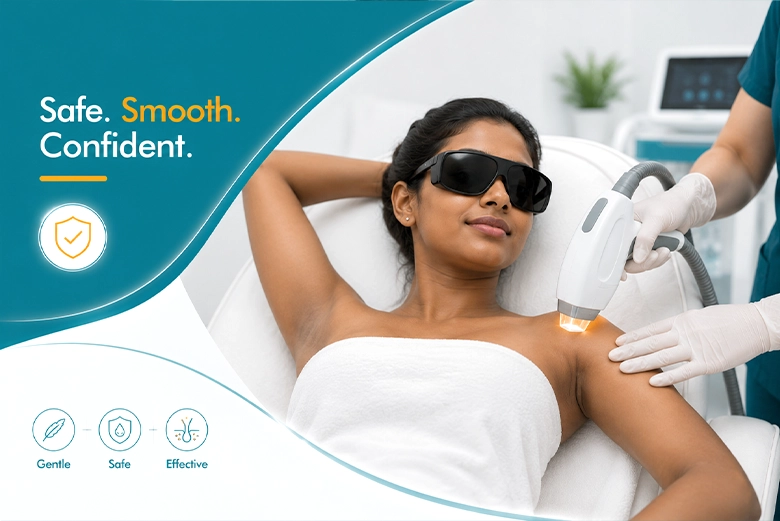
Skin is classified by how it reacts to sun according to a scale known as the Fitzpatrick system, which is the language your clinic should be speaking when planning laser. We are on a scale from Type I (very fair, always burns) to Type VI (darkly pigmented, rarely burns). The bulk of Indian skin — and what we predominantly only see in Chennai — must therefore be Type IV to VI.
| Fitzpatrick type | Typical description | Laser consideration |
|---|---|---|
| Type IV | Light brown / olive; tans easily | Nd:YAG preferred; diode possible with cooling |
| Type V | Brown skin; rarely burns | Nd:YAG strongly preferred |
| Type VI | Deeply pigmented / black skin | Nd:YAG is the safe standard; avoid alexandrite/IPL |
As a patient, why does that even matter to you? Because a clinic that never talks of Fitzpatrick type — or uses the same settings on a Type II and Type V — is missing the single most critical factor in your safety. When you ask "which parameter will you use for my skin?" Your answer will be more specific (and mention your type), and that is a good clinic. A shrug is a warning.
The lasers compared — which works best for brown and black skin
There are three or four laser types you'll encounter marketed for hair removal. They are not equal for dark skin. Here's the honest ranking.
Nd:YAG (1064 nm) — the safe standard for dark skin
Hands-down the best laser for brown skin. As one of the longest waves possible, it is least likely to be absorbed by epidermal melanin, thus rendering it with less potential harm than the rest for Fitzpatrick IV–VI and our go-to on repeat at VK Allure. Because it works deeper, the trade-off is that it can feel a little bit more uncomfortable than some other options — but modern cooling definitely helps with this. This is the laser for brown and black skin.
Diode (around 800–810 nm) — usable for medium-dark with good cooling
A middle-ground wavelength. Inexperienced hands with scientific laser knowledge and good contact cooling can use modern diode lasers safely on skin types IV (and sometimes lower V) It's effective and often comfortable. However as skin becomes darker, the margin of error tightens and for Type V–VI we would still feel more comfortable with a wider safety window offered by Nd:YAG. Many sophisticated systems combine diode and Nd:YAG wavelengths.
Alexandrite (755 nm) — excellent for fair skin, risky for dark
Very practical and quick on fair-to-light skin as the shorter wavelength is very well absorbed by melanin. That very same strength is the issue on darker skin types — with a strong melanin absorption comes a high level of UV-induced damage and pigmentation risk as found with Type V–VI. There's a time and place for that; it is just not or melanin rich skin.
IPL (not technically a laser) — generally not for dark skin
One difference is that intense pulsed light uses a broad spectrum rather than one specific wavelength, making it more difficult to control upon pigmented skin and creating an increased risk of burns and pigment changes. It's very typical of lower-end setups and some home devices. As it turns out, this transition is generally not good for brown and black skin — the problem with lasers in general is that they don't target a specific wavelength.
What "safe" actually depends on — beyond the machine
Here is where the marketing falls away. The right laser — necessary but insufficient When Nd:YAG is in the wrong hands, it can still cause injury, and the line between a good result and a burn is usually drawn by the person, not the hardware.
Correct energy settings
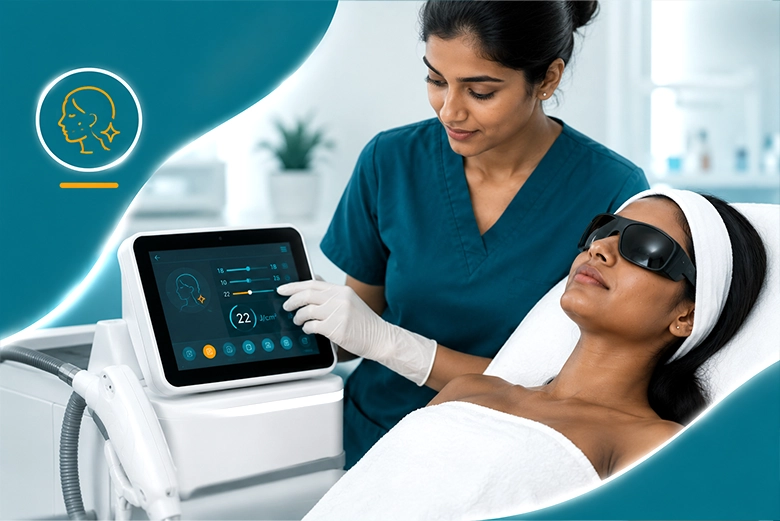
The correct wavelength requires the right fluence (energy), pulse duration and spot size for your individual skin and hair. If you go too high, you will lose the skin; if too low it simply won't work and your money is wasted. This is clinical judgement honed over years of knowing your skin type — hence why a dermatologist led clinic matters.
A patch test
A responsible clinic does a test patch, especially on darker skin, and waits to see how your skin reacts before treating a whole area. Skipping this to save time is a shortcut you don't want taken on your face or body.
Proper cooling
Contact cooling or cryogen protects the epidermis during the pulse, which is a big part of what makes treating dark skin safe. The cooling system isn't a luxury feature — it's part of the safety mechanism.
Your recent sun exposure
This one's on both of you. Tanned skin has more active melanin at the surface, which raises risk — so treatment is often deferred if you've had recent significant sun. In Chennai's sun, this is a real and frequent consideration, not a formality.
Put simply: the laser is the tool, but safety is a system — right wavelength, right settings, patch test, cooling, and a practitioner who reads your skin. Any one missing raises your risk.
Why this matters so much in Chennai specifically
Two local realities make the right-laser question sharper here than almost anywhere.
This one's on both of you. The surface of tanned skin has more active melanin, increasing risk — treatment is usually postponed if you've had significant sun recently. This is an actual and common contemplation in Chennai's sun, not just a formality.
First, skin type. Most of the residents of Chennai have Fitzpatrick IV–VI skin — precisely those categories where laser choice is crucial, because it is the difference between safety and harm. The laser menu for lighter skin is not so well suited for the local population; however, many setups will do whatever machine they purchased irrespective to who is on the table.
Secondly, sun: The degree of UV exposure is significant in Chennai for most of the year due to high temperatures and humidity forces people to have some level of a tan or active surface pigment making it even more critical that wavelength and settings are clinically optimal preventing both higher incidence as well as increased visibility of post-inflammatory hyperpigmentation consequences should things go haywire. It also means sun protection between and after sessions isn't only a piece of good advice — it's integral to the treatment working safely.
What to realistically expect from the treatment
Setting expectations honestly is part of doing this well, so here's the real picture rather than the ad version.
It's reduction, not permanent removal
This is the truth of the matter, and any establishment that claims "forever extraction" is overemphasizing. Laser features long-term hair reduction: most of the hair is gone, where hair does stay it can be finer and slower growing than before, usually with some repeat maintenance sessions required later on. That's an excellent outcome. It's never "not one hair again, ever.
It takes a course of sessions
Because hair grows in cycles, laser treatments are effective only on follicles that are in a growth phase at the time of treatment. Thus you require a setup — for the most part six to eight meetings, dispersed around four to a month and a half separated — so you can get follicles over their cycles. It would be unwise to think that one session will do it, whoever tells you otherwise.
Coarse dark hair responds best
This means for the most part Indian patients: laser preferentially works on dark > coarse hair against relatively light skin, because there is more melanin in the follicle to target. It is less effective on pale blonde, almost white or grey hair types as there is insufficient pigment to absorb the energy. It is worth knowing that before you invest.
Some downtime, usually mild
A few hours to a day (or two) of redness and mild swelling around the follicles can be expected and that is normal, it means the follicle was hit. Excessive blistering or darkening is not normal at all, and the right laser and settings are intended to take care of this.
Who should be cautious — and the honest contraindications
Laser hair removal is safe for most dark skinned individuals, but not all, so a good clinic will screen for this. If you are pregnant or breastfeeding (treatment is usually arrested for elective treatment), have had isotretinoin in the last 6 months (derm can be more easily injured), have a history of keloid scarring, suffer from active infections, cold sores or inflamed skin in the area, suffered significant sun exposure recently or tanned but not pasty white skins since eczema, then tell your derm and expect caution/postponement; obviously if you took meds that made you photo sensitive well before then. In situations like hormonal condition too such as pcod, chronic hair growth can be stimulated which needs to be medically managed in conjunction with laser or else results will continue being undermined.
None of these implies "never" to be certain. Mostly means, not right now or let's do this together. But if a clinic never asks any of it, then it isn't screening you — and adjusting for what you need is an critical part of why treatment on dark skin is safe.
Three questions that separate a safe clinic from a risky one
You don't need to be an expert to vet a clinic. Ask these three, and the answers tell you almost everything.
"Which laser will you use on my skin, and what wavelength?"
For dark skin, you want to hear Nd:YAG (1064 nm), or a well-justified diode-with-cooling for medium-dark tones. Vagueness, or a machine chosen without reference to your skin, is a red flag.
"Will you do a patch test first?"
The right answer is yes, especially on darker skin. A clinic keen to treat a full area on the first visit without testing is prioritising throughput over your safety.
"Who operates the laser, and is a dermatologist involved?"
Settings for patients with melanin-rich skin are left at the discretion of the clinician. It's OK for a trained operator working to a dermatologist's plan — not for an unregulated technician freelancing on a machine. The "it's just a beauty service" framing is what gets people burned here—literally.
Which areas can be treated — and what to know for each
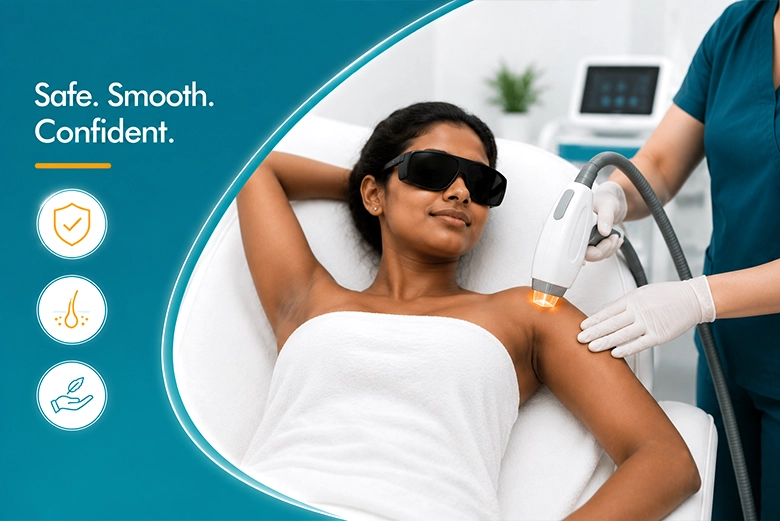
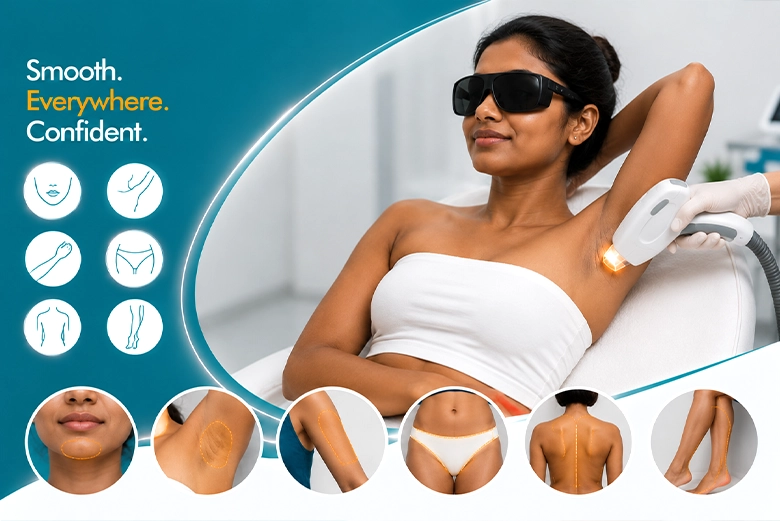
Laser hair reduction works across most of the body, and on dark skin the Nd:YAG handles all the common areas safely. A few are worth a specific note, because the skin and hair behave differently from place to place.
Face and upper lip
Widely Loved, And Works — but the skin on our faces is thinner and more visible which makes precise settings more important in this area. Right here, on dark skin is the worst place a misconfigured splash zone shows up — as pigmentation you don't want on your face. Because facial hair is usually caused by hormonal factors, stubborn growth may not be solved by the laser alone and may require some medical work. Many patients combine facial laser with skin treatments such as a HydraFacial for overall glow, spaced sensibly apart.
Underarms and bikini area
Usually vaguer and responsive, because the hair used to be thick and dark. Laser often also improves these areas, because they are prime real estate for ingrowns and folliculitis. Here, is naturally darker, so the Nd:YAG's enough margin of safety comes in handy.
Legs and arms
Large areas, so sessions take longer, but they respond well. Sun exposure is the main consideration — legs and arms catch a lot of Chennai sun, so recent tanning may mean deferring a session to stay safe.
Back and chest
Popular with men, where hair is dense and coarse — good laser targets. Density means it can take a few sessions to see the full thinning, so patience helps.
It all comes down to basic physics: the Nd:YAG's long wavelength is why dark skin was safe—and settings are adjusted based on both area and your skin. If postinflammatory hyperpigmentation from past hair removal or ingrown hairs are already an issue, procedures such as chemical peels or laser toning can be planned alongside to even things out.
Myths about laser hair removal on dark skin
"Laser doesn't work on dark skin."
Outdated. Laser is excellent for dark skin — the myth is from an era before long-wavelength lasers, when available machines truly could not safely treat melanin-rich skin. However, you can begin to say bye-bye to that period, if the brand appropriate laser is the one used.
"Laser will lighten or darken my skin permanently."
When done properly, laser hair removal will not result in darkening your skin. If the wrong laser or settings are used, temporary darkening however is post-inflammatory pigmentation, which means there was a mistake somewhere along its treatment. The perfect method of shading preserves your own skin color.
"More pain means it's working better."
No. Excessive pain or burning during treatment is a warning sign, not a measure of effectiveness. Proper treatment on dark skin, with cooling, is tolerable — sharp burning means the settings may be wrong for your skin.
"Home laser and IPL devices are just as good."
For dark skin especially, they're often worse — many home devices use IPL or wavelengths poorly suited to melanin-rich skin, with weak safety controls. The convenience isn't worth the pigmentation risk on Type V–VI skin.
"One session and I'm done."
Impossible, because of the hair growth cycle. Anyone selling a one-session solution is either misinformed or dishonest. Plan for a course.
How we do laser hair reduction at VK Allure
Briefly, so you can benchmark. With the vast majority of our patients being Fitzpatrick IV–VI, Nd:YAG-based laser hair reduction is what we use — the right one for the skin we actually treat rather than an upsell approach. Before treating a full area every course begins with an assessment of your skin type, hair type, medical history and any relevant conditions along with a patch test (where necessary).
This isn't one off permanent removal, we're straight-up about the fact it's not a silver bullet that's taking long-term reduction to course-with-occasional-maintenance. We use sufficient cooling, we customize the settings for your skin as opposed to a set protocol and we are open about sun precautions which matter a lot in Chennai — pre and post. If a treatment isn't right for you — recent tan, a contra-indication — we won't book you anyway.
You can see the full laser hair reduction details, browse our complete range of treatments, and if pigmentation is a related concern, our work on dark spot reduction and laser toning may be relevant too. We run the same protocols at both the Kilpauk and ECR Uthandi branches in Chennai.
Considering laser hair removal for your skin?
Book a consultation at VK Allure Dermaclinic — Kilpauk or ECR Uthandi, Chennai. We'll assess your skin type, recommend the right laser, and tell you honestly what to expect.
Book an Appointment Contact the Clinic📞 +91 96009 58060 · 💬 WhatsApp us
Final thoughts
Additionally, laser hair removal is actually safe for brown or black skin —just not with just any laser. The 1064 nm Nd:YAG is the best and safest option for high melanin epidermis as its long wavelength hits the follicle but spares your skin's surface: which is what has led to all those burns and dark patches that gave laser such bad PR on black skin. Safety goes beyond machine settings; it also includes a patch test, cooling, sun protection factors and having a dermatologist who takes time to read your skin. In Chennai, where the bulk of skin falls within that much-mattered-about range, the choice becomes an imperative — it's all or nothing out here. Your skin is unique to you; have it properly evaluated and this can be one of the most beneficial treatments you ever have.
Frequently Asked Questions
Which laser hair removal works best for brown or black skin?
What is the safest laser hair removal for dark skin tones?
Why is Nd:YAG better for dark skin than other lasers?
Is alexandrite laser safe for dark skin?
Can diode lasers be used on dark skin?
Is IPL good for dark skin hair removal?
Does laser hair removal work on Indian skin?
Will laser hair removal darken my skin?
How many sessions are needed for dark skin?
Is laser hair removal permanent for dark skin?
Does laser hair removal hurt more on dark skin?
What is the Fitzpatrick scale and why does it matter?
Why does a tan affect laser hair removal?
What hair types respond best to laser?
Is a patch test necessary before laser on dark skin?
Can I get laser hair removal during pregnancy?
Does PCOS affect laser hair removal results?
Are home laser and IPL devices safe for dark skin?
What are the side effects of laser hair removal on dark skin?
How should I care for my skin after laser?
Where can I get safe laser hair removal for dark skin in Chennai?
How do I know if a clinic is safe for dark-skin laser?
Medically Reviewed & Written By

Dr. Lokeshwari
Dermatology Specialist · VK Allure Dermaclinic, Chennai
- ✓ Certified Dermatology Specialist
- ✓ 7+ Years of Clinical Experience
- ✓ 5,000+ Patients Treated
- ✓ Aesthetic & Medical Dermatology
Dr. Lokeshwari is a Dermatology Specialist at VK Allure Dermaclinic, Has an extensive background in advance skin care; hair restoration, laser practice and aesthetic dermatology. There she works out of branches in Kilpauk and ECR (Uthandi) Chennai and has an evidence-based approach | tailored| to Indian skin types and the climate in our city. She writes about what really works, cutting through skincare folklore to get to the clinical truth.
This guide to laser hair removal for dark and melanin-rich skin has been reviewed by Dr. Lokeshwari to ensure every technical and safety point reflects current dermatology practice for Fitzpatrick IV–VI skin.
Book a Consultation with Dr. Lokeshwari →📞 +91 96009-58060 · 💬 WhatsApp · 🏥 Kilpauk & ECR Uthandi, Chennai