The acne cleared months ago. And here they remain: The part no one warned you about — the tiny craters, the uneven surface that lies in the light, the stains that make even good skin look tired. And now you are in the absolute middle of search results trying to figure out how many laser sessions this requires, if the deep ones are even salvageable and what that cream is you keep seeing commercials about does anything. Let's respond to all of it, in obvious terms.
Warning: a longer read (because acne scarring isn't one thing AT ALL) and an honest answer to how do I get rid of it, depends entirely on which type you have. We will discuss the types of scars, what laser does and does not do, realistic session counts, the deep scar population that should be treated to maximise results from this technology as well as where home care assists versus hope so. It's written from how we take care of scars at VK Allure Dermaclinic in Chennai — including the uncomfortable truths, because those are the ones that save you money.
Acne scar laser treatment — the short answer
Most people need 3 to 6 laser sessions, spaced 4 to 6 weeks apart, for meaningful improvement in atrophic acne scars — typically a 50–80% improvement, not total erasure. Deep scars (icepick, deep boxcar) respond best to a combination — subcision, TCA CROSS or punch techniques combined with fractional laser rather than laser alone. Most of your "scars" are really flat brown or red marks (PIH/PIE) that respond well to pigment treatment and go away over time without resurfacing. Conservative settings, and strict sun protection is needed to ensure pigmentation does not worsen on Indian skin.
First, the truth that saves you money: are they even scars?
This is where I stop half of new patients before they spend a rupee on laser. Not everything left behind by acne is a scar. There are three distinct things, and they're treated completely differently.
True scars (atrophic)
These are real changes in skin architecture — indentations where collagen was lost while healing. You can touch it, they create some kind of shadow. They are the ones that NEED procedures such as laser, subcision or microneedling. Nothing topical fills them.
Post-inflammatory hyperpigmentation (PIH)
Discoloration, which refers to flat brown or dark marks where the onetime acne was The skin is smooth — run your finger over it, and there are no dips. These are not scars. They're extra pigment, and they diminish with time – more quickly if the right pigment treatment is used in addition to sun protection. In fact, other resurfacing lasers marketed for PIH on Indian skin can aggravate it. It is very important here to make that distinction because overlying PIH is much more common in darker skin than true scarring.
Post-inflammatory erythema (PIE)
Flat red or pink marks, again smooth to the touch, common on lighter skin. Also not true scars — these are dilated vessels that settle over time, sometimes helped by vascular lasers.
Why labour this? Because people are spending cash on lasers for marks that would have faded, and wasting months on whitening creams for craters that were never going to fill. The entire game is getting the diagnosis right — and it's the very first step of a proper acne scar consultation sorts out.
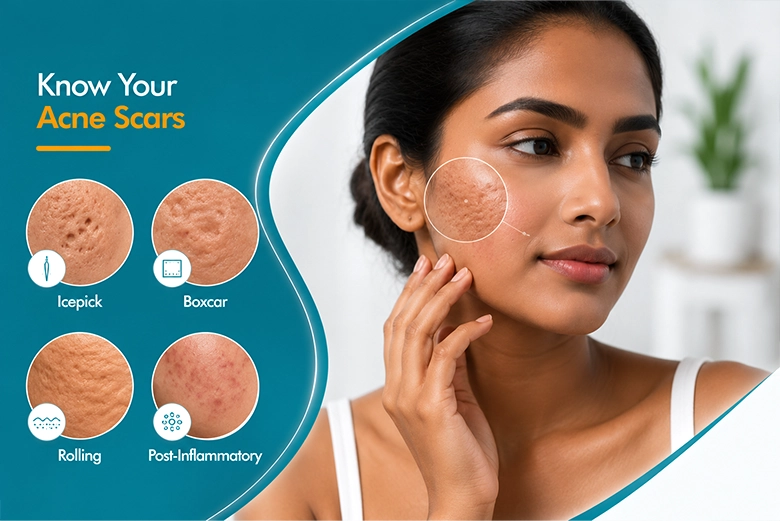
The types of true acne scars (this decides everything)
Atrophic scars aren't uniform either. The type of scar determines how they can be treated, hence the question 'what is the best treatment for acne scars' has no single answer: it depends on which ones you have and most people will have a mix.
Icepick scars
Narrow, deep, V-shaped — like the skin was pierced with a pin. Deep and steep-walled, so lasers alone often can't reach the base. These usually respond best to TCA CROSS (a focused acid applied precisely into the scar) or punch techniques.
Boxcar scars
Wider, with sharp vertical edges and a flat base — like small craters. Shallow boxcars respond well to fractional laser and microneedling; deep ones may need subcision or punch elevation first, then laser to refine.
Rolling scars
Broad, shallow, with a wavy, undulating surface caused by fibrous bands tethering the skin down from beneath. The key here is subcision — releasing those bands — often with laser or microneedling to finish. Laser alone underperforms on rolling scars precisely because it doesn't cut the tethers.
Hypertrophic and keloid scars
The opposite of atrophic — raised, thickened scars, more common on the chest, back and jawline. These need a different approach entirely: steroid injections, specific lasers, and careful management, not resurfacing.
Why it even matters: a clinic that goes for the same laser no matter the type of scar is using one hammer to pound in four different nails. Genuine results are obtained by method matching with surplus — generally many techniques, in series.
What laser actually does for acne scars
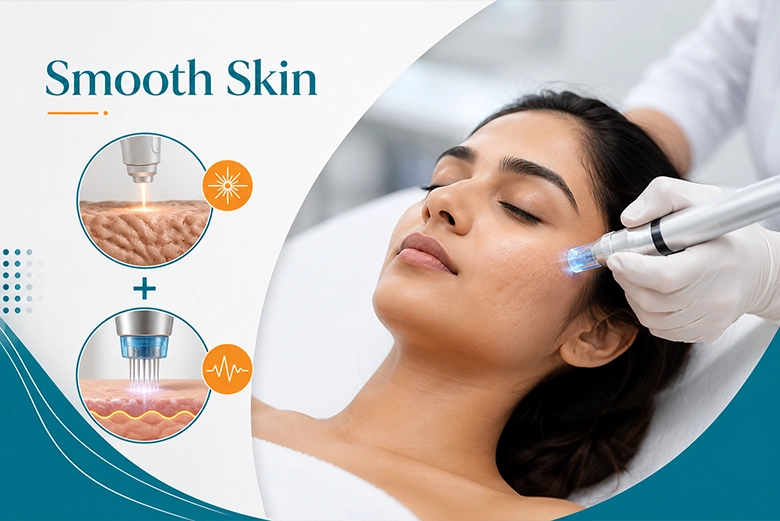
"Acne Scars by Laser would be truly, an umbrella to some of the separate technologies available in the Market. In a nutshell, they stimulate intentional micro-injury in the skin so that your body replaces it with new collagen as it heals — remodelling the scarred area over weeks or months. It doesn't vaporise the scar; it persuades your skin to remodel.
Fractional CO2 laser (ablative)
The heavy hitter. Fractional CO2 removes tiny columns of tissue, and promotes the intense remodelling of collagen. This method is the most efficient per session, but it has increased downtime (a few days of redness and flaking) and an even greater risk of post-inflammatory pigmentation on darker Indian skin if settings aren't conservative. This is powerful but requires a experienced hand here.
Non-ablative fractional laser
Heats column of tissue without removing the overlaying peak surface. Gentler, more downtime, lower PIH risk — potentially a better first line option for Fitzpatrick IV–VI skin at the expense of repeat treatment to achieve the same result. A classic trade-off that we talk about out loud.
RF microneedling
Not technically a laser, but often lumped in as one and usually our top choice for Indian skin. Wires inject radiofrequency energy into the dermis, creating some form of local heating that stimulates collagen deeper below the surface — which is one reason actually to fear injury from a treatment device. Rolling and boxcar scars, works well in conjunction with subcision.
Fractional laser plus other methods
In fact, as far as scarring goes, laser almost never works in isolation. This is the finisher after subcision has released tethers or TCA CROSS treated icepicks. And that, naturally, begs the question every deep-scar sufferer is really wanting to know.
What is the most effective treatment for deep acne scars?
Here's the honest, slightly unglamorous answer: for deep acne scars, the most effective "treatment" is almost never a single treatment. It's a combination protocol, sequenced over months. Anyone promising to erase deep scars with one machine in one course is overselling.
A typical deep-scar plan layers methods to their strengths:
- Subcision to release the fibrous bands tethering rolling and some boxcar scars from below — the foundation for anything deep.
- TCA CROSS for icepick scars the laser can't reach.
- Punch excision or elevation for individual deep, sharp scars.
- Fractional laser or RF microneedling to resurface and refine the overall texture once the deep structural work is done.
- PRP sometimes added to support healing and collagen response.
- Fillers occasionally, to lift stubborn depressed scars.
And deep scars are the ones where expectations need the most truth. Realistic improvement is significant — usually 50 to 70% better over an entire protocol, but not a perfect erase. Highly scarred skin never goes back to non-scared, it comes back visibly and often dramatically improved. The fortunate ones are the patients who get that going in. Those advertised "complete removal" are doomed to fall short of the promises that no clinic could keep. Thus, an optimally sequenced combination in skilled hands is the most effective treatment for deep acne scars when realistic expectations are established from the start.
How many laser sessions does it take to remove acne scars?
The question everyone opens with. The honest range for meaningful improvement in atrophic scars is 3 to 6 sessions, spaced between 4 — 6 weeks which makes a typical course span around four to eight months from start to finish. However the number undoubtedly varies and any clinic giving you a fixed number prior to ever even looking at your skin is guess!
| Factor | Fewer sessions | More sessions |
|---|---|---|
| Scar depth | Shallow, mild | Deep icepick, deep boxcar |
| Scar type | Rolling, shallow boxcar | Mixed / deep / widespread |
| Laser type | Ablative fractional CO2 | Non-ablative (gentler per session) |
| Skin type | Lighter, lower PIH risk | Darker skin (conservative settings) |
| Approach | Combination (laser + subcision) | Laser alone on deep scars |
A few realities worth internalising. To start with, REMOVE is the worse word — sessions remodel scars over months. Second, and this is all about skin tone: on darker Indian skin we often intentionally select softer settings — as well as spacing out sessions more to be even more protective against pigmentation — so you could find yourself doing an extra session or two; that's a bonus, not a downside. Third, deep scars which are treated with laser alone require more sessions and fall short of achieving the same improvement levels as compared to those scars treated with an appropriate combination. The solution often doesn't lie in more sessions but rather in the right mix.
How to get rid of acne scars: what works at home vs at a clinic
Let's split this cleanly, because the internet blurs it badly.
What home care genuinely does
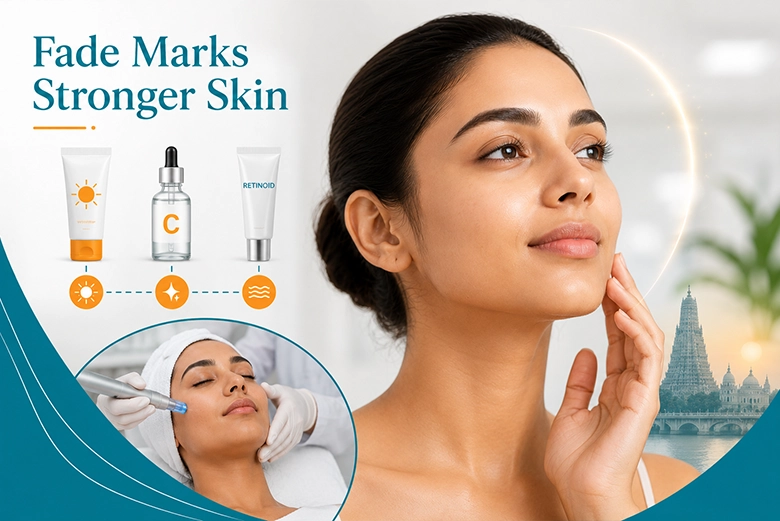
For marks What do you need for marks (PIH/PIE) — quite a lot actually. Broad-spectrum sunscreens — worn diligently — are the most impactful because sun exposure creates and sustains dark pigment. Overall, flat marks fade nicely with a vitamin C serum + retinoid (which increases cell turnover and support collagen in the long run)+ patience. A series of chemical peels accelerates this further. For pigment specifically, laser toning or targeted pigment treatment helps stubborn cases.
What home care cannot do
Fill a true atrophic scar. Not that cream, oil, or serum — vitamin E, onion extract (whatever the ad dares you to believe) — can reconstruct lost dermal collagen enough to elevate a crater. A depression in the skin structure requires a deep procedure that reaches the dermis; like laser, microneedling, subcision. Home remedies will not actually get rid of the scar; rather they will improve the condition of the skin around it but if you can feel an actual dip. Believing otherwise costs months.
The honest home-plus-clinic combination
So for most people, your best real-life action plan is to: home-treat marks (by always wearing sunscreen plus vitamin C and a retinoid); clinic-treat true scars (using the appropriate light/energy/ingredient-based procedure); and never forget to protect your skin in the sun since it protects results of all clinical treatments as well. Marks appear slowly, and with gentle attention, will also disappear. Scars need procedures. Both need sunscreen. And there we have it in a nutshell, "How to get rid of acne scars"."
The one thing that must come first: is your acne actually controlled?
We pull some bluebird patients here, as this is non negotiable. It will be pointless to resurfacing the scars whilst new acne is forming, you would actually be smoothing out old craters whilst new craters are being created. You are a rain painting wall.
Therefore, stage 1 is at all times to quiet energetic zits — via medical remedy, an audit of your routine – and typically oral drug treatment. We only begin scar work once the skin has been stable for some time. Patients want to hate hearing the word "not yet" but beginning scar therapy on active acne is a waste of money and may aggravate inflammtory things. The obvious example of this is when a clinic booking you directly in for scar laser hasn't checked to see if your acne is controlled — they are missing the most critical gate. Early on its the first conversation you have if your still breaking out — see our way to acne and scar management.
Acne scar treatment on Indian skin: why Chennai changes the plan
Fitzpatrick IV–VI skin — which covers most Chennai patients — behaves differently, and a good plan respects that.
The main point is that post-inflammatory hyperpigmentation has a higher incidence in darker skin. Treatments that are too aggressive and cause excessive inflammation can also produce brown marks that take months to dissipate, the very opposite of what you came for. Therefore we tend to prefer conservative laser settings, prefer RF microneedling and non ablative treatments where possible in many patients, space sessions allowing the skin time to recover properly and integrate sun protection as part of treatment rather than as an afterthought.
Chennai's climate compounds this. Because you're getting UV-intense, nearly all-year-round, we are mindful of risks to pigmentation after any kind of procedure and how quickly the skin may recover (or not) depending on time-of-year, so we're very conscious about when we do treatments as well as with what pre- and post-care. Rigid every day sunscreen is not a suggestion right here — it is the shield that guards the outcome you paid for. Our patients deserve the safest, most appropriate care and standard dermatology guidance for skin of colour has consistently endorsed this conservative, pigment-aware strategy.
What a realistic treatment journey looks like
So you can picture the whole arc rather than one appointment.
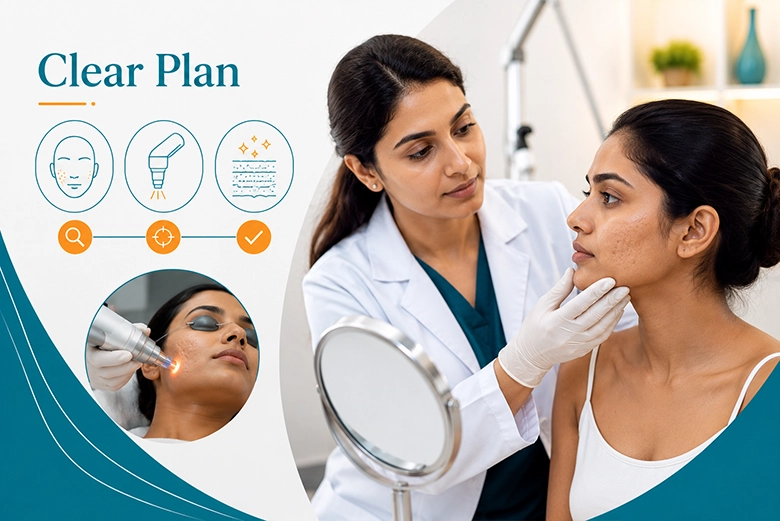
- Assessment. Diagnosis of scar types, a check that acne is controlled, and a plan matched to your specific mix of scars and skin type.
- Preparation. Sometimes a few weeks of prepping the skin — sunscreen discipline, occasionally topicals — before the first procedure.
- The active course. The sequence of treatments — often subcision or TCA CROSS for structural work, then fractional laser or RF microneedling to refine — spaced 4 to 6 weeks apart.
- Review points. Checking response and adjusting; scars respond differently between people, and the plan should flex.
- The long tail. Collagen keeps remodelling for months after the final session, so the final result isn't the day you finish — it's often three to six months later.
Since this is a standard course of several months, with frequent checkins, then having a weight-loss clinic you can get to easily helps you stick to it — sticking to it is what gets the result. It gives you an overall view of how scar work fits into the range of external inputs that you will be dealing machine learning driven approaches. range of skin treatments, and glow treatments like HydraFacial often sit alongside as maintenance between sessions.
Myths about acne scar removal
"One laser session will remove my scars."
No. A single session begins the collagen remodelling but never completes it. Meaningful change needs a course, and deep scars need a combination. Anyone promising one-session removal is selling a story.
"Lasers completely erase acne scars."
The honest goal is improvement, not perfection — often substantial, sometimes dramatic but rarely 100%. Deeply-scarring skin is markedly better (but it doesn't become never-scarred skin). Patients feel happy with more realistic expectations.
"Home remedies can fill deep scars."
They can't. Creams and oils improve surrounding skin health and can fade marks, but nothing topical rebuilds enough dermal collagen to lift a true crater. Deep scars need procedures.
"Laser is unsafe for dark skin."
Not when done correctly. Given the correct settings, appropriate choice of device and adequate sun protection, Indian skin can be treated safely and effectively. The risk is from improper settings and inexperienced use, not dark skin.
"Once I do laser, I don't need sunscreen."
The opposite. Post-treatment skin is more vulnerable to pigmentation, so sunscreen matters more after laser, not less. Skipping it is the fastest way to undo your progress.
Who should wait, and what to tell your dermatologist
There is no universal right time for everyone to start scar treatment. DO inform your dermatologist — and be prepared to wait — if you are pregnant or nursing, on isotretinoin in the last 6 months (skin is not a pink glowing canvas post acne healing has different timelines) or any active acne or infection in the area, keloidal predisposition, and an active cold sore if we are treating near mouth. Some lasers also can be ineffective under certain conditions. A clinic that doesn't ask any of this is not screening you properly, and with scar work where the entire mechanism is in how healing happens so that screening REALLY DOES MATTER.
Don´t assume there are no treatment options left for you if a previous treatment on other clinic did not bring the desired results or left pigmentation scars. Even a new, pigment-conscious designed plan can sometimes still get moving for you; come and have an honest look at what you could do from here.
How we approach acne scars at VK Allure
In summary, so you understand what an actual plan feels like. Every scar consultation begins with a diagnosis — what kind and how deep are the scars, and more importantly, is this really scarring or marks, because that makes all the difference. You have your acne under control before beginning. Next, we create over a combination plan customized to your scars & skin type and go over realistic percentage improve instead of talking about 100% erase (which we encourage no skin care provider selling this type of fantasybased miracles) and pricing it per session in writing.
We're clear about the fact this is a course administered over months, that darker skin requires a cautious, pigment-conscious approach and that part of the prescription involves sun protection. The same protocols are run at both Kilpauk and ECR Uthandi branches; that means no matter where you are in Chennai, a full course is only a short drive away! Not knowing if your scars are suitable for treatment — or even whether they are actually scars — is resolved in one visit with a consultation.
Want to know what's realistically possible for your scars?
Book an acne scar consultation at VK Allure Dermaclinic — Kilpauk or ECR Uthandi, Chennai. We'll diagnose your scar types, confirm what's treatable, and give you an honest plan.
Book an Appointment Contact the Clinic📞 +91 96009 58060 · 💬 WhatsApp us
Final thoughts
There are few real truths when it comes to getting rid of acne scars. Step one: Determine whether you are actually dealing with scars or just marks (marks can be treated with sun protection and pigment care without a need for lasers). For genuine atrophic scars, this is 50–80% improvement, not 100%, with a program of not less than three to six laser treatments over months. Single machines cannot solve this case, so a combination is needed — subcision, TCA CROSS and laser together to treat deep scars. For Indian skin in Chennai, a conservative pigment-aware approach with rigorous photoprotection ensures that the results dont backfire. Your scars are unique to you, no article can measure them all — however, with the right diagnosis and an action plan based on reality, real improvements are entirely possible.
Frequently Asked Questions
How many laser sessions does it take to remove acne scars?
What is the most effective treatment for deep acne scars?
Can laser completely remove acne scars?
How do I get rid of acne scars at home?
Are my acne marks the same as acne scars?
What are the different types of acne scars?
Which laser is best for acne scars?
Is RF microneedling better than laser for acne scars?
How long does it take to see results from acne scar laser?
Is laser treatment for acne scars safe on Indian skin?
Does acne need to be controlled before scar treatment?
What is subcision for acne scars?
What is TCA CROSS?
How much improvement can I realistically expect?
Is there downtime after acne scar laser?
Do chemical peels help with acne scars?
Can acne scars come back after treatment?
How much does acne scar treatment involve overall?
Can I get acne scar treatment during pregnancy?
Should I wait after isotretinoin before scar treatment?
Where can I get acne scar treatment in Chennai?
Medically Reviewed & Written By

Dr. Lokeshwari
Dermatology Specialist · VK Allure Dermaclinic, Chennai
- ✓ Certified Dermatology Specialist
- ✓ 7+ Years of Clinical Experience
- ✓ 5,000+ Patients Treated
- ✓ Aesthetic & Medical Dermatology
Dr. Lokeshwari is a Dermatology Specialist at VK Allure Dermaclinic, Possessing years of experience in advanced skincare, hair restoration and laser treatments and aesthetic dermatology. She works at the Kilpauk and ECR (Uthandi) branches in Chennai, where she uses an evidence-based approach specific to Indian skin types for a city like Chennai weather. In her writing, she explores what really works — cutting through skincare myths and clinical reality
This guide to laser and acne scar treatment has been reviewed by Dr. Lokeshwari to ensure the scar-type explanations, session ranges and safety notes reflect current dermatology practice for Indian skin.
Book a Consultation with Dr. Lokeshwari →📞 +91 96009-58060 · 💬 WhatsApp · 🏥 Kilpauk & ECR Uthandi, Chennai