Makhana did a stunning miracle in our Indian wellness culture for the whole of this lapse decade. What was once a temple prasad, and averting to black magic — turned into a "superfood" stocked in health shops from Mylapore to Indiranagar. And with the rise came the claims: luminous skin, anti-ageing, collagen boost, acne cure.
Some of those claims are based in real nutritional science. Some of them are marketing dressed up in the language of dermatology. The patients who come to VK Allure Dermaclinic deserve to know which is which.
The article outlines the proven nutrient profile of makhana, then explains the pathways through which those nutrients can modulate skin biology and finally sets realistic expectations about what a few dozen fox nuts per day can accomplish for your complexion. We will also talk about what follows a diet — when the skin issue requires more than just a snack on its way to recovery.
Makhana (Euryale ferox), as an example, gives us antioxidant flavonoids such as kaempferol and quercetin, along with some zinc, magnesium, iron, and thiamine — all of which have been documented to help various aspects of skin health. This type of support includes antioxidant protection from UV-induced oxidative damage, anti-inflammatory action to soothe acne-prone and reactive skin types, zinc mediated sebum regulation nogal glycaemic index that prevents insulin spikes associated with acne and collagen destruction. Importantly, it does not make collagen itself, will not reverse pre-existing pigmentation, and is a dietary supplement rather than a dermatological agent.
What Is Makhana — and Why Is It Nutritionally Interesting?
Makhana is the popped seed of Euryale ferox, an aquatic plant in the family Nymphaeaceae. The seeds are harvested from the ponds and sun-dried and then roasted at high heat to puff them like popcorn is produced. The end product is starchy, low-fat and astonishingly shelf-stable.
Makhana is produced in India, which dominates the global market with over 80 per cent of the world production of the seeds coming from Bihar. Used medicinally for centuries in Ayurveda and Traditional Chinese Medicine, it is often considered a kidney tonic and used for reproductive health. We now know from modern nutritional analysis that it has bioactive compounds in addition to macronutrients.
The reason for that is most of the flashy skin claims floating around on the internet are based on experiments, usually in vitro (cell culture) or animal studies looking at isolated makhana compounds — not from human clinical trials of people who ate mahamaxa as a snack. The difference is important, considering that the fate of kaempferol in a lab dish does not determine its fate after oral consumption, digestion, and distribution through the systemic blood circulation. The effects do exist, but they are smaller and slower acting than what the wellness industry would have you believe.
The Nutritional Profile of Makhana — What’s Actually in It
Per 100g of roasted makhana, the nutritional breakdown is approximately:
| Nutrient | Amount (per 100g) | Relevance to Skin |
|---|---|---|
| Calories | ~347 kcal | Moderate energy density |
| Carbohydrates | ~76g (low GI) | Low GI = reduced acne-triggering insulin spike |
| Protein | ~9.7g | Amino acid substrate for collagen-supporting proteins |
| Fat | ~0.1g | Very low — not a significant source of skin-relevant fatty acids |
| Magnesium | ~67mg (~16% DV) | Enzyme cofactor for collagen synthesis, barrier function |
| Zinc | ~0.5mg (~5% DV) | Sebum regulation, wound healing, anti-inflammatory |
| Iron | ~1.4mg (~8% DV) | Oxygen delivery to skin cells, reduces pallor |
| Potassium | ~500mg | Cellular hydration balance |
| Thiamine (B1) | ~0.14mg | Cellular energy metabolism in skin |
| Calcium | ~60mg | Skin barrier integrity, cell signalling |
| Kaempferol / Quercetin | Present (flavonoids) | Antioxidant, anti-inflammatory, anti-melanogenic |
A few things to note. The fat content is super low—it means makhana is virtually free of the omega-3 and omega-6 fatty acids that directly support the skin barrier, responsible for skin moisture retention. If you are munching on a makhana hoping to get your skin hydration like what walnut or flaxseeds do, you will be disappointed. That is not what it does.
Strengths: provides a decent dose of magnesium and a 1.2g antioxidant flavonoid profile but it is another low Glycaemic index snack That swap does matter for skin over time, on Indian diets where the average daily snack is perhaps a packet of biscuits or namkeen — both high-GI, low-nutrient.
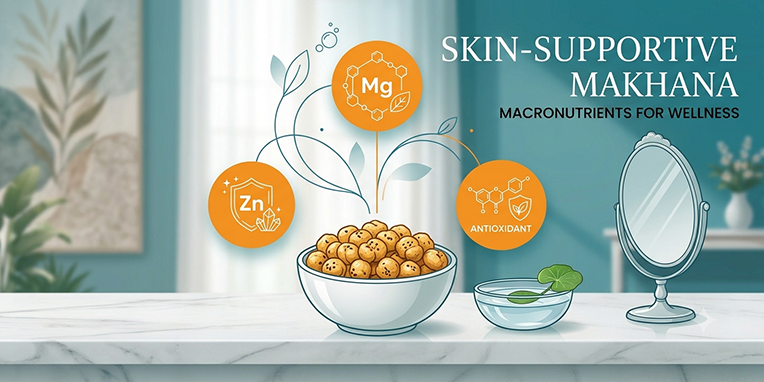
The 8 Genuine Skin Benefits of Makhana — With the Science
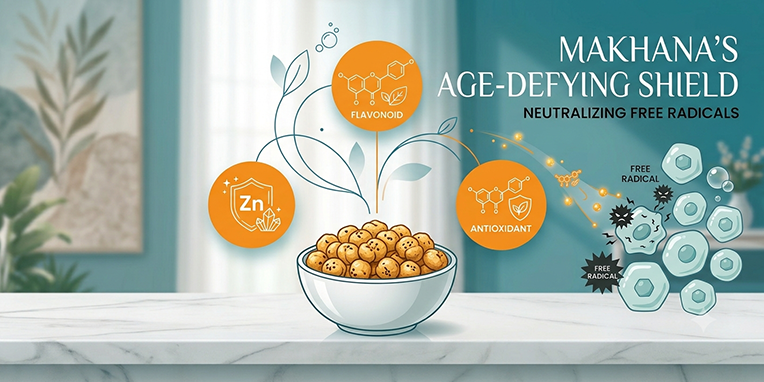
Makhana contains a high concentration of flavonoids, specifically kaempferol and quercetinwhich are known to be effective free radical scavengers. UV rays, pollution, and normal metabolic processes produce free radicals that damage skin cell DNA, oxidise lipids in the skin barrier and cause collagen degradation. Dietary antioxidants are basically the body’s own battery of UV fighting defence, & every time you consume makhana, it adds to your pool.
Chronic subclinical skin inflammation is what drives acne, photoageing, rosacea exacerbation and skin barrier instability. Pro-inflammatory Cytokines (TNF-α, IL-6) Inhibition by Kaempferol in cell models. Increased systemic inflammation is observed with magnesium deficiency. This combination makes makhana only mildly—yet authentically—anti-inflammatory in the dietary context.
Zinc modulates 5-alpha reductase activity: the enzyme that converts testosterone to DHT to stimulate sebaceous glands. Numerous clinical investigations have demonstrated decreased serum zinc in cases of acne versus controls. The zinc contribution of Makhana is only modest ( a handful x 5 days gives you a meaningful daily snack portion. It's not a zinc supplement, but it is a beneficial dietary supply.
Zinc plays a key role in the reparative processes such as wound healing, specifically the epithelial cell regeneration and inflammatory-proliferative phases [18]. Magnesium is a cofactor for the enzymatic reactions involved in structural protein synthesis. Both of which are provided for by makhana, helps skin recovery from acne, micro-tear repair from environmental stress and general skin turnover needs good levels of zinc and magnesium.
Lamellar body secretion, the process that releases lipids that seal the barrier, relies on a precisely regulated calcium gradient across the epidermis. Many of the enzymatic reactions to maintain barriers require magnesium as a co-factors. Both deficiencies are accompanied by increased transepidermal water loss, and sensitivity. Makhana contributes to both.
The relationship between a high-glycaemic diet and acne is well-documented in the dermatology literature. Low-GI diet significantly reduced acne lesion count, in a landmark 2007 AJCN randomised trial. Makhana is one of the few low GI starchy snacks ingredients available on Indian market. It is a balm for individuals with acne or those who want to lessen their dependence on chips, biscuits, or namkeen as a snack substitute.
In fact, iron deficiency anaemia is the most common cause of dull, pale or sallow skin amongst Indian women- especially in younger patient cohort of Chennai. Makhana release non-haem iron; when taken with a source of vitamin C (aamla chutney, lemon water along with), absorption increases nearly tenfold. Thiamine helps restore cellular energy metabolism to keep skin cells metabolically active.
But the pathway from diet to glycation, a process whereby excess glucose cross-links collagen and elastin fibres making them stiff and brittle, is one that many experts in skin ageing seem unaware of. Plain makhana has very little sugar and does not cause the post-prandial glucose spikes that lead to glycation. Antioxidant flavonoids also inhibit carbonyl stress. Asynctech makhana driver supplies anti-glycationbuilder thoughts say together as compared with the institution ofopcptra, Thegeneralleast consumptions carry slim deep high-density snacks.
Makhana and Acne — The Glycaemic Index Connection
This is probably the most clinically relevant skin benefit of makhana for the Chennai population. Let me explain the mechanism properly, because it gets hand-waved in most wellness articles.
Eating a high-GI food — too much white rice, maida-based snacks, biscuits and sugary drinks increases blood glucose swiftly. It is regulated by insulin released from the pancreas. Insulin then stimulates secretion of IGF-1 (insulin-like growth factor 1) from the liver. IGF-1 encourages the sebaceous glands to create additional sebum. It furthermore promotes keratinocyte proliferation, which causes a narrowing of the follicular canal. Those two effects combined — extra oil and increased size for the canal — are a recipe for an obstructed follicle, and ultimately, one that is ready to become an acne lesion.
This is not theory. Smith et al.'s 2007 study in the AJCN methods: after randomising acne patients to receive either a low-GI diet or a conventional Australian diet, researchers noted a 22% reduction in acne lesion count at week 12 in the low-GI group. This and subsequent data have led to the incorporation of dietary counselling in acne management guidelines by the AAD (American Academy of Dermatology) [7].
What does that have to do with Maca? The practical tips we offer are: — In our Kilpauk clinic, when we counsel patients with mild-to-moderate acne based on the data written above regarding dietary modifications one of my first works is to guide patients to have low-GI instead of high GI snacks. One of the easiest locally available, low-GI snacks besides plain roasted makhana is that which offers zinc (munchable seed figures) — and you can escape from the caramelised or belligerently salted commercial coatings here, okay? So that mix really does make it a valuable adjunctive dietary tool in acne patients!
It does not replace acne scar treatment or the topical and oral therapies that address active acne. But as a snack choice, it is one of the better ones your dermatologist would not object to.
Makhana and Skin Ageing — What Is and Is Not Supported by Evidence
The anti-ageing claim for makhana is the most overstated of the bunch. Social media posts often frame it as a collagen booster or skin-tightening food. Here is the honest picture.
What makhana does for skin ageing (genuinely)
- Antioxidant protection: We provide evidence that kaempferol and quercetin are known to suppress UV-evoked free radicals. Dietary antioxidants play a really protective role — photo-oxidative damage (UV + ROS) is responsible for most visible skin aging, ie, the wrinkles, combined with sagging and areas of pigmentation and irregular texture that many people associate as looking "older."
- Anti-glycation: Antioxidant activity and low sugar content help make makhana reduce dietary glycation – the process by which collagen is cross- linked by sugar molecules leads to a loss of flexibility in skin as well as stiffening. This is a very gradual, compounding benefit that matters when considering years of habitual eating.
- Magnesium for collagen enzyme function: The enzymes involved in collagen biosynthesis, such as prolyl hydroxylase and lysyl hydroxylase, are all mineral-dependent. Magnesium deficiency impairs these reactions. Makhana: It also adds 16% of the daily magnesium requirement per serving of 100g.
What makhana does not do (the honest part)
- Does not contain collagen. Collagen is exclusively found in animal tissues. Makhana contains no collagen, period.
- Does not stimulate significant collagen synthesis on its own. Vitamin C is the primary required cofactor for hydroxylase enzymes that stabilise collagen’s triple helix structure. Makhana provides no vitamin C. If collagen support is the goal, pair makhana with an amla or citrus source.
- Does not visibly tighten skin or lift sagging. There is no food that does this. Sagging results from dermal collagen and elastin loss, fat pad redistribution, and bony structure changes — all of which require in-clinic interventions like HIFU treatment or RF microneedling to address meaningfully.
The honest framing: makhana helps protect the collagen you have from being degraded faster. It does not replace lost collagen, produce significant new collagen, or do anything to the visible signs of ageing that are already established.
Makhana and Hyperpigmentation — The Kaempferol Angle
This is a nuanced area that is worth addressing separately, because kaempferol has some interesting research in the pigmentation space.
Kaempferol has been shown to be an anti-melanogenic agent in cell cultures by partly inhibiting the tyrosinase enzyme pathway which produces melanin in melanocytes. The mechanism includes the inhibition of MITF (microphthalmia-associated transcription factor), which is a genetic master regulator for melanocyte gene expression, as well as a subsequent downregulation of tyrosinase and TRP-1 /TRP-2. This is actual science from peer reviewed papers.
However, and this is a very big however indeed, the levels used for cellular studies are several orders of magnitude greater than would be achieved in skin cells via dietary intake from consuming makhana. Kaempferol is ingested, digested, partially degraded in the gut, absorbed as glycoside metabolites and eventually distributed throughout the organism. What you get at the skin melanocyte level is a tiny fraction of what you consumed
In our ECR Uthandi clinic, we do not recommend makhana as a dietary treatment for melasma or dark spot reduction. The established treatments — tranexamic acid, niacinamide, chemical peels, Q-switched Nd:YAG laser toning for pigmentation — have robust human clinical evidence. Makhana does not. Including it on a regular basis in an anti-inflammatory diet might offer some mild supportive background benefit — especially with conditions associated with post-inflammatory hyperpigmentation since the trigger is reduced when inflammation is lowered. That is a reasonable expectation. But expecting it to reduce pre-existing pigmentation is not.
The Hydration Myth — What Makhana Cannot Do for Dry Skin
Several makhana articles claim it “hydrates the skin from within”. This requires a direct response.
Skin hydration — usually referred to as the water content into stratum corneum skin hydrating status (the level of water in the upper layer of your skin) — is maintained mostly by skin barrier lipids. The dietary determinants of optimal skin hydration include: sufficient water intake, healthy fat (omega-3s, omega-6 in a beneficial ratio), and the integrity of the skin barrier.
Makhana contains essentially no fat and therefore there is no specific compound in Makhana that mediates moisture retention mechanisms of the skin directly. It does no such thing as "hydrate from within" in any sense that can be meaningfully supported. Its magnesium and calcium may also indirectly support the enzymatic processes that generate barrier lipid production (a more modest effect).
For dry skin, typical environments in air conditioned offices may be very drying to the skin.The most effective diet measures are: increase omega 3 fatty acids (flaxseeds, walnuts, oily fish), consuming more than 2.5litres of water per day and applying a moisturiser containing ceramides. Makhana also seems to be of no note in the scheme of dry skin. For dry skin types it is preferably of better use to pair it with a tadka of ghee or handful soaked almonds.
How to Eat Makhana for Maximum Skin Benefit
The form in which you eat makhana matters almost as much as whether you eat it. Here is what we recommend when patients ask.
Best form for skin
Plain roasted with minimal additions. Ghee, a pincho de turmeric (curcumin potentia el efecto antiinflamatorio), y un pco de pimienta negra (piperine mejora la biodisponibilidad del curcumina en hasta 20x). Simple. This is part of why the ghee (which also offers some help with fat-soluble vitamin absorption) and turmeric-pepper combination make so much sense together, as that concentrated botanical duo is very well established from a perspective of anti-inflammatory synergy.
Useful pairings
- With amla murabba or a squeeze of lemon: adds vitamin C, enhancing iron absorption from the makhana and providing the collagen cofactor makhana lacks on its own
- With a small handful of soaked almonds: adds vitamin E (fat-soluble antioxidant excellent for skin moisture protection) to complement makhana’s water-soluble antioxidants
- With a cup of green tea: EGCG from green tea and kaempferol from makhana provide complementary antioxidant coverage
Forms to avoid for skin purposes
- Caramelised or honey-coated makhana: the added sugar directly counteracts the low-GI benefit and promotes dietary glycation
- Heavily salted commercial varieties: excess sodium increases systemic inflammation and oedema; the skin appears puffier and less clear
- Deep-fried makhana: the fat absorbed during frying is typically refined seed oil at high temperature — producing oxidised lipids that are pro-inflammatory, the opposite of what you want for skin
- Flavoured “party makhana” varieties with artificial additives: these have little resemblance, nutritionally, to the plain product
Makhana vs Other Skin Superfoods — An Honest Comparison
Where does makhana actually sit in the hierarchy of skin-supportive foods? Let’s be direct about it.
| Food | Key Skin Nutrient | Best For | Where Makhana Wins |
|---|---|---|---|
| Almonds | Vitamin E (fat-soluble antioxidant) | Dry skin, moisture barrier | Makhana wins on GI, zinc, magnesium |
| Walnuts | Omega-3 fatty acids | Inflammation, dry skin, barrier | Makhana wins on GI and calorie count |
| Amla | Vitamin C (collagen cofactor) | Collagen synthesis, brightening | Makhana wins on sustained energy, minerals |
| Dark chocolate | Copper, flavanols | Antioxidant, copper for melanin | Comparable antioxidant; makhana has more minerals |
| Pumpkin seeds | Zinc, tyrosine | Acne, melanin support | Similar zinc; makhana has lower fat content |
| Makhana | Kaempferol, Mg, Zn, low GI | Acne, anti-oxidant protection, anti-glycation | Best as daily low-calorie snack replacement |
In any one category, Makhana is not the strongest skin food. Yet is actually uniquely qualified as a low-cal girth swath of daily snackage that not only ticks multiple boxes, but tastes good enough that people will actually eat it on a regular basis. In dietary skin support, consistency is a top challenge — the best skin foods are those you can eat daily.
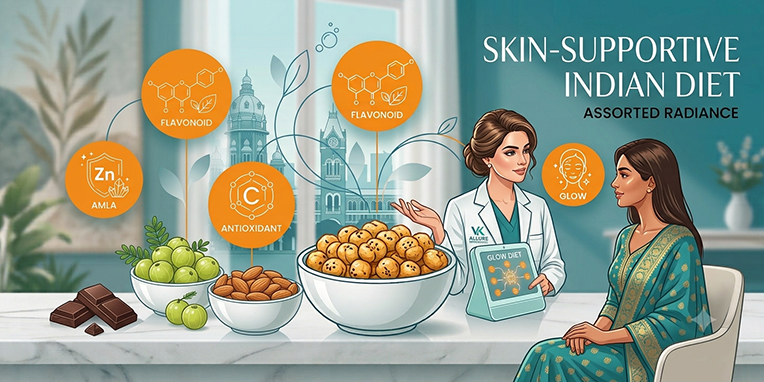
What Makhana Cannot Do — And When to See a Dermatologist
And we see enough of this in clinic to make it worth naming directly. A patient approaches you with acne, pigmentation, signs of early ageing or dull complexion and has already tried out dietarychanges, supplements or home remedies for 6 months which failed to provide any benefit. At times the dietary work has truly made a difference But the reason for the search almost always needed medical attention from early on, and time lapsed makes it much more difficult to manage.
Makhana, or any food, cannot:
- Treat established acne or prevent scarring — active moderate-to-severe acne needs prescription-grade treatment
- Reverse established melasma or post-inflammatory hyperpigmentation — these need topical actives, peels, or laser
- Tighten or lift skin that has already lost collagen and elastin — this requires in-clinic treatment
- Clear comedones, reduce large pores, or resurface acne-scarred texture — these are structural issues
- Protect against UV damage as a substitute for sunscreen — dietary antioxidants are the internal defence; SPF 30+ is the primary external defence
If you are dealing with active skin concerns, the right approach is: eat well (makhana is part of that), and see a dermatologist for the specific concern. Our full range of skin treatments at VK Allure covers the spectrum — from Hydrafacial and chemical peels for glow and congestion, to acne scar treatment, melasma treatment, and skin PRP for rejuvenation.
The Chennai Skin Context — Why Antioxidants Matter Here Specifically
A brief note about why dietary antioxidants are particularly relevant for skin health in Chennai.
Chennai experiences UV index levels of 10 and higher (excellent) during summer months (March–July).[8] The combination of high humidity (which enhances percutaneous absorption of environmental pollutants), particulate matter from traffic on arterial roads like OMR and Anna Salai, and the typical Chennai outdoor exposure pattern (outdoors most of the day for commuting, work, errand running), means that oxidative burden due to skin exposure here is much higher than in temperate cities.
This is important for the makhana conversation, seeing as it indicates that antioxidant-protection makhana offers, albeit fairly weak on its own, is put to use against a real daily oxidative stress. When you follow a diet with an abundant amount of antioxidants here (amla, makhana, green tea, colorful vegetables) patients have been shown to progressively achieve better skin quality over time as compared to people eating mainly refined food substances which are low in antioxidants. That is not marketing, that is clinical observation.
You have an actually effective internal-external antioxidant system for skin protection in Chennai’s UV environment; Marry those dietary antioxidants with SPF 30+ broad-spectrum fifteen minutes every single morning —–every morning, even on overcast days, even in the car—so they can do more than just rest.
Building a Complete Skin-Supportive Diet Around Makhana
Makhana’s limitations make it clear that it works best as one component in a broader dietary strategy. Here is how to position it within a complete skin-nutrition framework:
The daily skin nutrition framework
- Antioxidants (internal UV defence): Makhana, amla, colourful vegetables (bell peppers, tomatoes, carrots), green tea. This is where makhana fits.
- Anti-inflammatory fats: Walnuts, flaxseeds, fatty fish, avocado. Makhana does not cover this — these foods do.
- Collagen cofactors: Vitamin C (amla, lemon, guava), copper (sesame, dark chocolate), zinc (pumpkin seeds, dairy). Makhana partially covers zinc.
- Gut-skin axis support: Curd, buttermilk, fermented foods (idli, dosa ferment). A healthy gut microbiome significantly affects skin inflammation.
- Low-GI carbohydrate base: Makhana, millets, legumes, vegetables. This is makhana’s core contribution.
- Adequate hydration: 2.5+ litres of water daily, particularly important in Chennai’s climate.
In this framework, makhana comfortably covers two categories — antioxidants and low-GI snacking — and partially contributes to a third (collagen cofactors via zinc). That is a genuinely useful dietary role, without the superfood hyperbole.
Final Thoughts
Makhana is a good food. The flavonoid antioxidants alone would entitle it to a place in the skin-conscious diet, but add its magnesium and zinc benefits, its low glycaemic index (GI) and its comfortable daily usability-as-a-snack status. These are genuine benefits based on genuine nutritional science.
However, it is a snack and not a cure. Over time and with continuous usage, it can offer deep assistance for the skin from within. It is not an acne remove, dark spot fade, aging skin tightening remedy and it is no substitute for sunscreen. Anyone who tells you that otherwise is selling you something.
The intelligent way: munch on makhana each day as a snack in plain roasted kind with amla or lemon; additionally it is the excellent mixture for inadequate vitamin C. Then, build a comprehensive anti-inflammatory diet around this. All skin-related issues — pigmentations, acne rashes, skin roughness, premature aging— walk in for check-up. This is where the real job gets done.
Ready to take your skin health seriously?
Diet is the foundation — but specific skin concerns need targeted clinical solutions. Book a consultation at VK Allure Dermaclinic in Kilpauk or ECR Uthandi, Chennai, and get a personalised skin plan from our dermatology team.