Dark underarms are one of the most common skin concerns we see at VK Allure Dermaclinic — and one of the most quietly distressing ones. It's not a condition that gets talked about openly, so most people spend years trying every YouTube remedy before anyone tells them the honest truth about what's going on.
So, there you go, put out before you: dark underarms are very rarely a cleanliness issue. Darkening is from pigment — an oeverproduction of melanin as a result of friction, chemical irritation, shaving trauma or even from an underlying hormonal or metabolic disorder. Unfortunately, scrubbing harder, applying even more product and changing your deodorant more often generally don't address the cause of discolouration at all — and can even make it worse.
Having said that, there are a few home remedies that can be effective with regard to the mild darkening. And a routine skin regimen for that underarm area — which is strange since so many people never think about it — changes the way you smell in 8–12 weeks. Lets see it all one by one.
Dark Underarms — The Short Answer
Dark underarms: these are due to friction, shaving, chemical deodorants or a condition called acanthosis nigricans. Home approaches that are more evidence adjacent for mild cases (potato slice or juice (azelaic acid precursor), aloe vera gel, niacinamide serum, and switching to a gentle fragrance-free deodorant). Once or twice weekly, exfoliate gently to eliminate dead skin accumulations. Resistant or fast-tracking darkening — notably using velvet texture or neck participation — seek advice from your dermatologist as this could suggest an insulin, or even hormonal difficulty.
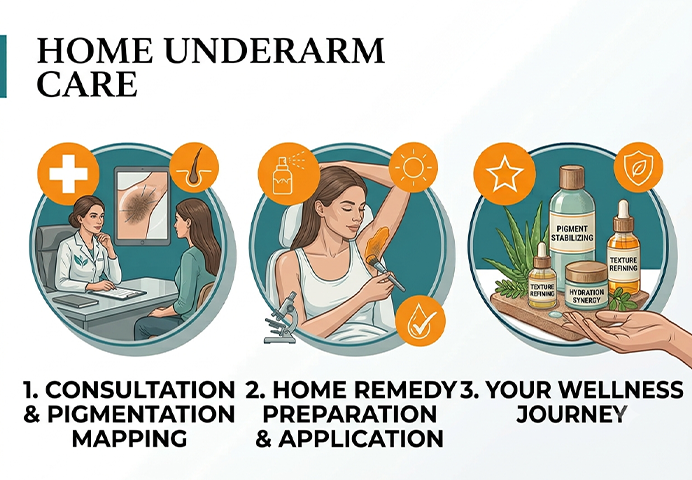
Most home remedies for dark underarms target pigmentation at the surface. Understanding the underlying cause determines how much improvement you can realistically expect.
Why Chennai Makes Dark Underarms Worse
Now, this is not just a political line — climate actually matters. Chennai heat + humidity = underarm skin that is almost always damp. The rest of the day, it remains warm, humid and in constant contact with fabric. This creates two pigmentation-specific issues.
First, friction. Slightly wet skin rubs more against clothing than dry skin; First, anyone with underarm irritation will know that every time we lift our arm — when we're walking, commuting or sitting at a desk — we inflict micro-trauma on the skin in the underarm region. This irritation — repeated over the course of months and years, it’s rhythmic pulsing — then activates melanocytes (the cells responsible for pigment) just as much as any perennial irritation would. The same way your elbow turns dark when you rub it too much, this process works on the underarm also.
Second, sweat and deodorant interaction. Ingredient Lists of Commercial Deodorants and Antiperspirants Most commercial deodorants and antiperspirants have aluminium compounds, perfumes, and alcohol in their ingredient lists. These are being applied to skin that is already a bit irritated from the friction in Chennai, you then sweat in them and repeat. The prolonged chemical irritation from alcohol and fragrance eventually causes post-inflammatory pigmentation—the same kind of darkening you get after a pimple, or abrasion on Indian skin.
The patients walking in with the highest levels of dark underarms at our Kilpauk and ECR Uthandi branches are almost invariably THE ONES WHO SHAVE REGULARLY, USE MOLESTING STORE OR TANNING RB ( STRICE TO DO SO ), SWATHED IN SYNTHETIC KITS EVERY DAY. Change any one of those three variables, and pigmentation has a tendency to become stable. Make all three and usually you'll see a benefit with even a single remedy.
The Real Causes — What Actually Creates the Darkening
Before remedies, causes. The treatment has to match the cause — that's true in clinic and it's true at home.
Friction and Repeated Trauma
The single most common cause. Movement of the arms, snug clothing, working out—all fragmentary microtrauma extends over months and triggers melanocytes. The skin doesn't hurt. So you just never notice till it gets deeper and deeper in colour. What responds favourably to less irritation (ie. loose, breathable fabrics and avoiding synthetic fibres) together with consistent gentle depigmenting agents?
Shaving
Each leg shave is a micro trauma. Each time you shave the razor takes away those surface keratinocytes together with the hair, and your skin reacts with a mild inflammatory response. Repeat this three or four times a week for years, the chronic inflammatory cascade you stimulate is measurable in pigmentation. If the root of the hair grows below the surface of your skin, shaving may leave this behind and you will have a grey or blue-grey shadow, even though the skin is freshly shaved. This is not pigmentation darkening — it's a hair root poking through translucent skin and nothing you put on it will remove the pigment. Hair removal is really the only solution for shaving shadow—not skin lightening. Our laser hair reduction clinic addresses this specifically.
Chemical Irritation from Deodorants and Antiperspirants
Aluminium chlorohydrate, alcohol and fragrances are just a few of the irritants for sensitive skin: The skin with the upper arm shrivelled– underarm skin is thinner than that of your forearms and generally remains also a little occluded (covered by your arm). A permeable microenvironment promotes deeper penetration of irritants and facilitates post-inflammatory hyperpigmentation. This is particularly the case with Fitzpatrick IV–VI skin — Indian skin types — which are genetically prone to tachyphylaxis and over-production of melanin in response to even very mild irritation.
Dead Skin Accumulation
The underarm is possibly the most ignored area of exfoliation on the body. Almost everybody can exfoliate their face, some even do it for their legs, but nearly nobody ever touches there armpits. Dead skin builds up, captures those deodorant residues, darkens slightly and makes the underarms appear dull and grey — not pigmentation in the dermis, just Surface crap. This form of "darkening" is most responsive to regular mild exfoliation.
Acanthosis Nigricans — The One You Should Know About
This is mostly the reason which gets underserved but needs to be flagged most. Acanthosis nigricans (AN) is a skin disorder of dark, velvety, thickened patches — most commonly found in the folds of skin under the arms, behind the neck and underneath the groin. This isn't from irritation or antiperspirant. Indisputably related to insulin resistance, PCOS, type 2 diabetes, hypothyroidism and sometimes obesity. Acanthosis nigricans is one of the markers of metabolic syndrome according to the AAD (American Academy of Dermatology) and merits further evaluation.
The differences: The fabric is velvety or maybe a bit pebbled but not as flat and smooth. The darkening may also occur on the neck (especially the back of the neck), armpits, inside elbows or groin. The condition is cumulative over months and does not improve with any topical treatment since the problem is inside.
And this is why we recommend obtaining a fasting glucose and insulin level for every patient presenting with moderate to severe axillary hyperpigmentation, ie not mild post-shaving discolouration, but marked velvety darkening of the skin. If it is a metabolic cause, wanting to treat the skin alone is like going around painting a damp wall. Our melasma and dark spot reduction protocols address pigmentation comprehensively, including coordinating with relevant specialists when systemic causes are suspected.
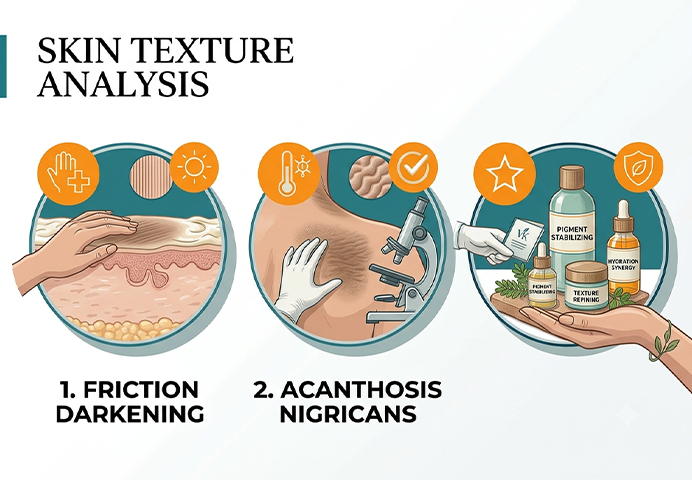
Understanding whether darkening is flat and smooth (friction, chemical irritation) or velvety and textured (acanthosis nigricans) determines the right approach entirely.
Home Remedies That Have Some Evidence Behind Them
1. Potato Juice or Slice
That is the most consistently proven kitchen-based method there is, and for good reason. Catecholase, a potato enzyme that inhibits tyrosinase—the primary pigment-producing enzyme in melanin synthesis—is abundant in raw potato. Commercial depigmenting agents such as kojic acid and arbutin also target that same pathway. In addition to potato starch, azelaic acid is clinically proven to brighten the skin and works in trace amounts.
In practice: cut a raw potato and rub the sliced side against the armpit for 2–3 minutes. Let the juice sit for 10–15 minutes and rinse. Dose: two times/day for 6–8 weeks, continuous. The effects are gentle — do not bring any chemical peel to mind when you consider speed or depth — but for superficial pigmentation causes by the friction from sleeping in face unions and by dead skin, this is truly maybe one of the best home alternatives.
Why is it so perfect for Chennai skin: it's cooling (great in the heat), mildly acidic (a light exfoliator) absolutely devoid of any harsh chemicals that can irritate further. And, there's zero risk of making the situation worse — which is more than I can say for many other natural remedies on this list.
2. Niacinamide Serum (OTC, Not Strictly a "Home Remedy")
Niacinamide (vitamin b3) is one of the select few active ingredients with true, peer-reviewed clinical studies behind its ability to reduce hyperpigmentation. It prevents the transfer of melanosome from melanocyte to keratinocyte and thereby interrupting the pathway that transports kertaomytic cells to surface from pigment. In a 2002 study published in the International Journal of Cosmetic Science, it was shown that measurable brightening effects were present at a concentration of 5% over an 8-week time frame.
The most clinically relevant home treatment for underarm darkening is a niacinamide serum or lotion (5–10% niacinamide) applied to the area after showering twice daily. Is available over the counter, cheaper than most antiperspirants and has an excellent safety record on Indian skin across Fitzpatrick III–VI. It also acts as an anti-inflammatory, assisting with the underlying irritation from constant friction that is actually responsible for darkening in the first place.
This pairs well with the gentle exfoliation approaches below. And it's also a core component of the laser toning for pigmentation home care protocols we prescribe after in-clinic treatment.
3. Aloe Vera Gel
Aloe vera means aloesin, which inhibits tyrosinase and competes with dihydroxyphenylalanine (DOPA) oxidation [30], both steps in the melanin production pathway. Limited but substantial evidence indicates that aloe vera can help lessen pigmentation caused by UV exposure. Its anti-inflammatory properties are the main mechanism by which it treats inflammation-based mechanical damage underarm darkening.
Aloe vera gel straight from the plant — or an aloe product with at least 90% of its composition as aloe vera and free of alcohol and fragrance, applied after bathing. It is so lightweight you can apply it under deodorant. No side effects. Mild cooling, which is an added comfort for Chennai summers. Results are gradual — wait 8–12 weeks of continued usage to evaluate.
4. Gentle Physical Exfoliation Once or Twice Weekly
In the case of dark underarms categorized as "surface buildup" — dull appearing, darker overall color with no specific velvety texture — this is generally the fastest seen method. A soft washcloth or an exfoliator with powder-smooth granules (never coarse sugar crystals or pulverized walnut shells, which induce micro-tears in delicate axillary dermis) applied in supple circles accomplishes this removing of built up keratinocytes. A session or two later and the underarm skin looks noticeably brighter — not because pigmentation has changed, but the translucency of new skin lets more light through.
Important: exfoliate only on days you're not applying a depigmenting active like niacinamide or potato juice. Exfoliating compromised skin over an active ingredient can cause irritation. Alternate: exfoliation days and active days.
5. Coconut Oil (Mild Moisturiser, Not a Brightener)
Coconut Oil is a common ingredient in the list of dark underarm treatments. To be specific about what it does: coconut oil is a good emollient. It hydrates the skin, provides slight friction protection (a thin oil film lowers skin-on-fabric contact and prevents micro-trauma), and has low antimicrobial properties. It doesn't meaningfully inhibit melanin. It doesn't exfoliate.
What you do: Spread on a thin layer of coconut oil before going to sleep and let it be absorbed, then apply the oil overnight as a moisturiser for armpits, will reduce irritation over time from friction. This indirect mechanism — less irritation = less melanin stimulus, leading to gradual brightening. But do not use it your deodorant. Coconut oil is not an antiperspirant/deodorant, and in the heat of Chennai, this has obvious disadvantages.
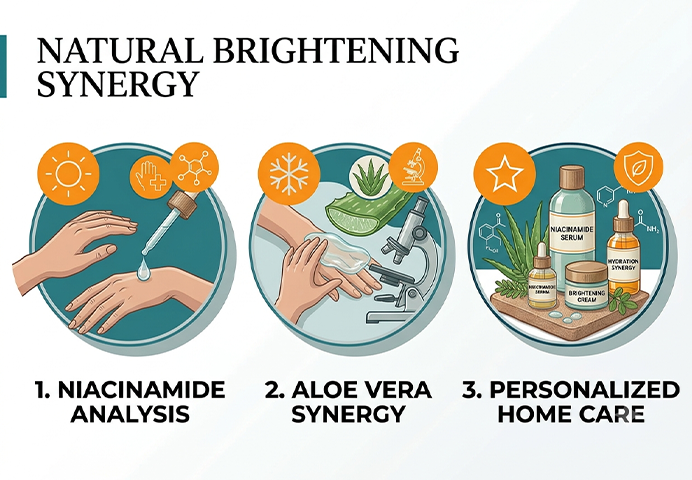
Niacinamide and aloe vera are the most clinically grounded home-care options for underarm darkening — both safe for Indian skin and available without a prescription.
Remedies That Are Harmless but Mostly Don't Work
Baking soda scrub: Baking soda is a pH of 8.3, and your skin is a pH of 5.5 (like pimples). Rubbing it into underarm skin disrupts the acid mantle, causes slight chemical irritation and — ironically enough — stimulates post-inflammatory hyperpigmentation that it's intended to decrease. Need to Stop — if you were doing this.
Lemon juice: The classic. Facial exfoliant of citric acid mildly, as strong disinfectant, & popular enough to find a place with every list. Now the real problem in plain words, lemon juice has psoralens. When psoralens are applied to our skin and sunlight or even merely bright Chennai daylight passes through a window, it causes a phototoxic reaction that worsens the darkening. Of course, the underarm has less direct sun exposure than in the face since it is usually covered. However, if you go out in sleeveless clothes and exercise after applying lemon juice, you are going to increase pigmentation. The acid concentration also varies too much to be used reliably and safely. There are better options.
Sandalwood paste: Fragrant, cooling, traditional. Mild anti-inflammatory substances do exist in sandalwood. However, the amounts of active ingredients in sandalwood paste are too low to produce significant depigmenting effects, and most sandalwood powders sold commercially contain added perfume that can irritate sensitive armpit skin. Even historically speaking, this is not the best option when there are more evidence-based options available.
Rose water: Soothing, mildly astringent, pleasant. Zero depigmenting chemistry. Makes skin feel nice for five minutes. Not a treatment for dark underarms.
What's Actually Making Your Dark Underarms Worse
This is worth its own section because several common practices — things people do thinking they're helping — are compounding the problem.
Scrubbing the underarm hard during showering. Like maybe this was a thorough clean. You are inflicting micro-trauma on skin that is already seeing repeated friction all day. Friction-prone, thin-skinned areas require gentleness, not aggression. Be gentle with the aid of a soft cloth and No harsh force
Using whitening or "fairness" deodorants. They often include fragrance, alcohol and aggressive actives in potencies inappropriate for the underarm's delicate skin. Many of them have induced contact dermatitis reactions in our patients, such that the hyperpigmentation lingers for months. We know dark-underarm product that gets you dark underarms is kind of an irony.
Shaving dry. Not using water or something like shaving foam increases the friction a lot. The blade rubs over parched skin instead of efficiently traversing a smoothed surface. Gradually, the total trauma is quantitatively greater than if you wet shave. When shaving, go for a clean single blade with plenty of shaving foam or gel applied properly along with cold-water afterwards to close the follicles.
Applying deodorant immediately after shaving. Heterosexual sex with no razor is microscopically abraded — surface keratinocytes are removed. Putting an alcohol- and fragrance-containing deodorant on top of this damaged surface is precisely the kind of irritant exposure that causes PIH. Wait at least 30 minutes. Or switch to a physical deodorant (fragrance-free formulas with little or no baking soda) so less irritating on newly shaved skin.
Applying home remedies with lemon or strong acids and then going out. As mentioned above — phototoxicity is a real danger under Chennai's UV poses. Acids applied to skin that subsequently gets sunlight must always be washed. No exceptions.
Building an Actual Underarm Care Routine
Most people have a 12-step skincare routine for their face and exactly zero steps for their underarms. That imbalance explains a lot.
In the Shower
Use a gentle foaming body wash or soap-free cleanser. Soft washcloth, light circular pressure. On ebony days (twice weekly): a gentle-grain body scrub or soft muslin cloth swirling 30 sec with a little more firmness. Rinse well. Pat dry — don't rub.
After Shower (Daily)
Use 5-10% niacinamide serum or lotion in the underarm area. Allow 5 minutes to absorb. Finally and this is the part most people miss out on wearing a fragrance-free, alcohol-free deodorant or anti-perspirant! Not a whitening deodorant. Not an aerosol with fragrance. An effective, kind formula for odour protection without the chemical burden. Glycerin or aloe-based brands generally work better on irritated/angry underarm skin.
Alternate Evenings (Potato Juice or Aloe)
Once you have showered of the night, before bedtime apply potato slice for 10 minutes or fresh Aloe Vera gel. Leave to dry. No deodorant over it — you have bed time. Give the skin 8 hours without any chemicals. That is often when the best repair work occurs.
Weekly (Exfoliation + Moisturisation)
Once a week: underarm gentle exfoliation followed by coconut oil or a fragrance-free body lotion to deeply moisturise. This prevents the cycle of dry, friction-prone skin that perpetuates the darkening.
That's genuinely all that's needed. Employment over the week in six simple steps. Not a dozen products, not ancient scrubbing, not batch cooking. There is too much variability in how this is rated from person to person and what level of friction it requires these are not even directly comparable so the only thing that will allow you to see a difference between mild to moderate friction darkening consistently in 8–12 weeks. Not overnight. But genuinely visible.
The Deodorant Switch — Most Important Single Change
Let me be very clear: if you are applying a commercial aluminum-based, fragrant and alcohol antiperspirant on already-darkened underarms (regardless of any claims it has not actually darkened them) you have been restimulating PIH each day. However, you are exposed to the irritant every day – and the home remedies work only against this daily re-exposure. It would be like putting burn cream on a wound but keeping your hand stuck on a hot stove.
Of all the changes with a single greatest influence our patients can make, switching to fragrance free alcohol free deodorant tops the list. Not yet a natural deodorant with baking soda – which produces touch dermatitis impacting around 20–30% of wearers, and not a lightening deodorant possessing chemical whitening brokers in skin-offending concentrations. A gentle, simple formula. What it won't do is lighten the armpitby itself — however, it prevents the daily re-darkening that undoes everything else you're doing.
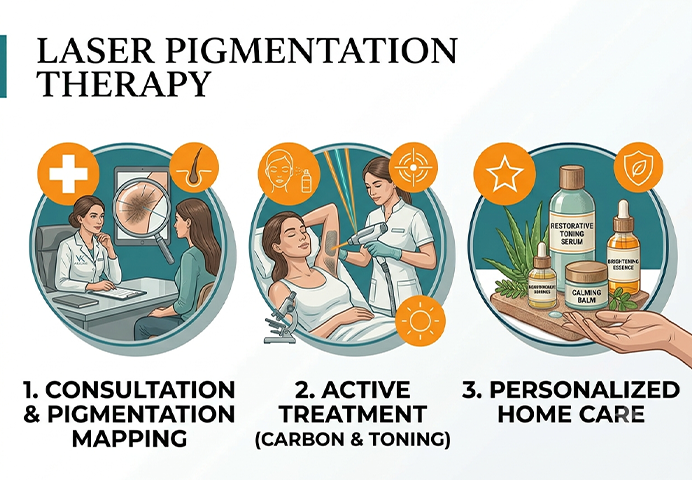
For resistant or significant underarm darkening, in-clinic laser toning, chemical peels, and laser hair reduction at VK Allure Dermaclinic deliver faster and more consistent results than home care alone.
How VK Allure Approaches Dark Underarms Clinically
If the patients arrive to our clinic after spending months on failed home remedies — or if the darkening is severe enough to merit more expedited relief — we will always assess before anything else.
The first question always starts with the cause. Frictional dyspigmentation, parakeratotic keratosis (shaving shadow), irritant contact dermatitis and acanthosis niegricans require very different strategies. Examining the skin for its texture, presence of AN as defined by a velvety pattern and clinical history of endocrinopathies and metabolic markers are also considered, and finally assessing the distribution — underarms, neck, groin — allows us to distinguish whether this is localized cutaneous issue or systemic signal.
For friction-driven and chemical irritation-driven darkening, our typical protocol combines:
- Chemical peels with lactic acid or glycolic acid, specifically formulated for body skin at appropriate concentrations — the underarm skin is thinner than facial skin and requires a different approach than a facial peel
- Laser toning using Q-switched Nd:YAG at 1064 nm — effective for post-inflammatory hyperpigmentation on Fitzpatrick IV–VI skin without the risk of paradoxical darkening that shorter wavelengths can cause on darker tones
- Laser hair reduction for patients where shaving shadow is a significant component of the darkening — once hair follicles are reduced, both the shadow and the repeated shaving trauma stop simultaneously
- Glutathione protocols for patients with generalised pigmentation concerns — glutathione inhibits tyrosinase and shifts melanin synthesis from eumelanin (dark) to phaeomelanin (lighter) at a systemic level
- Skin resurfacing for more significant surface texture and pigmentation in appropriate candidates
We collaborate with appropriate specialists — endocrinologists for acanthosis nigricans, gynaecologist if there is PCOS involvement and internal medicine when metabolic syndrome is suspected. Care of the underarm skin alone in case of AN is utterly incomplete. We tell patients this directly. The skin treatment is accompanied by the metabolic inquiry and not the other way around.
Improvement is seen within 3–4 sessions spaced 8–10 weeks apart for most patients with darkening driven by friction and chemical irritation. The shaving shadow or hair root visibility most often resolves within 2–3 laser hair reduction sessions, with ongoing progression of lower hair density. The condition responds partially to skin treatment but has an important metabolic component that must be managed to achieve lasting benefits.
You can book a skin assessment appointment Visit our Kilpauk or ECR Uthandi branch for a professional assessment. Sunday through Saturday 10 AM till 8 PM. It takes about 20 minutes and tells you precisely what your darkening is categorized as and which options make sense — no hard sell, no extravagances.
When to Stop Using Home Remedies and See a Dermatologist
Loosely speaking, home care is truly appropriate for mild to moderate friction-induced pigmentation in healthy patients. Yet, there are just some cases when the best option is to keep managing at home
- The darkening has a velvety or raised texture, rather than flat discolouration
- The darkening is also present on the back of the neck, inner elbows, or groin
- You've been applying home remedies consistently for 10–12 weeks with no change
- The darkening came on quickly — over weeks rather than months — without a clear triggering change in products or habits
- You have a known diagnosis of PCOS, insulin resistance, thyroid dysfunction, or are overweight and experiencing rapid darkening in skin folds
- The skin is becoming irritated, itchy, or sore — this means the home remedy or the deodorant is causing contact dermatitis, which will worsen the pigmentation
Any of the above is a signal to get the right assessment rather than continuing to experiment. Dark underarms that have a metabolic cause won't respond to topical treatment regardless of how consistently it's applied. Getting the diagnosis right is always the faster path to the result you want.
Five Things People Get Wrong About Dark Underarms
1. "It means I'm not clean enough." This is the most painful and false of all. You see, dark underarms are a pigmentation reaction — melanin over-abundance in response to rubbing, aggravation or systemic signs. They are unrelated to cleanliness. That extra scrubbing, that more-frequent washing, doesn''t reduce melanin; it only increases irritation and makes the situation worse.
2. "I need to stop sweating to fix this." Sweat itself doesn't cause darkening. What doesn't is the chemical content of commercial antiperspirants — aluminium, fragrance and alcohol. Simultaneously blocking sweat will not cause pigmentation If you need an underarm deodorant at all, it is often kinder on the skin to wear a fragrance-free, aluminium-free product and let the armpits sweat.
3. "Natural remedies are always safer than products." It is natural and causes phototoxic darkening (darkening caused by light activation). Natural: Yes Baking soda penetrates skin barrier. We already know that neat essential oils are natural and cause contact dermatitis. Natural means coming from the earth, not safety or efficacy." Many kitchen remedies can genuinely help and others are actively harmful. Categorize them by mechanism, not category.
4. "Laser will fix it permanently." Laser toning works well for friction-driven or chemical irritation-driven darkening, but only when the underlying factor (friction with clothing, irritant deodorant or shaving) is couteracted at a similar time. Endless cycles are when pigment emerges after being eliminated by a laser, while friction continues to create it. We explain to our patients that the changes at home and in clinic treatment are synergistic, not alternative.
5. "If I lighten my underarms, they'll stay light." Maintenance matters. Recurrence of pigmentation is very common if the factors which trigger it are still present. Once you hit the homeworker — or medical solution — for your desired tone, it's about what you do to maintain that (light deodorant, no trauma from shaving, indirect careful exfoliation; wear SPF when skin is exposed)
Final Thoughts
Home care works for dark underarms when the cause is not severe, and home remedies are applied consistently while also minimizing daily triggers — chemical deodorants (use natural), trauma from shaving and friction. Potato juice and niacinamide, along with aloe vera and a gentle exfoliation is an effective tool. They need to be used patiently and consistently over 8–12 weeks, not crammed into four days of trying everything.
For moderate to significant darkening, or for any darkening with a velvety texture or systemic associations, the home-care ceiling is real and in-clinic treatment is the more efficient path. At VK Allure Dermaclinic we handle this regularly at both our Kilpauk and ECR Uthandi branches, and the first step is always an honest assessment of what's actually going on — not just what's most convenient to treat.
If you've been at it for months and the home remedies aren't moving the needle, book a consultation. That 20-minute conversation usually saves patients another six months of guesswork.
Frequently Asked Questions
Medically Reviewed & Written By

Dr. Lokeshwari
Dermatology Specialist · VK Allure Dermaclinic, Chennai
- ✓ Certified Dermatology Specialist
- ✓ 7+ Years of Clinical Experience
- ✓ 5,000+ Patients Treated
- ✓ Aesthetic & Medical Dermatology
Dr. Lokeshwari is a Dermatology Specialist at VK Allure Dermaclinic, to treat patients and possess a lot of expertise with pigmentation treatment, laser treatments in addition as aesthetic dermatology management for Indian skin types. She practices in Kilpauk and ECR uthandi branches of Chennai.
Disclaimer: Dr Lokeshwari has audited this article on dark underarm remedies so that each individual recommendation is data-based, clinically sound, and relevant for the Indian skin type and Chennai weather conditions.
Book a Consultation with Dr. Lokeshwari →📞 +91 96009-58060 · 💬 WhatsApp · 🏥 Kilpauk & ECR Uthandi, Chennai