ECR stretch has silently become one of the better localities in Chennai — sea on one side, space to breathe and a road which is more than just flooded buses and broken cars piling up from the rest of Chennai. Somewhat surprisingly, and especially not mentioned in the pamphlet, is what it does to your skin. Uthandi, Kovalam, Neelankarai and the OMR belt patients walk into our chair with a very specific set of complaints, sometimes surprised that the coast is (almost) always part of it.
This is not a simple listing page disguised as an article. A no-frills primer on why coastal south chennai is its own skincare climate, how a discerning skin clinic in uthandi should be addressing the issue, and spotting one real dermatology setup versus every other beachside room with a machine. VK Allure Dermaclinic runs a branch right on ECR at Uthandi, so we see this pattern daily — but the guidance below holds wherever you end up going.
Skin clinic in Uthandi ECR — the short version
Coastal south Chennai skin faces strong UV, salt-laden humid air and constant sweat, which drives tanning, pigmentation, breakouts and dryness all at once. A good skin clinic in Uthandi should be led by a qualified dermatologist, Use equipment adjusted to Indian (Fitzpatrick IV–VI) skin, evaluate you prior to selling anything, and create a regimen surrounding sun protection first. Avoid clinics that guarantee permanent results or sell packages before even attempting diagnosis.
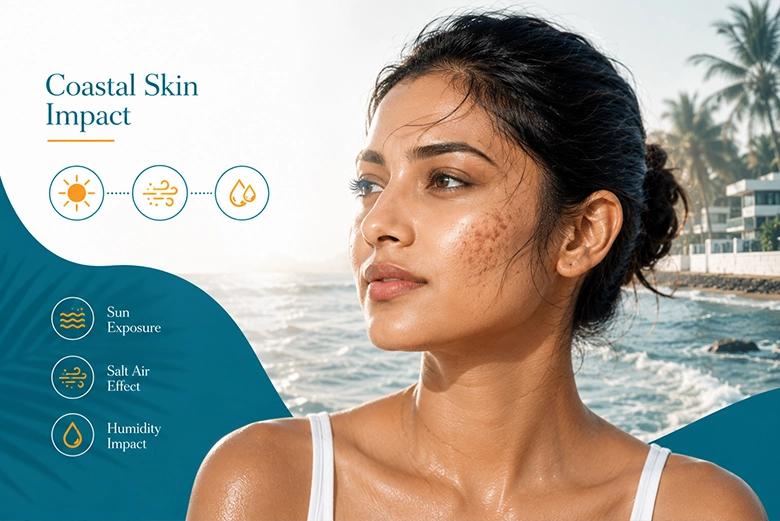
What living on ECR actually does to your skin
People assume "beach living" means glowing, sun-kissed skin. The reality dermatologists see is more complicated, because four coastal factors stack on top of each other.
The sun here is relentless
Wide-open coast means little interference from buildings breaking the light, more reflected UV bouncing off water and sand, long stretches of unshaded area. If you walk or run on ECR, and judging by the number we see charging along half of Uthandi, pretty much everyone does, you're being blasted by UV rays without even realising it as most people do not feel hot thanks to that cooling sea breeze! Cool doesn't mean protected. She explains: "Tanning & pigmentation is the one single most common reason coastal patients present and the sun drives both.
Salt air is drying, quietly
It creates a fine salt aerosol in the air with particles that are small enough. That's a little why the sea breeze feels delicious, and part of why your skin may feel tight, filmy, and strangely not wet enough even in humid weather. It also messes up hair, making it dry and frail in the long run. As some patients refer, my skin drinks moisturiser and stays thirsty. That's not imagination.
Humidity plus sweat equals congestion
The humidity in south Chennai is on the higher side for most of the year. The skin sweats, sebum fuses and mixes with sunscreen and salt, the pores get clogged. Acne seen in ECR patients is more often the sweaty, congested sunscreen-and-humidity-evoked variety than strictly hormonal. That changes how you care for it — richer creams are a no-no, and the solution is typically thicker but smarter layering, not more product.
The OMR commute adds pollution on top
Many Uthandi residents travel to work along the OMR IT corridor — Sholinganallur, Perungudi, Thoraipakkam. That commute adds to the traffic pollution and air-conditioned aridity of Cape Town. Sebum binds to particulate matter, that gets oxidized and leads to dullness and barrier stress. Sun and salt outside, AC and screens inside. Yes, that is a difficult mix to resist.
What a real skin clinic in Uthandi should get right
The ECR belt has grown fast, and with growth comes a mix of genuine clinics and opportunistic ones. Here's how to tell them apart before you hand over your face.
A qualified dermatologist examines you first
Not "a doctor is available." A dermatologist — MD (Dermatology), DDVL or DNB — who actually examines your skin, takes a history and formulates the plan before any device is turned on. Having a trained therapist executing that plan is normal and good. That is not a therapist making the plan. Ask by phone; one of the real clinics picks up cheerfully.
Equipment suited to your skin tone
This is presumably due to the fact that most Chennai patients fall into Fitzpatrick IV–V category, which colours everything about laser setting. When it comes to reducing hair on darker Indian skin, the 1064 nm Nd:YAG provides a safer solution that is less dependent on surface melanin when compared to older systems. Say which device, *Issues: Is it CDSCO-approved and the condition, i.e., what a setting that they would use to gets your tone? A good sign is confident there, not a blank look.
Sun protection treated as step one, not an afterthought
This is the coastal tell. No Uthandi clinic that does not push Sunscreen first and throw you on brightening / pigmentation treatment knows — where do they live? No regimen on ECR stands for long without a daily broad-spectrum SPF: the sun will just undo it. That is non-negotiable and a good clinic will not allow you to omit that.
Honesty about the downside — and about doing nothing
Every genuine treatment includes side effects and limits. Either a doctor is delusional, or he is selling if he describes a procedure with zero risks. And some of the best will occasionally tell you that you really shouldn't be having a procedure at all — that just fixing your regimen and your solar conduct is the complete solution. That's a verdict of many of the first visits in our practice.
The coastal skincare mistakes we see most on ECR
Before any treatment, half the improvement comes from stopping a few common habits. These come up again and again at the Uthandi branch.
- Skipping sunscreen because "it's just a walk on the beach." That walk is peak UV exposure. Reflected light off water and sand makes it worse than a city street.
- Using a heavy winter-style moisturiser. In coastal humidity it sits on top, traps sweat and salt, and triggers breakouts. Lighter, layered hydration works better here.
- Over-washing to fight the greasiness. Strips the barrier, so skin overproduces oil and gets more dehydrated underneath. A classic coastal spiral.
- Ignoring the scalp and hair. Salt air and hard water roughen hair and irritate scalps. People treat the face and forget the head above it.
- Chasing a "permanent" tan-removal fix. Tan fades as skin turns over; forcing it with harsh scrubs causes more pigmentation, especially on Indian skin.
Treatments that make sense for coastal south Chennai skin
A full-service skin clinic in Uthandi should cover the range below. The coastal environment just shifts which of these come up most.
Sun, tan and pigmentation — the ECR headline
This dominates coastal practice. Melasma and dark spot reduction, laser toning with Q-switched Nd:YAG for resistant pigment, and glutathione where appropriate. One honest caveat: melasma is managed, not cured, and on the sunny coast that means sun discipline is half the treatment.
Glow and hydration
HydraFacial is a coastal favourite because it deep-cleans congestion and hydrates without downtime — useful when your skin is oily-but-dehydrated. Chemical peels for controlled exfoliation (mandelic is often the gentle pick for sun-exposed, darker skin), carbon laser facial for oil and pores, and glass skin facials for event-ready radiance.
Acne and marks
Coastal, sweaty, congested acne needs medical management first — lighter routines, sometimes topicals or oral therapy — before touching the aftermath. Only once it's quiet do we address scars with acne scar treatment, fractional CO2 or skin resurfacing. Treating scars while acne still erupts wastes your money.
Hair and scalp
Salt air and hard water make this a bigger category on the coast than people expect. GFC, hair PRP, mesotherapy, low-level laser therapy and anti-dandruff protocols. Hair fall here is often multifactorial, so a clinic that jumps to PRP without bloodwork is skipping a step.
Laser, anti-ageing and body
Laser hair reduction (long-term reduction with maintenance — never "permanent"), HIFU for non-surgical tightening, RF microneedling and fillers, and tattoo removal. Some clinics also keep weight management, EMS and cool sculpting, plus semi-permanent makeup like microblading under one roof.
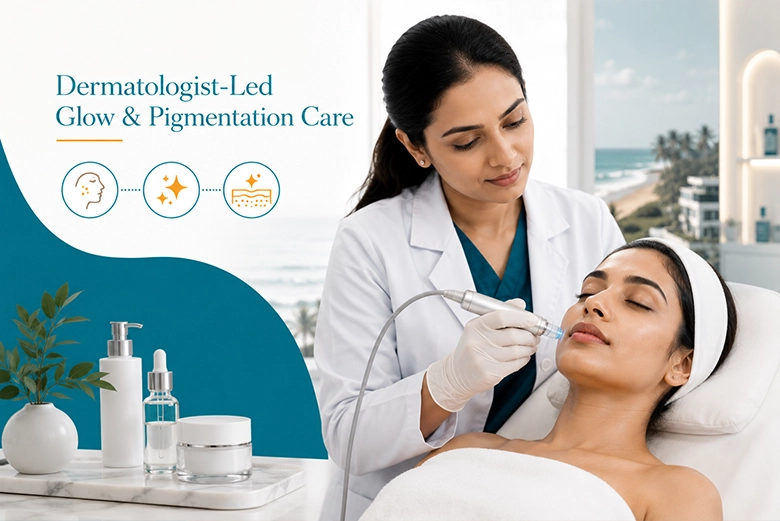
What your first visit should actually look like
People are often nervous about the first appointment, mostly because they don't know what to expect. Here's the shape of a proper first visit. If yours looks very different, that tells you something.
History before skin
Expect questions that feel unrelated. The amount of time you spend outside on ECR. Whether you swim at the sea or a pool. Your commute up OMR. Your water source at home. Includes data from Sleep, thyroid & any medications. Did you take isotretinoin in the last 6 months? Before we've even examined a single follicle, much of what appears on coastal skin is inscribed in those responses.
Examination under proper light
Daylight, or a dedicated lamp sometimes with magnification — not the ambient shimmer of a reception desk. Often, this will involve your dermatologist taking a close look at areas not mentioned during the exam, since pigmentation and sun damage don't restrict themselves to the region you first noticed.
The product and sun-habit audit
Bring everything you use, or photograph the shelf. This step alone resolves plenty of complaints without any procedure, because the culprit — a pore-clogging cream, a missing sunscreen — is usually sitting in the bag.
Bloodwork, when it's warranted
Not for everyone. For diffuse hair loss or sudden changes, we'd far rather measure ferritin, thyroid and vitamin D levels than make a guess. Treating the symptom, but not the cause.
A plan with the reasoning attached
It should include an understanding of why — why this treatment in particular, how many sessions and spaced at what intervals, what results are to be expected by when and if you won't respond, then what. And the home routine, because on the coast that piece weighs at least half the score. If done correctly, it takes somewhere between twenty and thirty minutes. A six minute first visit, which ended at a card machine – that was not a consultation.
Red flags — walk out if you see these
- "Permanent" anything. Laser hair reduction is long-term reduction; melasma is managed. The vocabulary tells you who's selling.
- No sunscreen conversation on the coast. Unforgivable in Uthandi. If it doesn't come up, they don't understand where you live.
- Packages pushed before diagnosis. Especially with a "today only" discount.
- No dermatologist on site. "Doctor visits on weekends" is not a dermatology clinic.
- Won't name the device. Basic transparency you're entitled to.
- Guaranteed results in writing. Nobody honest guarantees a biological response.
- Pressure to decide now. Skin problems are rarely emergencies; good clinics let you think.
Three people who walked in this month
Composites, but real patterns we see at the Uthandi branch.
The 29-year-old runner with a stubborn tan and new dark patches
Seems to run on ECR most mornings, never wears sunscreen because "it's early and cool." Some dark patches on his cheeks were not just tan, but early sun driven pigmentation. The fix began with — surprise, surprise! — an actual sun regimen followed by some gentle ingredients to address pigmentation. No aggressive laser. Once the sun input was halted, his skin settled - something no device could achieve during beats of training bare-faced.
The 36-year-old with oily-but-tight skin and constant small breakouts
Classic coastal congestion. Her skin was "just oily," she continued to over-wash it and pile on a thick moisturizer. The routine was simplified, we switched to light hydrators, hydration and added a HydraFacial to extract congestions and the breakouts settled in weeks. Lesson learnt: her skin is dehydrated and oily, treating for oil only aggravated her condition.
The 42-year-old IT professional commuting up OMR with dull, tired skin
Endless hours, cushy seats in the AC cabin, ECR sunlight on weekends, retina burn during the weekdays. Not damaged — depleted. The skin care routine for barrier repair, sun protection and in-salon clinical cleansing did the heavy lifting, with a very simple glow facial ahead of a family occasion. No stacking of aggressive treatments. Restore, but do not resurface with depleted skin.
Notice the pattern. In each case the correct answer was, respectively, "less and smarter" not "more and stronger," with sun protection in all three. A clinic that relies on selling procedures finds it difficult to get there.
Myths we hear at the Uthandi front desk
"Sea air is good for skin, so I don't need to do much."
The breeze feels good, but salt aerosol is drying and the accompanying sun exposure is the real driver of coastal skin complaints. Feeling refreshed and being protected are different things.
"I'm dark already, so the sun won't affect me."
Darker skin has more natural protection but is more prone to pigmentation and post-inflammatory dark marks, not less. Sun still tans, still ages, and still triggers melasma on Fitzpatrick IV–V skin.
"Laser will thin my skin."
Backwards. Fractional and non-ablative lasers stimulate collagen — the dermis typically thickens over months. The redness and flaking afterward is healing, not damage.
"Expensive means better."
Price tracks device generation, rent and marketing at least as much as skill. On the coast, the variable that matters most is whether the dermatologist builds sun protection into the plan — and that isn't on any price list.
When you need a dermatologist, not a facial
It ranges from purely cosmetic to must-have— some are clearly issential, and a couple of them are enabled only because you have natural (as coastal) sun exposure. If you have: a mole changing in size, colour or border; a patch that bleeds, crusts or won't heal at three weeks; a new or growing spot on sun-exposed skin; sudden patchy hair loss; painful cystic acne; any rash with fever — book an actual medical consultation (not treatment). Don't let a changing spot anywhere on the body sit for years in your unprotected coastal Sun because that raises stakes on skin lesions. AAD guidance on when to get a lesion checked (2 minutes of reading) DermNet is how this looks all in one easy-to-read place
Also — this isn't for everyone, and you should find a clinic that tells you so. Elective procedures are all deferred during pregnancy and nursing; certain devices do not go over pacemakers or metallic objects; therapy is held up over active infection or inflamed skin; and there is additional caution in place if any isotretinoin was used in the previous six months. If a clinic never asks you any of this, it is not screening you — it is booking you.
How we do things at the ECR Uthandi branch
In short, because you can make the rest of the judgement yourself. It starts with an assessment: history, examination, review of what you are using and the sun, sea commute and water questions that patients find peculiarly specific until they understand its relevance on the coast. Then, a summary plan and the rationale for that step above it that's a built in to your planning - not an afterthought.
We are clear about the maintenance because coastal skin invariably won't keep a result. You will be warned about side effects, because a little redness for a day or so after a peel is normal and knowing this beforehand is the key to composure rather than panic. And we don't quote up results you can't realistically hope for — all with skin type, sun habits, compliance and biology out of our control. If the honest answer is, "straighten your routine and your sunscreen, and then come back," that is what you'll hear.
You can browse the full service list or read more about the clinic and team. If central Chennai is easier for you, the Kilpauk branch runs the same protocols.
Visiting the ECR Uthandi branch
Address: Plot No. 8, New No. 1, Vaigai Street, ECR, VGP Uthandi Layout, Part 1, Uthandi, Chennai, Tamil Nadu 600119
Hours: Monday to Sunday, 10 AM – 8 PM
Phone / WhatsApp: +91 96009 58060
Also at: Kilpauk — Block No.6, Plot No.4, Kilpauk Garden Road, Aspiran Garden Colony, Chennai 600010
Getting there: On ECR at Uthandi, easily reached from Neelankarai, Palavakkam, Injambakkam, Kovalam, Sholinganallur and the OMR corridor.
Skin acting up from the coast and the commute?
Book a no-obligation consultation at VK Allure Dermaclinic, ECR Uthandi. We'll examine your skin, build a plan around how you actually live, and tell you if the answer is "nothing yet."
Book an Appointment Contact the Clinic📞 +91 96009 58060 · 💬 WhatsApp us
Final thoughts
ECR is a scenic and short-term demanding skin shade to reside within. Sun off the water, salt in the air, humidity and sweat, then AC and screens up the OMR — this is a potent cocktail; you need to see a clinic that keeps them as one well-oiled unit instead of fighting with broad-brush thinking. There are 4 honest checks that you should do before selecting a skin clinic in Uthandi: Right dermatologist (the Dermatologist who consults and check your health first), Correct equipment suitable for your skin tone, Treatment plan keeps sun protection on the front end & Honest enough to call it as it should be (like ask when you should do nothing). Nail those and the interiors and Instagram come a distant second. Your skin is unique, slightly more so from the coast, and there is no article that beats someone looking at it in good light.
Frequently Asked Questions
How do I choose a good skin clinic in Uthandi, ECR?
Why is coastal skin on ECR different from the rest of Chennai?
Does living near the beach cause more pigmentation?
Where is VK Allure Dermaclinic's ECR Uthandi branch located?
What treatments does a skin clinic in Uthandi usually offer?
Is salt air really bad for skin and hair?
Why does my skin feel oily and dry at the same time on the coast?
Do I still need sunscreen if it's cloudy or I'm just walking on the beach?
Is laser treatment safe for Indian skin?
Can a tan from the beach be removed permanently?
Can melasma be permanently cured at a skin clinic?
What qualifications should a dermatologist in Uthandi have?
How should a skin clinic in Uthandi quote its charges?
Does the OMR commute affect my skin?
Do I need a consultation before starting treatment?
What are the red flags at a skin clinic?
Can I get skin treatment during pregnancy?
What are the side effects of common skin treatments?
When should I see a dermatologist urgently?
Does treating acne scars work while acne is still active?
How long before I see results from skin treatment?
Does VK Allure have branches other than ECR Uthandi?
Do I need to book in advance or can I walk in?
Medically Reviewed & Written By
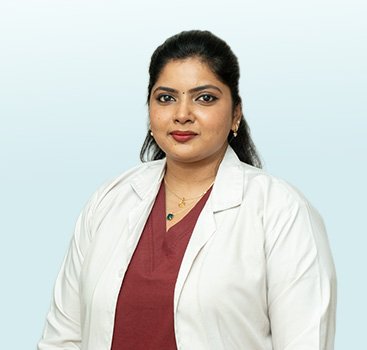
Dr. Lokeshwari
Dermatology Specialist · VK Allure Dermaclinic, Chennai
- ✓ Certified Dermatology Specialist
- ✓ 7+ Years of Clinical Experience
- ✓ 5,000+ Patients Treated
- ✓ Aesthetic & Medical Dermatology
Dr. Lokeshwari is a Dermatology Specialist at VK Allure Dermaclinic, of having years of excellence in advanced skin care, hair restoration, laser therapy & cosmetic dermatology. She functions out of both the Kilpauk and ECR (Uthandi) clinics in Chennai and follows an evidence-based approach for Indian skin types, combined with a knowledge about Chennai's climate. She writes about what works — separating skincare fact from clinical fiction.
This guide to choosing a skin clinic in Uthandi, ECR has been reviewed by Dr. Lokeshwari to ensure every clinical point, coastal-skin note and safety caution reflects current dermatology standards for Indian skin.
Book a Consultation with Dr. Lokeshwari →📞 +91 96009-58060 · 💬 WhatsApp · 🏥 Kilpauk & ECR Uthandi, Chennai