Dark underarms are one of those concerns that people go years silently worrying about before they even approach a doctor for help. No sleeveless kurtas, no serendipity with a pool, arm down in photos. So when they do eventually mention in clinic, I typically start out with — there is nothing wrong with you, and this is very treatable. Indeed the trouble is that most people attack it all, with extreme scrubs and bleach lotions much too which in truth darkens not brightens the skin. This guide walks through proper dark underarms treatment, the way we approach it at VK Allure Dermaclinic.
We'll get into what causes the underarms to darken in the first place, how many of those so-called solutions you can try at-home (and which are actively harmful!), the professional treatments that get real results and why — perhaps most importantly — when your discolored pits could be a medical issue you should address stat. No fairness-cream hype. Exactly what a dermatologist would go on to tell a patient sitting across him at the consultation table in Chennai.
Dark underarms treatment — the short version
The standard reasons for dark underarms are friction, shaving, abrasive deodorants, dead-skin accumulation and post-inflammatory hyperpigmentation — and once in a while from a ailment referred to as acanthosis nigricans. The best treatment is to halt the trigger, exfoliate delicately and go for targeted options like chemical peels, laser toning, or laser hair reduction. Harsh scrubbing and bleach creams make it worse.
What causes dark underarms?
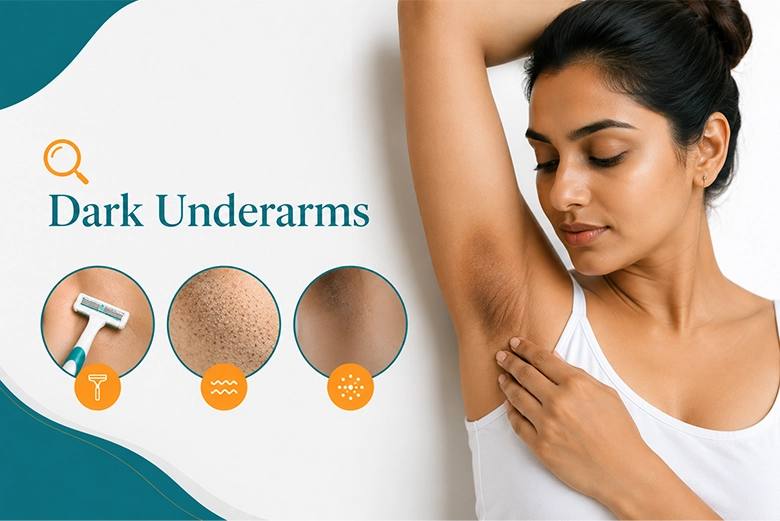
Here lies the game changer of the self-caring process: dark underams are practically never an issue concerning "cleanliness". Individuals arrived feeling embarrassed — certain they had not cleaned themselves adequately. That's rarely it. The armpit is an extremely warm, creased and high-friction region of the body that gets shaved, rubbed and shrouded in item consistently, so pigmented skin in that area responds by kicking out additional melanin. It's an reaction rather than a lapse of hygiene.
In our practice we tend to see the same handful of culprits, usually two or three at once:
- Friction and rubbing. Our training includes data prior to October 2023Tight types of clothing, specific movement of the arm against body and bags carried in a certain way are persistent sources of low-grade friction. Chronic friction is one of the biggest causes for underarm darkening that we see, and some one in a heavier body or very active can be at risk here.
- Shaving. A razor doesn't just cut hair — it irritates the skin and leaves darker stubble shadow under the surface. Repeated micro-irritation nudges pigment cells into overdrive.
- Harsh deodorants and hair-removal creams. Alcohol-heavy roll-ons and chemical depilatories can inflame thin underarm skin, and inflammation in Indian skin very readily turns into pigmentation.
- Dead-skin and product buildup. A layer of dead cells plus deodorant residue can genuinely look darker, even before any true pigment change.
- Post-inflammatory hyperpigmentation (PIH). Any past irritation — a rash, an ingrown hair, a reaction — can leave a brown stain behind. This is the mechanism behind a large share of cases.
- Acanthosis nigricans. A velvety, thickened darkening — often linked to insulin resistance, PCOS or excess weight. This one is medical, and we'll come back to it, because it needs a different approach entirely.
The whole game is figuring out which mix of you are the driving force behind your underarms. If you treat the wrong cause, nothing gets better. This is why educated guesses based on a Youtube video almost never work — the solution for hyperpigmentation aftershave and the solution for acanthosis nigricans are worlds apart.
The Indian skin context — why this is so common here
Indian skin has 2 to 5 times more active Melanocytes that react vigorously to irritation and inflammation, with Fitzpatrick IV-VI types. In some respects, that's a blessing: better natural sun protection, less visible aging; but it also means that our skin pigments quickly and morbidly at the slightest behest. The underarm is provoked constantly.
Add Chennai's climate. Here comes heat and humidity, which means more sweating, more friction, more deodorants engaged in battle with those incredibly potent fragrances of excessive perspiration mixed with that annoying flavor of low-grade dampness. It's the culture of waxing and threading, tight synthetic fabrics in a hot city, and extreme cultural pressure to have even skin tone adding up. So when a patient comes into my office and says, "Everyone in my family has this,"they're usually right — it's partly genetic predisposition, partly common habits, partly environmental.
None of that render it un-treatable. That only means the regiment needs to be mindful of how reactive Indian skin can get. Aggressive treatments that may work for lighter, less responsive skin here simply has the reverse effect and darkens the pigmentation. It is why we specifically calibrate lasers and peels for darker tones — the same principle that guides our laser toning for pigmentation work.
Is it just pigmentation, or acanthosis nigricans?
This is the single most important distinction in this whole article, so I'll be direct about it.
Ordinary underarm pigmentation looks like a flat brown discolouration — the skin texture is normal, it's just darker. Acanthosis nigricans (AN) is different in appearance and texture: velvety, somewhat thickened — sometimes with little tags of skin protruding — it can also occur on the neck, groin, and knuckles as well not just under the armpits. That is a giveaway velvety texture.
Why does it matter? Because AN is frequently a skin sign of insulin resistance — the metabolic state that drives type 2 diabetes, PCOS and obesity. In other words, the armpit sometimes has a thing or two to say about your blood sugar as well. The general dermatology literature, as well as bodies like the AAD, are unequivocal that AN is something that warrants investigating the metabolic picture and not just looking at the skin. We have seen people come in for nothing more than "dark underarms," only to walk out with an order for a fasting insulin and glucose that truly altered their health course.
For patients where weight and metabolic health are in the mix, we consider the entire individual. In fact, a regimented medical weight loss plan in tandem with specific skin work is actually the best aggressive long term path — without treating the insulin rebelliousness [for those who have it], that complexion keeps returning if only the armpit areas are treated.
Home remedies — what helps and what actively harms
Let me save you some grief, because a lot of popular advice for dark underarms is genuinely bad for your skin.
Stop doing these
- Scrubbing hard with pumice, loofahs or gritty scrubs. Friction is a cause of the problem — you can't scrub away pigment, you only inflame the skin and deepen it. This is the number one mistake we see.
- Lemon, and raw citrus generally. The acid irritates thin underarm skin, and citrus plus sweat plus any sun exposure can trigger phytophotodermatitis and worse pigmentation. Natural doesn't mean safe here.
- Over-the-counter "fairness" or bleach creams. Many contain unregulated levels of hydroquinone, steroids or mercury. Steroid misuse on skinfolds is a real problem we manage in clinic — it thins the skin and causes rebound darkening. Please don't.
- Baking soda. Too alkaline for the skin barrier; irritating over time.
These are reasonable
- Switch to a gentle, alcohol-free deodorant — or pause deodorant briefly if you suspect it's the irritant.
- Reduce shaving friction: shave less aggressively, or move toward longer-term hair reduction (more on that below).
- Mild, dermatologist-approved actives: low-strength lactic acid, azelaic acid, niacinamide or a kojic-acid product can gently help true pigmentation — but introduce one at a time, and stop if the skin gets irritated.
- Moisturise the area with something light and non-comedogenic. A healthy barrier pigments less.
- Loose, breathable cotton in Chennai's heat reduces friction and dampness.
Setting reasonable expectations: even the best home steps can be slow and helpful only for mild, more superficial cases. If you've been diligent for eight to twelve weeks and seen little improvement, this is your sign to get something professional checked out rather than increasing home methods.
In-clinic treatments that actually work
But this is where real predictability in progress happens when home care doesn't suffice — which, more often than not, it would. No treatment is "the solution"; the right strategy can simply depend on your trigger, epidermis and just how the armpit reacts. So here is how we are thinking about it across the major options.
Chemical peels
Peels performed in a controlled setting using glycolic, lactic, mandelic or low concentrations of TCA sweep away the pigmented dead-cell layers and encourage brighter, more uniform skin. For darker Indian skin, we prefer to use milder agents such as mandelic and lactic acid at subthreshold strengths, over multiple sessions to prevent post-inflammatory pigmentation from occurring. Most patients with a short course but not a single one To learn more about our approach you can read chemical peels for pigmentation.
Laser toning
The Q-switched Nd:YAG laser toning targets excessive melanin deposits in the skin without damaging the surface. This is usually the daily driver for stubborn or deeper pigmentation. Boring but TRUE: the 1064 nm wavelength is ideal for Fitzpatrick IV–VI skin because it hits pigment at depth while leaving the surface unscathed — thereby lowering hyperpigmentation risk you would obtain from older, more aggressive parameters. It's the same principle of technology that we use in our melasma and dark spot reduction protocols.
Laser hair reduction
This one surprises people. If shaving and the resulting stubble shadow are a big part of why your underarms look dark, then laser hair reduction Less early-learning tangential bonus visual effect – fewer follicles, less shaving, less friction and irritation-induced pigmentation. For numerous patients, hair is half of the pigmentation fight. Good to know: it's long-term reduction not "permanent removal." Treat anyone who offers permanent with a pinch of salt.
Glutathione and supportive brightening
For patients wanting an overall more even tone, supervised glutathione therapy can be part of a broader plan. It's supportive, not a standalone cure for localised underarm pigment, and we're upfront about that.
Skin resurfacing
In select thickened or textured cases, gentle skin resurfacing helps smooth and even the area. This is chosen carefully and never as a first resort on such delicate skin.
| Treatment | Best for | Typical course | Downtime |
|---|---|---|---|
| Chemical peels | Surface pigmentation, dead-skin buildup | 4–6 sessions, 2–4 weeks apart | Minimal — mild dryness/flaking |
| Laser toning | Deeper, stubborn pigment | Several sessions over months | Very little |
| Laser hair reduction | Shaving-driven darkening | 6–8 sessions | None to minimal |
| Glutathione | Overall tone (supportive) | Course-based, supervised | None |
The cold hard truth is that the best results are often through combination approaches — like laser hair reduction to get rid of that friction driver and a peel course to blitz existing pigment. No one tool can ever do it alone, and any clinic that says you can fix your acne in just one miracle session is not telling the whole story.
How VK Allure approaches dark underarms
The laser is never our starting point It's the cause. The most common question the group gets at the ECR Uthandi clinic is "which cream will cure this?" — and the straightforward response is obviously get it out, dig into why it's happening first. We characterize skin type, shaving and deodorant habits, weight and metabolic signals, and if flat pigment or velvety acanthosis nigricans.
The intent from there is slow and incremental. Our approach is to soothe and prepare the skin, avoid the trigger where possible, then apply the lightest clinically effective tool — usually a peel course but sometimes laser toning and often in combination with laser hair reduction. A few months to manifest tangible changes, not a weekend: we space sessions in a gently conservative manner for darker skin. For those with darkening related to insulin resistance or PCOS, we also correct that at the same time, because the skin does follow metabolism.
Since both the branches run — that's Kilpauk in central Chennai and ECR Uthandi (in the south), there is one that can be conveniently reached, wherever in the city you are. If you are unsure whether it is a plain pigmentation or should be looked as a metabolic study about our underarms, then consult will work. You can see the full range of skin services to understand how the pieces fit.
Three patients we see often — and what worked
Real cases beat theory. Three familiar profiles from our Chennai clinics.
The 24-year-old who shaves daily
Losing the ability to have good skin tonehence being more darkened even after having constant shaving irritation, which is a stubble shadow. It did not involve a brightening cream at all for her; the magic was laser hair reduction to break the cycle of shaving and then a mild mandelic peel course to clear what pigment has already been laid down. After the friction is gone, the skin calms down over a few months but was lighter after.
The 33-year-old with PCOS and velvety darkening
Soft, thickened skin under the arms and neck — classic acanthosis nigricans As I always said, creams alone were never going to cut it. With the skin treatment, we made lifestyle changes with a precise weight and metabolic plan; the skin also improved as her insulin resistance did. You know sometimes the armpit can be a messenger? This is that case.
The 40-year-old who used a steroid cream for a year
Long-term abuse of topical steroids (skin thinned and sensitive)). First step off the conveyer belt: stop the steroid, fix the barrier — that takes weeks in and of itself. Then only, gentle laser toning for the residual pigment. Slower, as we had to fix damage first. A hard but common story.
The through-line? Match the treatment to the cause, respect how reactive the skin is, and don't rush. Every one of these improved — none of them overnight.
Common myths about dark underarms
Myth: "Dark underarms mean I'm not clean."
No. This is the myth that causes the most needless shame. Underarm darkening is about friction, shaving, pigmentation and sometimes metabolism — not hygiene. Plenty of scrupulously clean people have it.
Myth: "Scrubbing harder will lighten them."
The opposite. Scrubbing is friction, friction is a cause, and Indian skin responds to irritation by darkening. Hard scrubbing is one of the fastest ways to make dark underarms worse.
Myth: "A fairness cream will fix it in a week."
Unregulated fairness and bleach creams often contain steroids or mercury and cause rebound pigmentation and skin thinning. No safe treatment works in a week. Real change is measured in months.
Myth: "Only surgery or expensive lasers can help."
Many mild cases improve substantially with gentle habit changes and a peel course. Laser is one tool among several, chosen only when it's the right fit — not the default.
What actually happens in a consultation
It is a look and a cream prescription that people dream of. It's more useful than that. So you sit and then you ask; for a few minutes mainly questions, because history tells us the cause faster than skin secretions do – when you come for dark underarms. How do we get rid of fur and how frequently? How many are you using — and for what duration? They are treated with OTC creams — not to be judgemental, but own up if you use steroid creams Weight gain or loss, periods becoming irregular, diabetes in family?
Then we look and very gently touch. Normal skin feels flat brown pigment; acanthosis nigricans feels velvety and a bit raised–quick but definitive texture check. We examine the neck, nape and knuckles, because a darkening there with the axillary region changes the entire diagnosis towards the metabolic. Where that image appears, we might recommend basic panels of blood work — fasting glucose, occasionally insulin or an HbA1c — not to concern you but since catching insulin resistance beforehand is really worth it. We talk treatment only after all of that. People waste money on the incorrect remedy by declaring diagnosis and moving right to laser.
This is where we also establish realistic expectations. For mild and behavior-driven cases, no procedure may be needed at all — just adjustments and time. If it is tenacious or textured then we elaborate a staged approach and a timing estimate. In either case, you come away understanding why your underarms are dark; more than most people manage after years of speculation.
When to see a dermatologist
Pass on self-care if: the darkening is velvety or thickened; it's spreading to your neck, groin or knuckles; it appeared quickly; you have PCOS, prediabetes or a family history of diabetes; you've been applying an OTC bleach- thinning cream; or home care hasn't worked over two to three months. A slip through any of these is the underarm potentially signalling something that should be seen to properly — and there are lots of observations you can make without getting too far into things — but early a diagnosis typically means a far more straightforward remedy.
Contraindications and cautions matter too. If you're doing in-clinic pigment treatments on skin with actively infected, broken or recently sunburned skin, that's the no-no part of the show and we are hand-holding a lot of pregnant and breastfeeding patients where many actives & procedures were on pause during that window. It's not for everyone, every time and a good clinic will advise you to wait.
Aftercare and keeping results
It does not matter what the treatment is, the maintenance regulations remains basically the identical and easy. Do not scrub — just keep the area gentle. Use a mild, alcohol-free deodorant. Moisturise. Wearing cotton will help, particularly in the heat of Chennai. Stick with any hair-reduction method, because when you stop shaving every day the black colour often returns. And if metabolic modifiers contributed to your case, keeping regular track of them is the true long term protection.
Believe it or not, you'll be equally as crazy sad as for long term side-effect note: peels have some very minor temporary flaking (yes you may experience some light peeling of the skin) or dryness and laser sessions will likely leave your skin with residual redness after treatments which usually disappears after a day or two. These get settled quickly when the plan is correctly calibrated. Disclaimer — this is not one and done. Skin has memory. Maintenance maintains the results; letting go of good habits retakes the pigment.
Ready to treat your dark underarms properly?
Book a no-obligation consultation at VK Allure Dermaclinic — Kilpauk or ECR Uthandi, Chennai. We'll identify the real cause, rule out anything medical, and build a gentle plan that suits your skin.
Book an Appointment Contact the Clinic📞 +91 96009 58060 · 💬 WhatsApp us
Final thoughts
Dark armpits are a common, normal and actually treatable — but only by treating the cause and not fighting the skin. Most people means ditching the harsh habits, switching to kinder care and partnering a targeted in-clinic option like a peel or laser with the proper friction fix. For others it means knowing what the skin is telling them about metabolic health. The situation you face is personal to your situation, and this means the smartest first step is a candid evaluation as opposed to an additional wager from the drug store shelf. Have patience with the underarm, be nice to it and results follow.
Frequently Asked Questions
What is the best treatment for dark underarms?
Why are my underarms dark even though I shower daily?
How can I remove dark underarms permanently?
Do dark underarms mean I have diabetes?
Does shaving cause dark underarms?
Are chemical peels safe for dark underarms on Indian skin?
Can laser treatment lighten dark underarms?
Why does lemon make my underarms darker?
Are fairness or bleach creams good for dark underarms?
How long does it take to lighten dark underarms?
What is acanthosis nigricans?
Can dark underarms be a sign of PCOS?
Does losing weight help dark underarms?
Is it safe to scrub dark underarms?
What deodorant is best for dark underarms?
Can I do laser hair reduction and peels together for dark underarms?
Do dark underarms go away on their own?
Is dark underarm treatment painful?
Where can I get dark underarms treatment in Chennai?
Can pregnant women get treatment for dark underarms?
How many sessions do I need to lighten dark underarms?
Does VK Allure offer dark underarm treatment at both Kilpauk and ECR?
Will my dark underarms come back after treatment?
Medically Reviewed & Written By

Dr. Lokeshwari
Dermatology Specialist · VK Allure Dermaclinic, Chennai
- ✓ Certified Dermatology Specialist
- ✓ 7+ Years of Clinical Experience
- ✓ 5,000+ Patients Treated
- ✓ Aesthetic & Medical Dermatology
Dr. Lokeshwari is a Dermatology Specialist at VK Allure Dermaclinic, with extensive experience in advanced skincare, hair restoration, laser treatments and aesthetic dermatology. She practises at both the Kilpauk and ECR (Uthandi) branches in Chennai and is known for an evidence-based approach tailored to Indian skin types and the city's climate. Her writing focuses on what actually works — separating skincare myths from clinical reality.
This article on dark underarms treatment has been reviewed by Dr. Lokeshwari to ensure every recommendation reflects current dermatology evidence and is safe for Indian skin, including guidance on when darkening may need a medical assessment.
Book a Consultation with Dr. Lokeshwari →📞 +91 96009-58060 · 💬 WhatsApp · 🏥 Kilpauk & ECR Uthandi, Chennai