
Walk into any pharmacy on a Chennai high street and you will find Vitamin E capsules stacked next to the cosmetic shelf, often with a sticker that says "for skin and hair". It is one of the most-Googled nutrients in Indian hair care — and one of the most misunderstood. Patients at VK Allure Dermaclinic ask us about it almost every week. Does it really regrow hair? Can I just rub it on my scalp? Is it safe? Will it stop my hair fall?
The honest answer is somewhere between hype and dismissal. Vitamin E is not a miracle. It is also not pointless. Used correctly, it has a real role in scalp health and hair quality. Used carelessly — especially in Chennai's humidity and pollution — it can quietly make things worse. This article is the long version of the conversation we have at the consultation table, so you can decide for yourself whether Vitamin E belongs in your hair routine.
Vitamin E is a fat-soluble antioxidant that reduces oxidative stress on the scalp, improves microcirculation, and supports the natural lipid barrier of hair. It cannot reverse genetic balding or hormonal hair loss. Most people see benefit from diluted topical use once a week, dietary intake from nuts and seeds, and — for actual hair loss — clinical treatments like GFC, Hair PRP or mesotherapy.
What you'll find in this guide
What Vitamin E actually is (in plain language)
Vitamin E is not a single molecule. It is a family of eight fat-soluble compounds — four tocopherols (alpha, beta, gamma, delta) and four tocotrienols. Alpha-tocopherol is the form your body uses most. It sits inside cell membranes and stops a chemical chain reaction called lipid peroxidation, which is the slow, invisible rusting of cells caused by free radicals.
That's the textbook version. The version we tell patients goes like this: every cell in your scalp — including the cells in the hair follicle — has a fatty outer skin. Pollution, UV, smoke, heat styling and even normal metabolism damage that skin. Vitamin E is the molecule that absorbs the damage so the cell doesn't. When you eat foods rich in it or apply it topically, you're giving your scalp a small layer of protection it would otherwise have to scavenge from elsewhere.
The Indian Council of Medical Research and the National Institutes of Health both list Vitamin E among the essential micronutrients for adults. The recommended dietary allowance in India sits at around 10 mg per day (15 IU) for healthy adults, with slightly higher numbers during pregnancy and lactation. Most healthy people get this from a normal mixed diet — but vegetarians, dieters and those on long-term low-fat regimens often run low without knowing.
Why hair responds to Vitamin E specifically
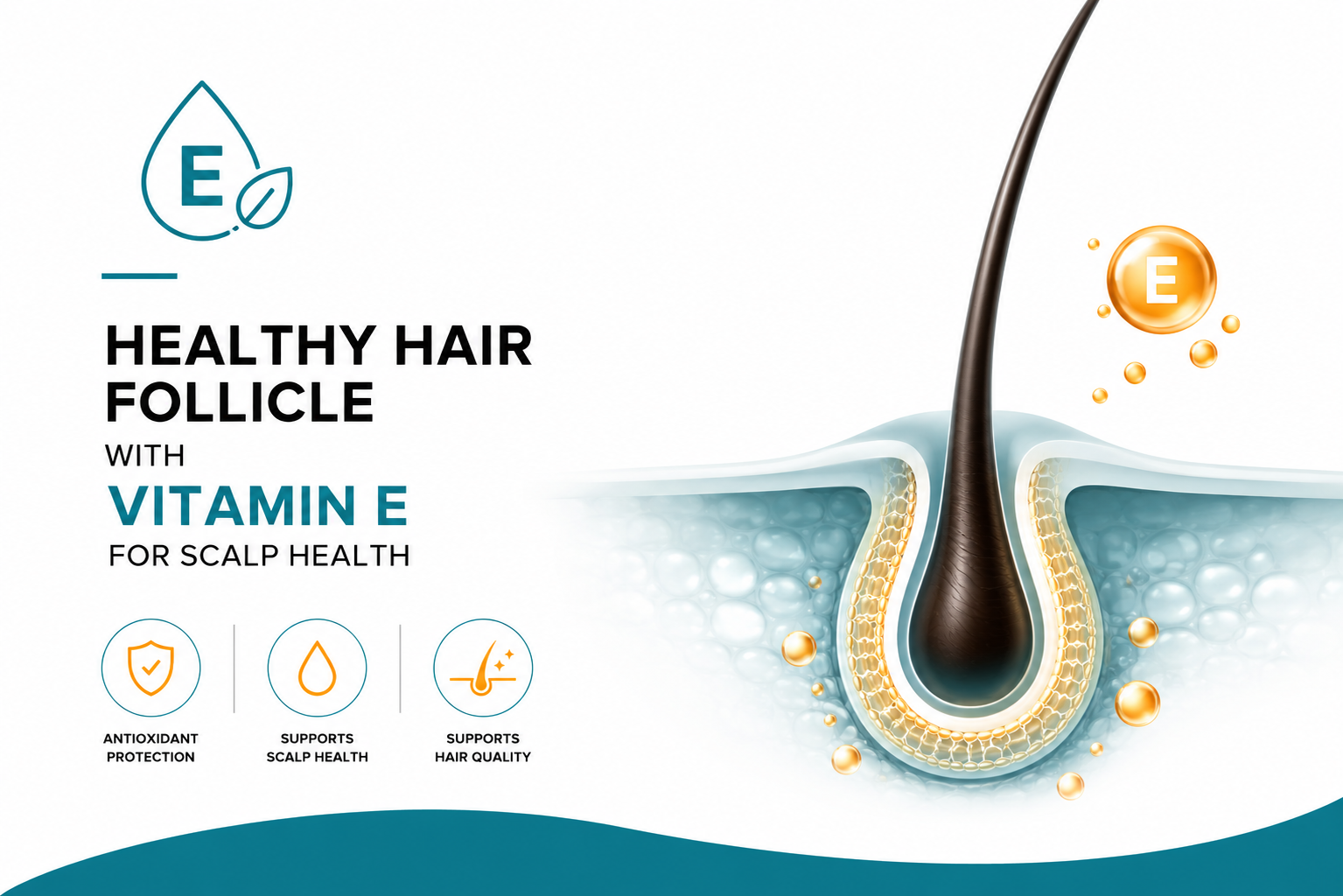
Hair sits in a tricky spot. The follicle is a metabolic hotspot — one of the fastest-dividing tissues in the body — and the scalp is one of the most sun-exposed, sweat-exposed, product-exposed surfaces you own. That combination produces a lot of oxidative stress. The follicle has to keep cycling between growth (anagen) and rest (telogen), and chronic oxidative damage shortens the anagen phase. Shorter anagen means finer, weaker, faster-shedding hair.
Vitamin E intervenes in two ways that matter:
- Antioxidant defence around the follicle. A 2010 study published in Tropical Life Sciences Research by Beoy et al. supplemented 38 volunteers with mixed tocotrienols and saw a 34.5% increase in hair count over eight months compared to placebo. The hypothesised mechanism — reduced oxidative stress on the follicle.
- Improved scalp microcirculation. Vitamin E supports vasodilation in small blood vessels, which means better delivery of oxygen and nutrients to the follicle base. Better-fed follicles produce thicker, longer hair shafts.
Notice what those mechanisms are not. They are not a hormonal blockade. They are not a follicle stem-cell activator. They do nothing about the DHT (dihydrotestosterone) that drives male and female pattern hair loss. Vitamin E plays a supportive role, not a curative one — and that distinction is where most of the patient confusion comes from.
The real benefits of Vitamin E for hair
Here are the benefits that are actually backed by evidence and that we see hold up in clinical practice. Some of them are smaller than the internet would have you believe. A couple are bigger.
1. Reduces oxidative damage to the follicle
This is the headline benefit. The follicle, like every cell, is constantly under low-grade chemical attack from free radicals. Vitamin E quietly absorbs that damage. Patients with high pollution exposure — daily commuters on OMR, two-wheeler riders along ECR, anyone whose hair is constantly meeting Chennai's particulate-laden air — usually have measurably higher scalp oxidative stress. Topical or dietary Vitamin E reduces that load.
2. Improves shine and reduces frizz
Vitamin E sits in the cuticle layer and helps lock moisture in. The result is a smoother shaft, less frizz on humid days, and a visible shine. It will not change the structure of your hair, but the surface looks healthier within a few uses. Most patients notice this faster than they notice any growth effect.
3. Supports a healthier scalp barrier
The scalp is just skin with more hair. Like facial skin, it has a lipid barrier that holds moisture in and irritants out. Vitamin E reinforces that barrier. For people with dry, tight, occasionally itchy scalps — especially after summer or after a stretch of frequent shampooing — diluted Vitamin E can settle the irritation within a few days.
4. May slow premature greying
Premature greying is partly oxidative. The melanocytes that produce hair pigment are damaged by free radicals over time. Some evidence suggests antioxidants like Vitamin E may slow this process. Genetics, vitamin B12 status and thyroid health are usually bigger drivers, so we tell patients to think of Vitamin E as a small support, not a fix. And once a strand has lost its pigment, no nutrient brings it back.
5. Helps in mild, diffuse hair shedding
For patients with telogen effluvium — the diffuse shedding that follows a viral illness, post-partum recovery, a sudden weight loss, or a chronic deficiency — supplementing the diet with Vitamin E along with iron, ferritin, vitamin D and B12 (the real culprits we test for) tends to support faster recovery. On its own it does very little. As part of a panel, it helps.
6. Soothes mild dry scalp and post-treatment irritation
After certain in-clinic procedures — for example, after a session of Low-Level Laser Therapy or after using minoxidil in the early weeks — some patients report a transient scaly, slightly irritated scalp. A gentle Vitamin E and jojoba oil blend, applied sparingly, can ease that without interfering with the active treatment.
7. Acts as a mild humectant in styling routines
For colour-treated or chemically straightened hair, Vitamin E mixed into a leave-in conditioner adds a layer of slip and reduces breakage during brushing. This is cosmetic, not medical — but it's a real, daily-life benefit our patients with chemically processed hair appreciate.
Who should — and who should absolutely avoid — Vitamin E for hair
Who tends to benefit
- People with dry, dull, chemically processed hair
- People recovering from telogen effluvium (post-viral, post-partum, post-crash-diet)
- Heavy-pollution exposure — daily two-wheeler riders, outdoor workers, frequent travellers
- Vegetarians and low-fat dieters who may run low on dietary tocopherols
- Mature adults whose scalp barrier is thinning with age
Who should not be putting Vitamin E on their scalp
This is the part the internet tends to skip. In our practice, we routinely tell these patients to stop topical Vitamin E altogether:
- Oily scalp. If you have to wash your hair every other day, adding oil is the last thing your scalp needs.
- Active dandruff or seborrhoeic dermatitis. Fungal-driven dandruff thrives on excess sebum and oil. Vitamin E feeds the problem.
- Scalp acne or folliculitis. Occlusive oils clog already inflamed follicles.
- Forehead acne triggered by hair products. If your forehead breaks out after oiling, your skin is telling you to stop.
- A history of allergic reactions to cosmetics or carrier oils. Vitamin E itself can occasionally cause contact dermatitis.
- Anyone who notices more shedding 1–3 weeks after every oil session. That is your follicles complaining about the occlusion.
And on the oral side: anyone on warfarin or other anticoagulants, anyone with a bleeding disorder, anyone scheduled for surgery within the next month, and pregnant or lactating women considering supplementation above the RDA — please consult your physician before taking Vitamin E capsules orally.
How to actually use Vitamin E for hair
Most of the harm from Vitamin E in our patient pool comes from using it the wrong way — neat capsules straight on the scalp, leaving heavy oils overnight, daily use that builds up. Here are the methods that work and the dilutions we recommend.
Method 1 — Diluted pre-wash scalp oil (weekly)
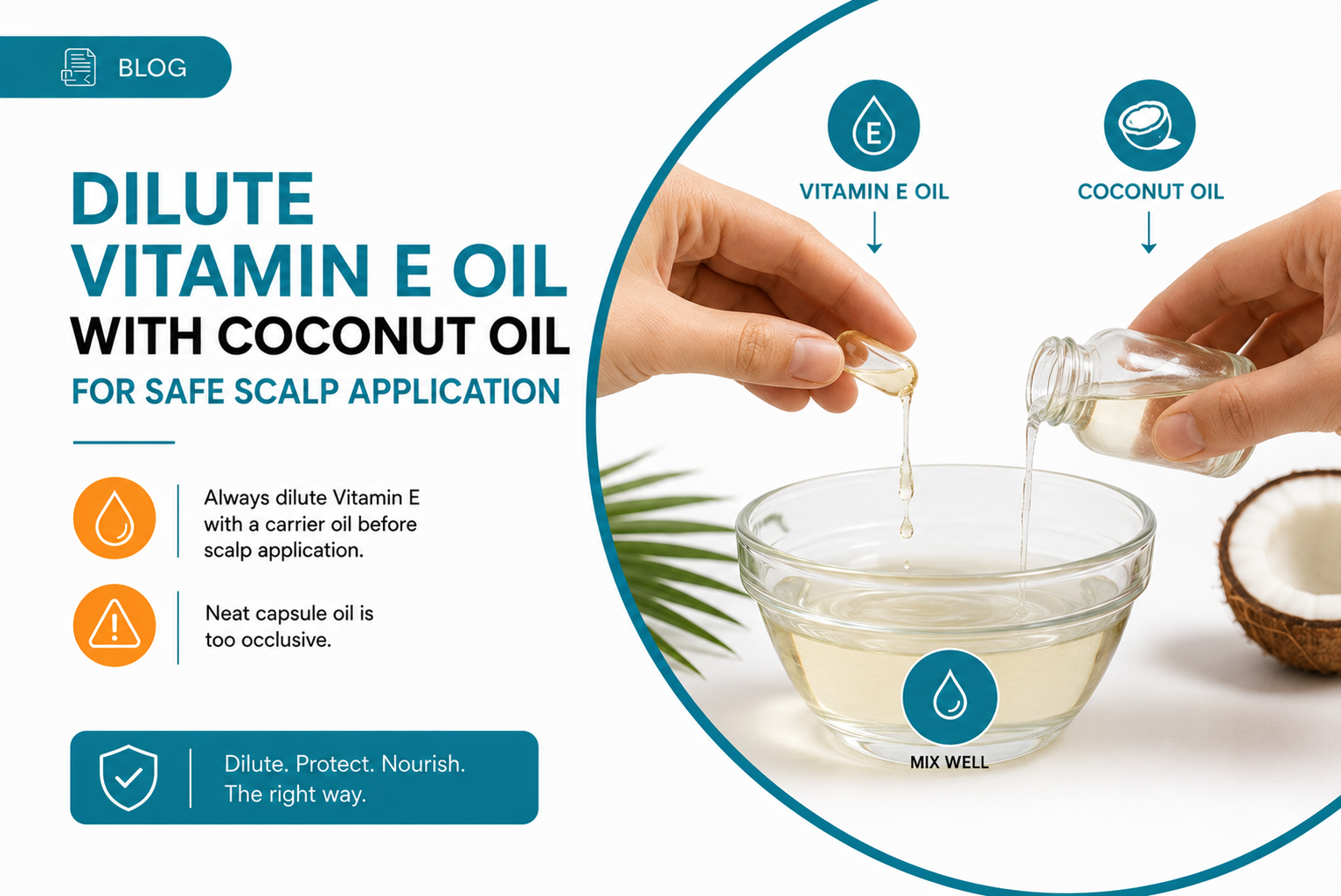
The most reliable everyday method. Take one Vitamin E capsule (around 400 IU) and break it into two tablespoons of a carrier oil — coconut for dry hair, jojoba for combination hair, almond for fine hair. Warm slightly between your palms. Section the hair and massage into the scalp in small circles for two to three minutes. Leave on for 30 to 60 minutes, then shampoo out. Once a week. Twice a week max for very dry hair. Never daily.
Method 2 — Vitamin E hair mask (every 10–14 days)
Mix one Vitamin E capsule, one tablespoon of yogurt, one teaspoon of honey and a teaspoon of olive oil. Apply mid-length to ends, avoiding the scalp if you are oily. Leave on for 30 minutes. Wash with a sulphate-free shampoo. Particularly useful before a wedding, a sun trip or a colouring session.
Method 3 — In your shampoo or conditioner
Empty one Vitamin E capsule into a fresh bottle of conditioner (around 200 ml), shake thoroughly. Use as normal. This is the gentlest option and the one we recommend for sensitive scalps. The dilution is automatic and the daily exposure is minimal.
Method 4 — Diet first, always
The most underrated method. A handful of almonds, a tablespoon of sunflower seeds, half an avocado, regular spinach or palak in your meals, occasional kiwi or mango — that covers your daily Vitamin E need without any of the topical risks. Indian kitchens already contain most of the answer.
Specifically rich Indian-pantry sources:
- Almonds — 7.3 mg per 28 g serving
- Sunflower seeds — 7.4 mg per 28 g serving
- Hazelnuts — 4.3 mg per 28 g
- Peanuts (roasted) — 2.2 mg per 28 g
- Mango — 0.9 mg per cup
- Spinach (boiled) — 1.9 mg per cup
- Wheat germ oil — 20 mg per tablespoon (highest natural source)
Method 5 — Supplementation (only with medical guidance)
If your dermatologist or physician has confirmed a Vitamin E deficiency on bloodwork — and that does happen, particularly with malabsorption disorders, cystic fibrosis, chronic pancreatitis or after bariatric surgery — they may prescribe a specific dose. Self-supplementing above 400 IU per day for months on end is associated with increased bleeding risk and has been linked in some meta-analyses to higher all-cause mortality at very high doses. Don't freelance with capsules.
What we do not recommend
- Pure capsule oil neat on the scalp. Too thick, occludes follicles, causes folliculitis in our experience.
- Overnight oiling without dilution. Eight hours of heavy oil on a scalp is far longer than the skin needs to absorb anything useful.
- Daily use. Vitamin E is fat-soluble and builds up. Excess buildup attracts dust and dulls the hair instead of brightening it.
- Layering Vitamin E over hair-styling products. Always start with clean, dry or lightly damp hair.
Side effects you should actually know about
This section gets glossed over by most blogs. It shouldn't. In our clinic, the patients who come in concerned about hair loss after using Vitamin E are usually the ones who used it incorrectly — and the side effects are real.
Topical side effects
- Allergic contact dermatitis. Vitamin E is one of the more common cosmetic allergens documented in dermatology literature. Reaction shows up as red, itchy, sometimes weepy patches on the scalp or hairline. Stop use immediately and consult.
- Folliculitis from occlusion. Small, painful, pus-tipped bumps on the scalp two to seven days after heavy oiling. Common in oily scalp types.
- Worsened seborrhoeic dermatitis or dandruff. Fungal organisms feed on lipids. Adding oil-soluble Vitamin E to an already fungal-prone scalp tends to push flakes from mild to severe.
- Forehead and back acne. Anything you put on your scalp tends to migrate. Patients with cosmetic acne almost always need to stop their hair oils before topical acne treatment will work.
- Hair shedding 2–4 weeks later. A wave of telogen shedding can be triggered by the inflammatory response to clogged follicles. Self-corrects once you stop, but takes another 2–3 months to recover the hair.
Oral side effects (with high-dose supplementation)
- Increased bleeding risk — especially relevant if you are on aspirin, warfarin, clopidogrel or apixaban
- Nausea, diarrhoea, stomach cramps
- Headache, fatigue, blurred vision
- Possible interference with vitamin K-dependent clotting
- Some meta-analyses have raised concerns about long-term high-dose use; the consensus recommendation is to stay within or near the RDA unless prescribed otherwise
Vitamin E vs other common hair treatments
One of the most useful things we can do here is set realistic expectations. Vitamin E is at one end of a spectrum that runs from "cosmetic support" to "medical treatment". Here's how it compares with what else is out there.
| Treatment | Type | What it does best | What it won't do |
|---|---|---|---|
| Vitamin E (topical) | Cosmetic / supportive | Improve shine, scalp barrier, reduce oxidative stress | Regrow lost hair, reverse balding |
| Minoxidil | FDA-approved medical | Prolong anagen phase, regrow hair in androgenetic alopecia | Cure DHT-driven balding (lifelong use needed) |
| GFC (Growth Factor Concentrate) | In-clinic medical | Stimulate dormant follicles with concentrated growth factors from your blood | Replace lost follicles (transplant territory) |
| Hair PRP | In-clinic medical | Improve hair density and thickness, support follicles | Work for advanced or scarring alopecia |
| Hair Mesotherapy | In-clinic medical | Deliver vitamins, peptides & minerals directly into the scalp dermis | Address hormonal root cause alone |
| LLLT | In-clinic device | Improve follicle metabolism with red light photobiomodulation | Show overnight results — needs consistency |
| Finasteride / Dutasteride | Oral prescription | Block DHT pathway in male pattern hair loss | Be suitable for women of reproductive age or anyone wanting children soon |
The pattern is clear. Vitamin E sits comfortably as a daily-life support — diet and the occasional topical mask. The heavier lifting in actual hair loss is done by the medical treatments in the rows below it. They are not interchangeable.
The Chennai context — why generic advice often backfires here
One of the things every dermatology-content piece misses is local context. Chennai is hot, humid, salty near the coast, hard-watered, and the air quality on certain corridors is genuinely poor. Each of those factors changes how Vitamin E behaves on your scalp.
Humidity: heavy oils on a humid scalp don't evaporate. They sit, attract dust, and turn what should be a clean treatment into a sebum-trap. We routinely halve the recommended frequency for our humid-month patients.
Hard water: Chennai's groundwater is hard. Mineral deposits already sit on the cuticle. Layering oils on top compounds the buildup. A good chelating shampoo every 10–14 days helps reset things.
Pollution corridors: if your daily commute is OMR, IT corridor, GST Road or Anna Salai, your hair is taking a measurable pollution hit. This is where Vitamin E earns its keep — diet plus a weekly mask offers genuine antioxidant support.
Sea-side scalp (ECR / Uthandi): patients near our ECR Uthandi branch often deal with a salty residue on their hair. Salt is dehydrating. A pre-wash Vitamin E mask once a week makes a visible difference here.
Summer: avoid heavy oiling in April, May and early June. The scalp is already producing more sebum to cope with heat. Add oil and you cross into the territory of scalp acne and fungal flares.
Common myths — and what's actually true
Myth 1 — "Vitamin E will regrow bald patches"
It will not. Patches of true alopecia areata, advanced androgenetic alopecia and scarring alopecia are medical conditions that respond to medical treatment. Vitamin E may very slightly support the surrounding hair, but does not regrow hair in bald patches.
Myth 2 — "More Vitamin E equals more hair"
Dose-response curves for Vitamin E and hair are not linear. Above a certain point, more Vitamin E means more side effects, not more hair. The 2010 tocotrienol study used a specific 100 mg per day dose; randomly taking 1,000 IU capsules is not "more of the same".
Myth 3 — "Capsule oil is purer than bottled oil"
The molecule is the same. The difference is dosage control and shelf stability. Capsules are easier to dose; bottles are easier to mix.
Myth 4 — "Vitamin E can replace shampoo"
It cannot. Vitamin E is not a surfactant; it does not lift dirt or sebum. Use it before shampoo, not instead of it.
Myth 5 — "Topical Vitamin E penetrates to the follicle root"
Penetration is shallow and limited. Most topical Vitamin E acts on the surface stratum corneum of the scalp and on the hair shaft. Anyone selling deep follicular delivery from a topical oil is overselling. For real follicular delivery you need mesotherapy — microinjections that bypass the barrier.
How VK Allure Dermaclinic approaches hair loss
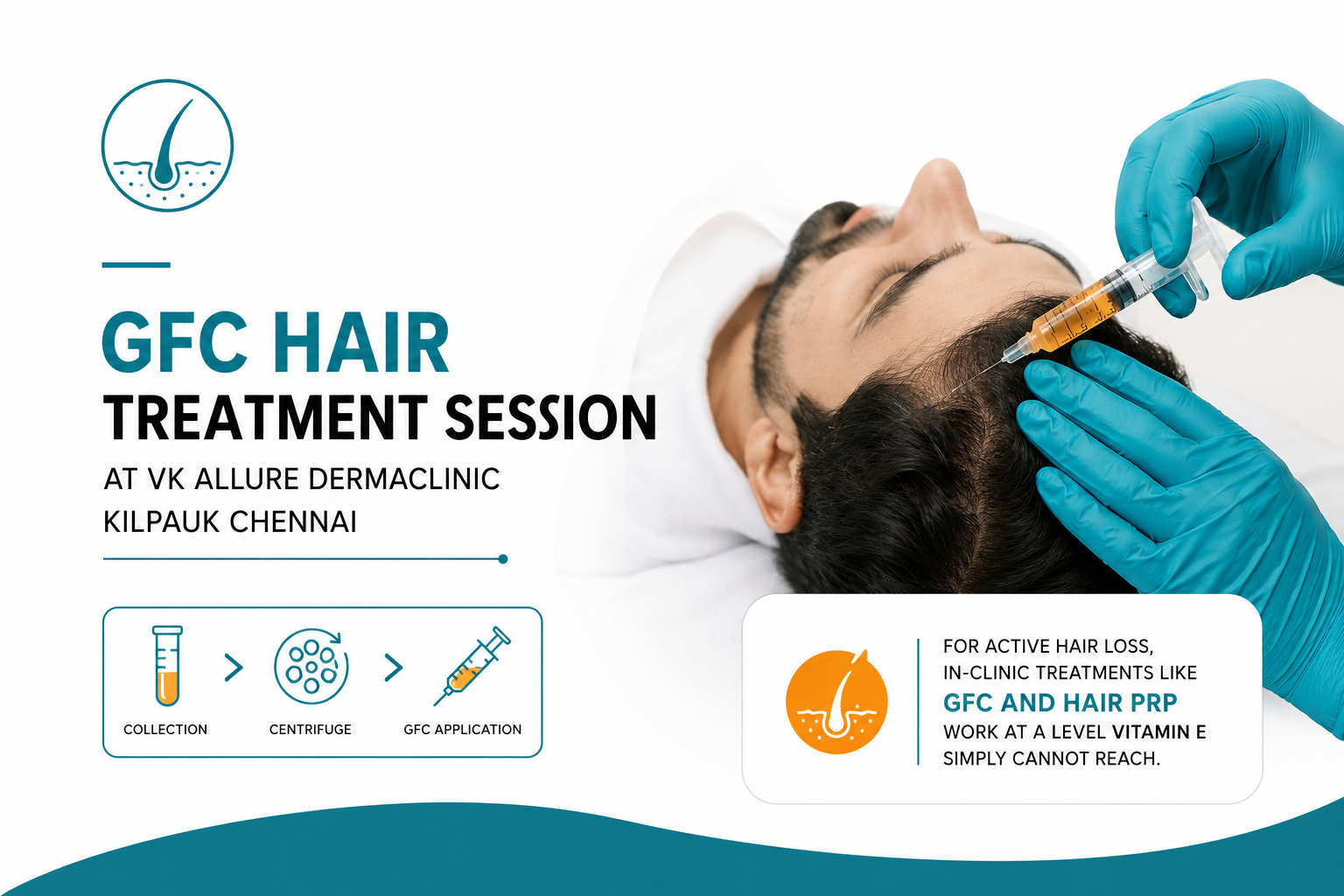
When a patient walks into our Kilpauk, ECR-Uthandi branch or Ambattur branch with a hair-fall concern, we do not start with a hair pack. We start with a diagnosis. Our protocol broadly looks like this:
Step 1 — Trichoscopy and history
A magnified scalp examination tells us whether we are looking at androgenetic alopecia, telogen effluvium, traction alopecia, alopecia areata, or a scarring alopecia. The treatment paths from each diagnosis are different. Skipping the diagnosis is how patients end up on the wrong product for years.
Step 2 — Bloodwork where needed
Ferritin, vitamin D, vitamin B12, thyroid panel, sometimes hormonal panels in women. A surprisingly high number of our hair-fall patients are simply iron deficient or low on vitamin D — and the fall stops with replacement, no scalp products needed.
Step 3 — A tailored plan
Depending on the diagnosis, we draw from:
- Medical hair loss treatment with topical minoxidil and, where appropriate, oral therapy
- GFC (Growth Factor Concentrate) — a refinement over PRP, usually 3 to 4 sessions a month apart
- Hair PRP — platelet-rich plasma microinjections, suited to early-to-moderate androgenetic alopecia
- Hair mesotherapy — direct delivery of vitamins, peptides and DHT-blockers into the scalp dermis
- Low-Level Laser Therapy (LLLT) — non-invasive red-light photobiomodulation, often paired with GFC or PRP
- Anti-dandruff protocols for patients where seborrhoeic dermatitis is the underlying driver
Step 4 — Lifestyle and diet
This is where Vitamin E and the broader nutrient story come in. We give patients a realistic, Indian-pantry food plan — almonds, sunflower seeds, dark leafy greens, eggs (where applicable), oily fish, lentils — and where lab work shows true deficiencies, we add specific supplements at clinical doses. Patients walk out with a plan they can follow without buying ten new products.
Step 5 — Review at 3 months
Trichoscopy is repeated at three months. Hair density, miniaturisation patterns and shedding rates are compared with baseline. The plan is adjusted based on what the scalp is actually doing — not on what the patient hopes is happening.
When to stop self-treating and see a dermatologist
Please book a consultation if any of these are true for you:
- You are seeing scalp through your hair where you didn't before
- You are losing more than 100–150 hairs a day for over 6–8 weeks
- Your part line is widening, or your temples are receding
- Hair fall came on suddenly after illness, surgery, weight loss or pregnancy
- There are smooth, hairless patches on the scalp or beard area
- The scalp itches, burns, scales or shows visible inflammation
- You have been on a "hair vitamin" for more than three months without visible change
Hair loss is one of those conditions where time matters. The follicle isn't dead the moment hair stops growing — but the longer it stays dormant or miniaturised, the harder it is to revive. Earlier intervention almost always means a better outcome. Our team at VK Allure sees this pattern repeated every week.
Final thoughts — where Vitamin E really belongs
Vitamin E is a useful tool. It is not the answer to hair loss. Eat well, oil sparingly with a diluted Vitamin E and carrier-oil blend once a week, protect your scalp from heavy pollution and heat, and don't expect a vitamin to do the work of a treatment. If your hair is shedding, thinning or refusing to grow back the way it used to, the conversation you need is with a dermatologist — not with a capsule.